

COMMUNICATE – A NECESSITY
The “Azores-Diaspora Media Alliance”, which was formally born in 2022, could be a turning point in bilateral relations between the media in the Azores and the Diaspora.
And, considering the dominant importance of contemporary communication, it could be the founding moment of a new era in mutual knowledge of the Azorean reality on our islands and in our communities.
Among the other potentialities arising from the implementation of this agreement is the possibility of sharing press, radio, and television content between news organizations on both sides of the Atlantic.
This will create the conditions for a better understanding of the current reality of the Azorean diaspora in the Azores and, conversely, for our communities to always and increasingly follow the news from their islands of maternal identity and permanent reference.
The need has been detected, the will has been expressed, the opportunity has been created and the capacity has been realized.
Now, this pioneering platform for understanding and cooperation can either be an ephemeral illusion or a lasting, concrete, and consequential reality.
It will be up to the media outlets that founded it and the media outlets that join in its development to determine how useful, operational, and long-lasting this good intention will be.
This is a historical imperative.
For the sake of the media and for the sake of the Azorean diaspora.
On the other side of the Atlantic, considering only the Portuguese communities in the United States, which are mostly Azorean, the presence and mission of the media are old and important, to maintain and affirm the distinctive mark of our identity.
The historic legacy of the Portuguese-American press dates back to the 19th century, with A Voz Portuguesa founded in California in 1870 and Jornal de Notícias published in Pennsylvania in 1877.
Among the titles still in publication are the Luso-Americano, with 95 years in Newark, New Jersey; the Portuguese Times, with 52 years in New Bedford, and O Jornal, with 48 years in Fall River, both in Massachusetts; or the Tribuna Portuguesa, with 44 years in Modesto, California.
Not to mention the indispensable radio and television presences that preserve the Portuguese language and affirm Azorean culture, from coast to coast, in the great American nation.
Therefore, along with the new paradigm of social networks, the media has and maintains a structuring importance for Nemésio’s good “Azoreanness” on both banks of Onésimo’s “Atlantic River”.

It couldn’t be any other way.
According to the 2000 US census, with subsequent estimates, around 1.3 million Portuguese and Lusodescendants officially reside in the United States.
Of these, 160,000 still come from Portugal, but 1.1 million were born in the United States – which prompts a pertinent reflection on new media content for contemporary generations.
California is the state with the largest Portuguese presence, officially totaling more than 330,000 emigrants, mostly from the Azores Archipelago and especially from the five islands of the central group.
In Massachusetts, the officially registered Portuguese population was 280,000 emigrants, also mainly of Azorean origin, but here especially from the two islands in the eastern group.
Also in New England, the smallest of the US states, Rhode Island, there is a proportionally significant Portuguese presence, with around 90,000 registered emigrants, mostly from the island of São Miguel.
So, in these three states alone, we are talking about a potential number of Azorean emigrants and Azorean descendants that is three times greater than the current population of the Azores.
This justifies all the efforts we can make – public authorities and private entities – to bring the Azores and the United States ever closer together, affirming the Azorean identity here and taking advantage of the American potential there.
For this reason, the size and dynamism of the Azorean diaspora in North America must be better and better known on the islands, while at the same time, it is important to update and intensify knowledge of the new Azores abroad.
In the Azores, the better known our communities are, the more esteemed, considered, and respected our diaspora will be – as it well deserves.
And then some will better understand that going to the communities is not an option or an outing. It’s an obligation and an investment.
A cultural, social, and economic investment that adds value to the Azores.
The media is fundamental to this awareness.
Media cooperation is crucial to this rapprochement.
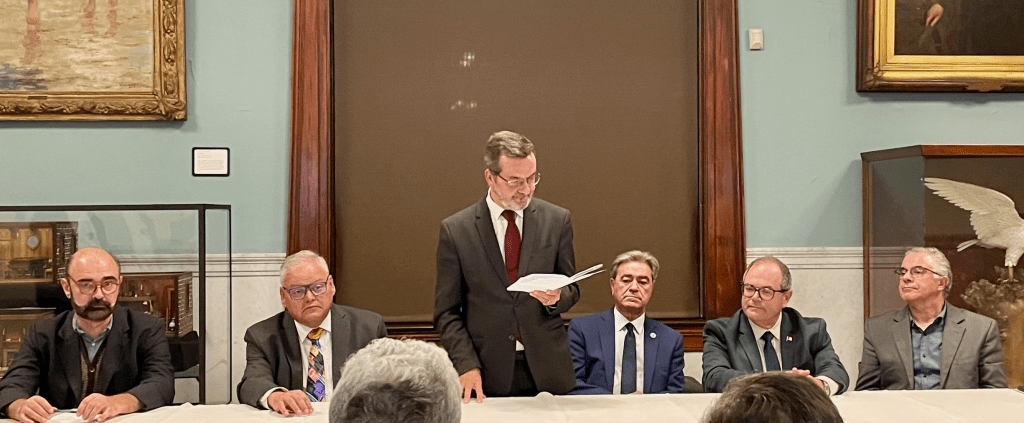
José Andrade is the Regional Director for Communities in the Government of the Autonomous Region of the Azores
This chronicle is based on a piece from his book Transatlântico – As Migrações nos Açores (2023)

 Filamentos (artes e letras)