
Dance, object theater, musicals, performances, installations, short films. The choice is vast and free, but not in a theater. Until tomorrow, you can find various shows throughout the day in cafés, restaurants, and stores on the main streets of Angra do Heroísmo.
For the fourth year running, the Cães do Mar company is promoting the “Rua Direita” festival this year with the theme “Filhos da Madrugada” to mark the 50th anniversary of April 25th.
Nine venues, including stores, cafés, bookstores, and restaurants, will host three installations and six performances, which will be repeated in 94 10- —to 15-minute performances over six days.
On Rua Direita, many people hurry in and out of stores. At a slower pace, many tourists follow, carrying backpacks and cell phones.
Minutes before the performances, Ana Brum, artistic director of Cães do Mar, is handing out leaflets to passers-by.
Perhaps because it’s lunchtime, there are few stops, but the balance is positive on the fourth day of the event.
“It’s going really well. We’ve had quite a turnout of people, those we usually see at our shows, but also those we’ve never seen and who come to discover us. Some people are already looking for us,” he says.
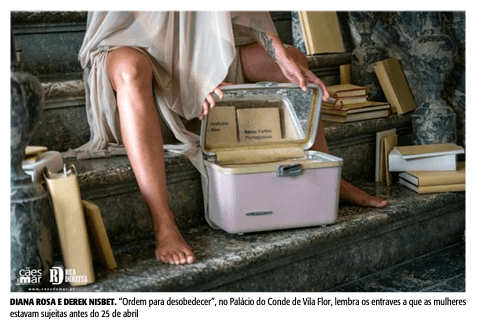
At the Palácio do Conde de Vila Flor entrance, between a restaurant and a pharmacy, Diana Rosa dances to Derek Nisbet’s violin in the show Ordem para Desobedecer.
She descends a staircase covered in books, which she keeps in a small suitcase as she loosens her veil.
“It’s about female education and what women were denied because of social constraints. There were many women, some because they were too poor, others because they were too rich, who were denied the idea of studying,” explains Ana Brum.
Born in Angra do Heroísmo, Rosa Lima is already a regular at “Rua Direita.” She attends the show practically alone but stresses the importance of the message conveyed about April 25.
“It’s a way of reaching audiences who don’t normally go to shows. It’s a different form of presentation and the shows are very good,” she says.
The shows all take place at the same time and are repeated six times throughout the day. Those who miss the 11:30 show can wait for the 13:00 or 14:30 show.
On the same street, a few meters further down, Bianca Mendes presents “Casa Alheia”, at the Basílio Simões store, one of the oldest in the city.
Among the chocolates, nuts, and spices sold in bulk, Bianca tells the story of Jaquinda and Manuel, who emigrated to Angola and returned with nothing. Jaquinda is represented by a whitewash brush, and Manuel by a bar of soap.
The show is “a punch in the gut,” some people get emotional and seek out the actress later to share their story.
“All the characters, despite being objects, are real people, real stories and real phrases. When I think about it and when I meet the eyes of the audience who have also been through it, it’s very difficult because there’s a lot of identification there and it’s very hard to hold back the emotion,” she says.
Bianca has been working in the store, which is also part of the show, for the second year. “I attend to people during the interval. If they’re busy, I sell things myself,” she jokes.
The play is just finishing when Margarida buys a few grams of coconut and bicarbonate of soda. She doesn’t stay to watch, but she likes what she sees.
On the other side of the counter, José Luís, who watches as she sells, says there are “one or two strange people, but everything goes well.”
On vacation on the island where she was born, Sara de Melo Rocha arrives on time to watch the show, and when it’s over, she moves on to the next one.
“The Basílio Simões alone is a wonderful stage. The actress managed to use a lot of objects from the store itself, which are also a little part of the Portuguese imagination, to talk about something important in Portugal, which is the war in the colonies, the departure of many people from Angola and their return to Portugal. She touched on many sensitive points and I think it’s very well done,” he says.
The hours pass, and there’s another show. On the terrace of the Aliança restaurant, musician and composer Márcio Faria from Madeira and actress Lara Costa from Terceira perform “A Forbidden Opera”, in which a father sees communism in the book “The Red Pony”, in the music of Elvis Presley or in a simple bikini.
Dirk Berger, a German teacher taking part in an Erasmus program, doesn’t understand a word of Portuguese, but he understood what the show was about.
“It was very interesting. I was able to follow what was happening, even though I didn’t understand the words,” he says.
He was accompanied by Graça Coelho, a teacher and actress, who no longer misses “Rua Direita”.
“I really like the work the Cães do Mar do. I think they do a lot for the local community, in taking these young people and integrating them with professionals in the field and it’s undoubtedly an asset for the city,” she says.
Also in the audience is the IuventuteVirtutis theater group from the island of São Jorge, which closes the festival on Saturday with the show Livrei.
For Andreia Melo, the show’s director, “Rua Direita,” is an opportunity to open up horizons for the young people who make up the theater group, who are between 12 and 19 years old.
“They arrived and said: Is this the theater? Is it an opera? What do you mean? They were wondering. It was an unconventional space, an unconventional theme, very unusual for the smaller islands,” she says.
“It’s very important in terms of opening up mentalities. They may not even continue on this path, but it’s important for them to realize that other things are happening that are different from what they think is normal,” she stresses.
Translated to English as a community outreach program from the Portuguese Beyond Borders Institute (PBBI) and the Modern and Classical Languages and Literatures Department (MCLL) as part of Bruma Publication and ADMA (Azores-Diaspora Media Alliance) at California State University, Fresno, PBBI thanks Luso-American Education Foundation for sponsoring FILAMENTOS.

 Filamentos (artes e letras)