
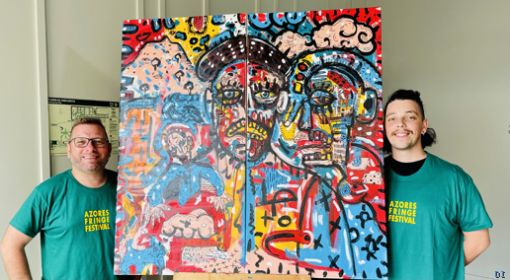
The Fringe festival, which ran for over a month on various islands in the Azores, ended in June. What is your assessment of this edition?
The 12th edition of the AzoresFringe International Arts Festival has ended after more than 40 events welcoming 2,000 people to the nine Azores islands. The SHORTS@FRINGE program reached many corners of the archipelago, and audiences voted for their favorites, who will now receive the Audience Award – Fringe 2024. There was theater, dance, literature and books, films, exhibitions and programs with artists working live, an arts and customs fair, and even music. Even though it was a success from an artistic point of view and also from an audience point of view, we’re reaching a point where we need to clean up and make a change, and we announced this when we presented edition #13, which is now being built to take place in May-June 2025.
Is the next Fringe already being prepared? What ideas are you thinking of?
#Fringe13ParaSempre or #Fringe13Forever are the hashtags for the 13th edition of the AzoresFringe Festival, which will be the last edition of the festival as we know it. Change is good for society and the development of the cultural arts sector. Some festival programs can and should continue, while others have to be revised or eliminated from the list of opportunities. But the initial aim of this festival was to be an agenda, a showcase for what is being done in the Azores, and that is what we want from the Fringe for the Azores, the “artistic explosion from the Azores to the world.” That’s why the time has come for our collaborators to step up and produce their own events at home, in their workshop, in the café around the corner, in the gallery, auditorium, library of their town, on their island. That’s what we want to see happen with the Fringe. At the epicenter, we welcome new Azorean projects. But the main thing has to be for our artists to open their doors in their localities.

Will there be Música no Forte again this summer? Who will be there?
The third season of Música no Forte focuses on MiratecArts employees, so we’ve never seen so many Azoreans on stage. João Moniz from Micael opened the summer with his original songs and also welcomed Picaroto singer Bruno da Rosa on stage; this Sunday, we have two musical groups from Terceira Island, Coro Pactis and Wave Jazz Ensemble, with the project “Diz que é Fado”, and next week it’s Carmen Raposo’s turn with her full band to take the stage at Forte de Santa Catarina, in Lajes do Pico. In the middle of the summer, there are two premieres of projects that we have been supporting: Marcos Fernandez Trio, led by the Galician who has made the island of Pico his home for several years, accompanied by two young people from the mountain island, bassist Nuno Mendes and guitarist Bernardo Alves Macedo, the youngest musician to set foot on this stage; and FOLKJADA, a collective of musicians from different backgrounds, which was born out of the desire to establish a dialog between the Traditional Songbook of the Azores and classical music. On the one hand, this is a project whose aim is to disseminate the Azorean musical roots, which we believe are fundamental to understanding the archipelago’s cultural identity, and, on the other, to link this invaluable heritage with the more specialized avenues of music, to broaden their respective audiences and break down preconceived boundaries between them. The project features the well-known Romeu Bairos, on vocals and Viola da Terra dos Dois Corações, and the musicians from the conservatory Gonçalo Sousa (violin), Micaela Sousa (violin), Lídia Sousa (viola d’arco) and Natália Ferraz (cello). These two new projects, with roots in the Azores, have the potential to reach all the islands and even represent the Azores beyond the archipelago. I hope they succeed. To round off the season, we have a duo from Spain, more specifically Galicia, who have just won the Best Folk Group award and are taking traditional Galician music, with contemporary arrangements, around the world, with violin and accordion. It’s a pleasure to premiere Caamaño&Ameixeiras in the Azores, bringing our program to a close at sunset on August 11. This program is made possible with the partnership of the Municipality of Lajes do Pico, and this year, we also have the additional support of the Regional Directorate for Culture and the INATEL Foundation.

The Lavadias open-air film festival is also returning. What films are on the program, and how have audiences been?
Lavadias is an open-air film festival with the theme of the sea, the oceans, and the waters surrounding us, and it takes place at Forte de Santa Catarina in Lajes do Pico. This year, we have three nights of programming. We open on August 13 with an evening dedicated to documentaries, with the premiere of new works by Nuno Sá and José Rodrigo Freitas, a young man from Faial, with the works “Lajes Terra dos Gigantes” and “Entre o Mar e a Ilha”, respectively. The second night is dedicated to the family with the new animated film “Noah’s Ark”, an adventure adaptation of the classic story, led by characters inspired by Brazilians Vinicius de Moraes and Tom Jobim. Closing on the evening of August 15 is an adventure film for adults about the struggle for survival after a plane crashes in the Pacific Ocean. “No Way Out – No WayUp” is Claúdio Fah’s new film, featuring sharks and suspense.
In the past, you’ve warned of the risk of some of MiratecArts’ events not taking place due to lack of funding. Was it possible to overcome these constraints?
There is always a lack of funding. A lot is done with ingenuity and creativity, but also because a lot of investment comes from the artists themselves, who sometimes don’t earn their daily bread from their work. It’s all very well, but if you make a living from the arts, you have to get paid or can’t make a living, and what’s more, in our archipelagic society, we have individuals with no other job. Their work is their art, and so we have to be able to provide these opportunities for professionals and not just for those who are part-time artists or make art their hobby. MiratecArts has more than 40 projects, and last year, Visitarte and Balada da Despedida, among others, fell out of our plan due to a lack of budget. Some projects with artists went into the drawer and are still there. The Azores have manpower in the artistic and cultural sector, but they don’t have funding. Most people think it’s just AzoresFringe and the Cordas Festival, but our association has a year-round program and supports artistic and cultural development from January to December.

Is there still little investment in cultural events in the Azores?
Most people see culture only as entertainment because that’s how they’ve been fed. 90% of municipalities’ annual culture budgets are invested in summer festivals – popular programming, pure entertainment – while they have crumbs to invest in artistic culture the rest of the year. The Municipality of Lajes do Pico is noticing this and is increasingly investing “in the rest of the year” or alternatives to the summer festivals. Still, most of our municipalities continue to invest only in “the party.” Imagine if they removed 10% of that budget and allocated it to winter programming. It would be much more beneficial for our society and for the cultural arts sector itself. As for regional investment, we have to think that we’ve more than doubled our professional bodies and artists in the region in ten years, but the budget hasn’t kept up. Not to mention that everything costs more, and nothing can be produced in this region without investing in transport, accommodation, and restaurants. The artistic and cultural sector feeds all the other sectors, and if we don’t invest in them, there’s no gain for society in general. We have reached the point where we need a revolution and a significant restructuring of the artistic and cultural sector today and how we invest in it on the nine Azores islands.
From Diário Insular-José Lourenço, director
Translated to English as a community outreach program from the Portuguese Beyond Borders Institute (PBBI) and the Modern and Classical Languages and Literatures Department (MCLL) as part of Bruma Publication and ADMA (Azores-Diaspora Media Alliance) at California State University, Fresno, PBBI thanks Luso-American Education Foundation for sponsoring Filamentos.


 Filamentos (artes e letras)