

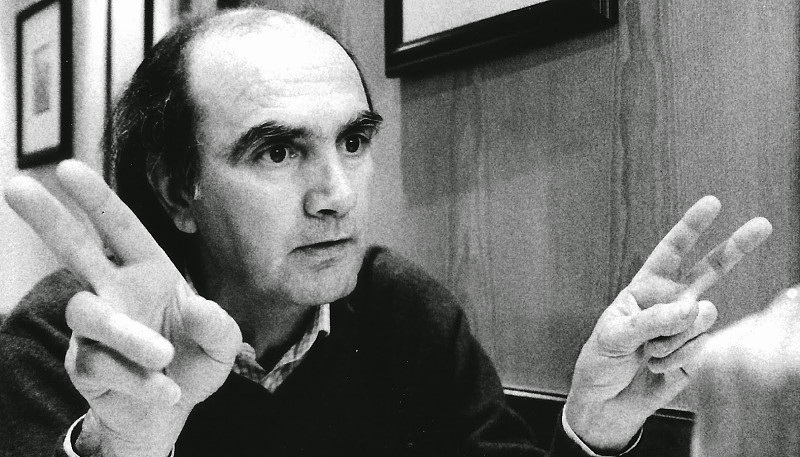
Portuguese singer-songwriter Fausto Bordalo Dias has died. He was 75 years old. The musician died during the night from a long illness, his agent confirmed to Observador. Author of albums such as Por Este Rio Acima, O Despertar dos Alquimistas, Para Além das Cordilheiras, A Preto e Branco or Crónicas da Terra Ardente and songs such as O barco vai de saída, Como um sonho acordado or A guerra é a guerra, he is one of the most influential singers in the history of Portuguese popular music.
His latest album, Em busca das montanhas azuis, was released in 2011 and features musical arrangements by José Mário Branco. In all, he recorded 12 albums between 1970 and 2011. One of his most memorable concerts took place in July 1997, in Belém, during the celebrations of the 500th anniversary of Vasco da Gama’s departure for India. Also in recent memory are the Três Cantos shows he gave with Sérgio Godinho and José Mário Branco (which were later released on record and DVD).
Fausto Bordalo Dias was a constant presence in the recordings and live performances of the generation that led the protest song movement before and after April 25. In this context, he was also present at the founding of the Cultural Action Group – Vozes na Luta (GAC), together with José Mário Branco, Afonso Dias, and Tino Flores. He would later become the protagonist of one of the most creative and influential ways of combining different musical languages, between Portuguese and African tradition and pop rock languages, working with similar care on the melody, harmonies, and poetry he sang. Born on board the ship Pátria during a voyage between Portugal and Angola, Fausto Bordalo Dias was registered in Vila Franca das Naves, Trancoso. In Angola, from where he returned years later, he formed his first band, Os Rebeldes. He settled in Lisbon in 1968, when he entered the former Instituto Superior de Ciências Sociais e Política Ultramarina, now ISCSP – University of Lisbon, to take a degree in Socio-Political Sciences. At this time, he recorded Chora, Amigo Chora, which in 1969 won him the Revelation Award for the old radio program Página Um, broadcast on Rádio Renascença.
Pró que Der e Vier (1974) and Beco sem Saída (1975) are his initial works marked by revolutionary experience. These were followed by Madrugada dos Trapeiros (1977), which includes the song Rosalinda, Histórias de Viajeiros (1979), which opens the way to Por Este Rio Acima (1982), his big hit, inspired by Fernão Mendes Pinto’s Peregrinação. Para Além das Cordilheiras (1989) won the José Afonso Prize. “With Fausto, it’s a whole journey through the universe of sounds, of collective memory, of the deepest feeling that unites us as communities,” reads the page dedicated to the musician.
The Prime Minister, Luís Montenegro, says that “the contribution [Fausto Pinto] made to music and to Portugal is eternal. “The music of Fausto Bordalo Dias has enchanted us for decades. It is with deep regret that I receive the news of his death, which does not mean his disappearance,” the Prime Minister wrote on the X social network.
The President of the Republic, Marcelo Rebelo de Sousa, considers that his musical legacy is intertwined with the history of Portugal. In a note of condolence published on the official website of the Presidency of the Republic, Marcelo Rebelo de Sousa states that he “received with sadness the news of the death of Fausto Bordalo Dias, who over the decades left a musical legacy that is intertwined with the very history of Portugal”. “Fausto belonged to a constellation of musicians who translated the feelings of the Portuguese people into songs of intervention, and it is therefore inevitable to associate Fausto’s name with the greatest names in Portuguese music, such as José Afonso, José Mário Branco or Sérgio Godinho,” adds the same note. The head of state sends his “most heartfelt and affectionate condolences” to Fausto Bordalo Dias’ family and friends.
In a statement sent to the press, the Ministry of Culture, led by Dalila Rodrigues, stressed its “deep sorrow at the death of the musician Fausto Bordalo Dias, whose work is forever linked to the movement of opposition to the Portuguese dictatorial regime and resistance against fascism.”

The PS Secretary-General has also reacted. In a note published on the party’s website, Pedro Nuno Santos recalls “the guitarist, the singer, the composer, the poet, the attentive citizen committed to the causes of culture. “Expressing our deep sorrow at the death of Fausto Bordalo Dias, we pay tribute to him and send our deepest condolences to his family and friends.
Musician Sérgio Godinho, who worked with Fausto Bordalo Dias, reacted to the musician’s death: “He invented a very unique aesthetic” which makes him “someone with a very strong identity”, he said. “Fausto’s disappearance is a very sad but unfortunately expected event,” the singer and writer told Lusa news agency, admitting that he knew Fausto was ill. “He was a great creator, performer, creator of lyrics and music and he created his own universe, very personal and very customized. We can tell that song is Fausto’s because he really had a stamp on it,” he said.
The PCP has also highlighted the role of Fausto Bordalo Dias, “creator of many of the most beautiful Portuguese songs throughout his artistic career,” reads a note sent to the newsrooms by the party. The communists stress that “they will never forget the fact that Fausto Bordalo Dias accepted the invitation, in 1985, to arrange the music for A Carvalhesa, a popular Portuguese song, originally from Trás-os-Montes, which accompanies the PCP’s political activity in successive election campaigns and at the Festa do Avante! And which arouses joy and confidence in the future in a lively and enthusiastic way”.

On Observador radio, David Ferreira, a former editorial manager in the Portuguese music industry, recalled the late moment when he met Fausto: “Around 2005, 2006, António Macedo used to do the mornings on Antena 1, and sometimes he would invite someone to bring a series of records, and then there would be a conversation around the records. I even had some difficulty choosing. And I chose a song by Fausto, A Ouro e Prata, which people don’t talk about much. It doesn’t have an obvious meaning; it’s the story of a relationship between a luxury prostitute and a financial speculator. I explained why I’d chosen it, and later that day, I received a call from a voice I didn’t know: Fausto.
“Fausto was about 20 years younger than José Afonso, but he entered the musical life of that whole generation,” David Ferreira recalled. “He appeared with many of them because he was an excellent musician. Later on, he played a leading role in some of the radicalism of that period and then there were all the albums he made thinking about the travels of the Portuguese, the relationship with Africa. It’s very important because of the way he became an influence.”
In Observador
Translated as a community service by PBBI-Fresno State for Filamentos.
Remembering Fausto
 Filamentos (artes e letras)