

MEMORY OF COLONIAL POWER IN MOZAMBIQUE
by Jorge Martins Bettencourt
June 2024
When I first published a text about the June 14, 1958 report from the governor of the Zambézia district, Administrative Inspector Álvaro de Gouveia e Melo, to the governor-general of Mozambique, Captain Gabriel Teixeira, about the presidential elections on the 8th of the same month, a friend understandably asked me if the document was part of my father’s estate. (1)
I said no because my father had definitively closed the Mozambican chapter of his life in 1961, rarely spoke about it, and didn’t keep any documents from the final part of that period. In circumstances that I will try to explain later, in 1959, the Mozambican colonial authorities expelled him from the land where he was born, grew up, married, raised his two children, and pursued a challenging professional career. It was a violent shock that brought him down and almost ended his life. Fortunately, he managed to overcome the severe health problems that resulted from it. He rebuilt his professional career, first in Portugal, then in Brazil, and later in other countries around the world, in much more rewarding and psychologically healthier ways than in Mozambique.
By pure chance, I found this report in an internet search in the digital archives of the Mário Soares Foundation (| Cc | Archives (casacomum.org)) as part of a set of documents deposited by my comrade and friend Luís Costa Correia. Although the archivist identified the set as “Relatório-Secreto n.º 2/G, das Eleições Presidenciais de 1958”, in reality, it is a collection of documents in which some are reports – “Relatório-Secreto n.º 2/G” is just one of them – on those presidential elections, mainly in Mozambique. As Luís Costa Correia later explained to me, the set of documents in question was one of only two that he removed from the DGS/PIDE archives in May 1974, when he coordinated their occupation after the military coup of April 25, 1974, to hand over later to entities responsible for historical archives, because he thought it would be unfortunate if they were lost in the probable processes of future transfers. However, when he removed the documents, he left a note in the archive explaining his intention to send them to an appropriate entity that studied the electoral methods of the Estado Novo, which would happen later.
It was good timing because reading those documents allowed me to confirm what my father had told me about the 1958 presidential elections in Mozambique, where he headed the Zambezia Agriculture and Forestry Department and, in addition, the Delegation of the Coffee Export Board. It allowed me to consolidate my strong suspicion about my father. However, not a militant oppositionist, he was heavily penalized for remaining impartial and not collaborating with the colonial authorities’ electoral manipulations and fraud, in the case of district governor Gouveia e Melo and governor-general Gabriel Teixeira.
My father was born in Lourenço Marques, now Maputo, in 1924. He was the fourth child of two Madeirans, Maria Isabel Jardim from the parish of Arco de São Jorge in the north of the island and António Jorge Bettencourt from the parish of Gaula, who sought a better life in Mozambique and stayed there until the end of their lives. He grew up and studied in Mozambique until the 6th year of high school when he came to Lisbon to complete the 7th year of the old high school and enter the Instituto Superior de Agronomia. After graduating as an agronomist in 1948 and completing an internship at the Agricultural Hydraulics Board in the Idanha-a-Nova project, my father returned to Mozambique. He applied to the Agriculture and Forestry Services. He started working in the Agricultural Hydraulics Section. Still, as the bureaucracy of Lourenço Marques didn’t enthuse him, he asked to be transferred to Inhambane to study and work on cultivating racemosa coffee, a spontaneous species on Mozambique’s sandy coast. He evolved and progressed until he was appointed Delegate of the Coffee Export Board and authorized to begin work on arabica coffee in Upper Zambezia.
He dedicated his entire life to supporting small Mozambican farmers who saw coffee as an alternative to the cotton, cashew, tea, sisal, rice, and sugar cane crops imposed by the colonial administration. For these crops, it was up to the concessionaires, protected by the colonial state, to organize sales markets and monopolize purchasing the final product. But coffee in Mozambique escaped these monopolistic circuits, and for a few years, the market functioned normally. My father set up experimental stations hundreds of kilometers from home, first in Malamba, south of Inhambane, and then in Gurué, Zambezia, for arabica coffee, when he was later transferred to Quelimane. He produced and distributed seeds to ranchers and farmers who took over the coffee production and sales circuit.
However, his activity was often hampered or blocked by the colonial government’s centralism, which opposed any form of autonomy for the colonies. In fact, power was firmly installed in Lisbon in the hands of Salazar and his Overseas Ministers, who delegated certain powers to the colonial governors he appointed. Colonial legislation was drawn up in Lisbon, as were the budgets of the various colonies, and they also depended on ministerial decisions in everything relevant. My father needed a lot of energy and patience to deal with the colonial administrative authorities: in Quelimane with the governor of the Zambézia district, Administrative Inspector Álvaro de Gouveia e Melo, a civil servant from the Metropolis on commission; in Lourenço Marques with the governor-general, Captain Gabriel Teixeira, a naval officer with whom he shared Madeiran roots.
Until the 1958 presidential elections, in the Estado Novo elections, few voters cast their ballots using the ballots each competing force delivered in advance. The opposition’s great difficulty was getting their ballot papers to the people. However, in the 1958 presidential elections, the opposition in Mozambique was well organized and managed to get ballot papers for Humberto Delgado to the most remote places, competing effectively with the authorities who put the colonial administrative machine at the service of the regime’s candidate, Américo Tomaz.
In Quelimane, district governor Gouveia e Melo instructed my father to hand out ballot papers for Admiral Américo Tomaz to the Agriculture Department employees so that they would vote for the National Union candidate. My father accepted on the condition that he also distribute ballot papers for General Humberto Delgado, which, of course, Governor Gouveia e Melo did not accept. Despite the setback at the Agriculture Office, the governor remained confident that victory was certain.
However, Governor Gouveia e Melo had a hard time after the elections, and the votes were counted. Like other district governors in Mozambique, he had to justify the defeat of the National Union candidate. They all gave their reasons in classified reports to Governor-General Gabriel Teixeira, who then discussed them in two secret reports to the minister in the metropolis. These reports are part of the documents that Luís Costa Correia deposited in the archives of the Mário Soares Foundation.
(the image in Portuguese reproduces the first page).

The two reports by the governor-general Gabriel Teixeira are excellent demonstrations of the mentality of those who were responsible for the government of the colony of Mozambique: the obsession with the threat of the communists and the external interests that, according to him, dominated the opposition, the praise for police surveillance and control of the citizens, the lack of confidence in the majority of the district governors and the contempt for the service directors and similar (“all lax, and perhaps even, many of them, worse than lax”). According to him, the “elections, with all their evils, had the merit of highlighting various weak points in national life” and “also laid bare the duplicity of some and the lukewarmness of others, many of whom occupy commanding positions in the civil service. In short, they were a lesson, and if we know how to take advantage of it, and I’m sure we will, the outcome of the elections will be beneficial for the nation.”
The repression that followed the 1958 presidential elections in Mozambique’s various social, political and economic sectors showed his understanding of what was “beneficial for the nation”.
In an interview he gave in 2010 (Depoimento de Aníbal Jardim Bettencourt – actd:MOAJB (iict.pt)), my father explained what happened to him and the services he ran:
“For 12 years, I worked in Mozambique, setting up two experimental stations, one for the racemose species and the other for the arabica species, in entirely different geographical areas. The stations were very advanced, and so was the crop promotion. I had managed to create an exciting team of agronomists and agricultural managers; at that time, they were technical agrarian engineers, and from one moment to the next, I received an order from the head office in Lourenço Marques, in the capital of Mozambique, from the Minister of Overseas Territories to stop all the work that was being carried out in Mozambique on coffee growing, and the justification, for me, it was absolutely absurd, that Mozambique couldn’t produce coffee, it could only produce tea and that Angola could only produce coffee. Not tea and that, therefore, I would hand over all the movable and immovable material, the buildings, everything that had been built with money from the agricultural services delegation. I think, to some planning board, I would be transferred to Angola to work on coffee in Angola (. .). And what is true is that I remember an estimate that was made at the time, just before there was that order from the minister, that there were already some 5,000 hectares of arabica in Upper Zambezia, including Gurué, Tacuane, Nauela, Milange, etc., the main areas for the spread of arabica.
I called the Experimental Station, it was called Alverca. In this place, the Gurué Coffee Experimental Station was, and I said: I’m going there to help you do the inventory because there were trucks, there were tractors, there were buildings, the whole thing; I was going to see how it was done, well, I didn’t know anything about inventories, but I took someone to guide you in doing that work of inventorying things for delivery. So I usually went by car, with the service driver, to Gurué and to the Experimental Station, some 400 km from where I lived.
When I got there, I set up the machine immediately so that everything was working fine, and it was only after a week that I got dizzy. Now, a 35-year-old guy, full of energy, moving all over the place, I didn’t know what dizziness was. I got dizzy, I stopped for a while, I waited, and the dizziness went away, well, I thought, this is something I ate, but what’s true is that after half an hour or so, I got dizzy again and what’s true is that the second one worried me a bit. But I was even more worried when it hit me a quarter of an hour later, five minutes later, and by then, it was permanent dizziness. I lost the ability to drive anything; I only had the energy to tell the driver to get in the car and get me in. Lying in the back seat, I drove straight to my home in Quelimane, 400 km away. There, he drove the 400 km and handed me over to my wife. And that’s when I entered a highly complex phase because, from one moment to the next, a person who had all that energy, who sold health and who had never had any problems, how had he suddenly become such a wreck? I lost my strength; I couldn’t lift my arms.
The interview goes on, but to summarize, I’ll just say that the ban on coffee growing in Mozambique, a measure that almost destroyed my father and caused enormous losses for Mozambican coffee growers, especially in Zambezia, was just one of the retaliatory actions taken by the colonial power after the defeat in the 1958 presidential elections.
To the detriment of the people of Portugal and Mozambique.
- Aníbal Jardim Bettencourt was born in Lourenço Marques, now Maputo, Mozambique, on June 6, 1924. An agronomist with a PhD in agronomy from the Instituto Superior de Agronomia in Lisbon, he retired in 1992 after a long and intense professional career. He died on September 16, 2015, in Cascais.
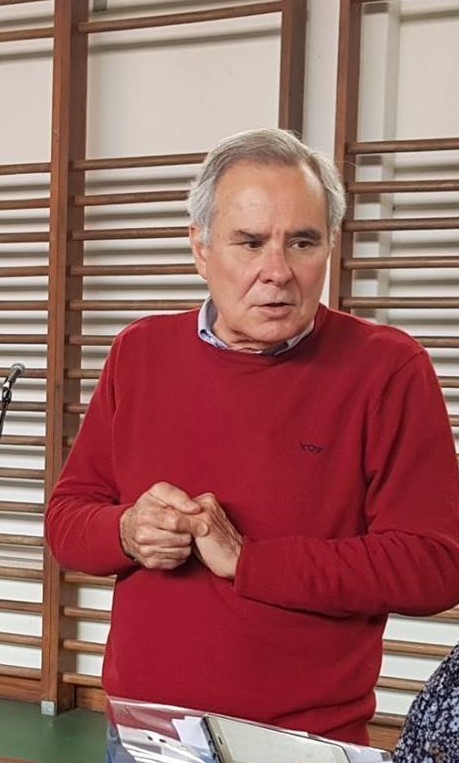
Jorge Bettencourt is a retired commander from the Portuguese Navy and has been doing grand work, especially with schools and the project Semear Abril.
In April of this year (2024), he was at California State University Fresno for a program to commemorate the 50th anniversary of the Carnation Revolution. The program included programs with Fresno State students, High School students from the Valley, and two community outreach programs, one in Hilmar at Casa dos A”cores and one in Tulare with the Tulare-Angra Sister City Foundation at the local museum.
 Filamentos (artes e letras)