
From the outset, I’d like to clarify that I had been living in the USA for two years when April 25 happened (incidentally, that day, I was at a Luso-American congress in California, which Jorge de Sena also attended). So, I didn’t experience this story on the ground. I heard about it eight time zones away, then five, when I got home to Providence, Rhode Island, where I’m talking about now. It wasn’t until two months later, in June 74, that I returned to Lisbon, where I encountered an inevitable discouragement on the part of many people who had experienced the euphoria of May 1 but sensed that the enthusiastic galvanizing spirit of the Portuguese on the streets had already begun to wane. After an experience of almost two weeks in the capital, I returned to the United States and only revisited Portugal in 1976.
This preamble explains why I hesitated to accept the invitation to speak about such an essential event in national history when I hadn’t experienced it up close. However, I was told that I had been invited because of my interest in national identity. That’s why I agreed to share some of my thoughts here.
Over the last few decades, in magazines and collective books, I’ve written about Antero and his youthful but luminous text Causas da Decadência dos Povos Peninsulares (Causes of the Decay of the Peninsular People). In some of them, I have tried to emphasize the power of this essay and the role it still plays today. By this, I mean that the Portuguese debate on the issue now known as modernity was broadly traced back to Antero de Quental’s Casino Conference. In the years that followed, the national conversation – in peaceful discussion or in verbal infighting – was fought out between the Anterian vision and, in a completely opposite field, the vision that would have in Teixeira de Pascoaes, then in extreme Lusitanian Integralism and then in Salazarism, the other face of Janus. In various places, I have tried to demonstrate how emblematic figures in our public conversation, such as António Sérgio and the Seara Nova group, and so many other outstanding figures, such as Natália Correia and Mário Soares himself, thought and acted within the previous paradigm.
Without claiming originality, I have argued that Antero de Quental most lucidly sketched the X-ray of Portuguese culture about the modern world. I’ve also consistently argued that his famous essay, written after his speech at the Casino Conferences, became the paradigmatic text that divided the people of Portuguese thought (political and otherwise) into modern and non-modern.
In various writings, I have also pointed out that identity does not only concern the past. The common marks of collective behavior are one thing, and the ideals around which a community organizes itself in the face of the future are another. This has, in fact, been a very distinct presence in our last two centuries—the struggle between a specific past and a different kind of future. It’s from this perspective that I’m speaking today.
José Medeiros Ferreira once told me that he was responsible for creating the quasi-slogan of the 1974 revolution – the three Ds that sum up the April program: decolonize, democratize, and develop. Because I’ve referred to the three Ds several times since Medeiros Ferreira revealed their paternity to me, I started to do him justice by associating his name with them.
And why do I find this creation so curious and vital? Because, in my forays into the Portuguese debate (I say Portuguese because it’s not restricted to Portugal; in Brazil there’s a long list of contributions, from Manoel do Bomfim to Sérgio Buarque de Holanda, Vianna Moog and Fernando Henrique Cardoso) around the question of modernity, which goes back to the old question of the estrangeirados (those who have a foreign thinking process) – the first manifestation of the conflict between the Ancients and the Moderns in Portugal – I realized that this “Portuguese debate” reflects, above all, a confrontation with modernity. I’m referring to the modernity that our own country had pointed to and to which it had contributed in its opening up to the empirical world in the 16th century (although this turned out to be almost a misfire when we look at what happened in subsequent centuries). The modern paradigm, brilliantly identified and outlined by Antero, underlies the whole ideology of the April 25 revolution. The three great mistakes that Antero points out as having led Portugal to decadence – the overseas adventure, the return to the old absolutist authoritarian political-cultural regime, and the closure in a traditional economic model – correspond, in their upbeat and programmatic version to the priorities pointed out by the three Ds of the Carnation Revolution.
Why highlight this fact at the 50th-anniversary celebrations of the Carnation Revolution? Just to remind you, mutatis mutandis, that the Portuguese debate on whether or not to join Europe, which followed April 25 and has now become more acute with the arrival of Chega, is an old one and lies at the heart of the issue that not a few social scientists prefer to brush aside because they think the problem of identity is a false and obsolete issue. In these days of celebration, I think it’s important to remind ourselves of the subject, addressing to these scientists a famous phrase made famous in a political debate between Álvaro Cunhal and Mário Soares in the hot years following the Carnation Revolution: Look, not really!
It was precisely in this kind of ideological framework that, almost a year ago, when I was asked by Grândola to write a short text about April 25 for a series of postcards to be published around this time, I wrote the following:
This postcard is for another April
I doubt there have ever been more utopian years in the contemporary world than in the late 1960s. The Russia of fifty years earlier could claim that award, but it was far from the global climate of the madness of the second half of the century. And yet, without patriotic narcissism, I believe no revolution has ever been as pure (or naive) as April 25. The idea of our “original socialism,” translated into poetry and music, grabbed the Portuguese youth by the scruff of the neck (as well as many elderly people recovering from lost years) and galvanized the generation that was the offspring of the Parisian May 68, sensing in 74 that the longed-for radical transformation was finally taking place.
April 25th was the dreamlike celebration of graffiti that captured the dominant spirit of the time: We want it all! Enraptured as we were in the sweetest, utopian dreams of a new human being and a new world. We were led to this by our ignorance of the social sciences – we were innocent “humanists” – and above all by our ignorance of visceral biology, which is still so disdained by most social scientists today, considering – naively again – everything to be “culture,” in other words, believing that human beings can change whatever they want if they set their minds to it. What has happened, however, in the years since, despite significant events, has been a return to the same rough and tumble animal of the past. Much has returned to sameness, only now more dangerous because technology has exponentially increased the destructive capabilities that were once non-existent. Today, even the idea of progress is questioned, as it is an ideal of modernity that has become an obsolete utopia. Its critics forget that the idea of modernity allowed us to get here. They mustn’t lose sight of the fact that their ideals have to harmonize; we can’t overdo the pursuit of one value to the detriment of others. At the moment, we can’t see any better alternative to modernity, so it would be a huge mistake to neglect it if we want April 25 to continue to be synonymous with spring.
This concludes my postcard. What follows is a development of the central ideas expressed in that short text. And I’ll start with a critique of the current tendency to criticize the very idea of modernity. The immediate response that constantly assails me is: where are the alternatives? Or at least an alternative?
It’s almost commonplace today to point to liberalism as having reached the end of its potential. I believe, however, that we shouldn’t be too hasty.
In recent decades, the English philosopher John Gray has pointed out the exaggerations of modernity, which he holds responsible for the greatest horrors of the 20th century – fascism and communism. Try as I might, however, not even in his most recent book, precisely entitled The New Leviathan. Thoughts After Liberalism, I can’t find any alternative routes. John Gray is far from alone in this type of sharp criticism, which points out exaggerations without shedding light on new paths.
We need to understand that the ideals of modernity are values and, as such, debatable. But suppose there’s anything we should learn from Aristotle, whose Ethics has been recovered today. In that case, in the non-platonic universe, such as his and that of the builders of modernity, the sensible position is to harmonize the various values. Any tendency to strengthen one to the detriment of another creates the risk of imbalances. This is precisely what happened, for example, in communism, when the fundamental value of freedom was completely ignored. In the case of the two values most desired by modern societies – freedom and justice – the ideal is to safeguard both. We are aware of the antagonisms between them, but we also know that they have to coexist, and therefore, we need to find compromise solutions. I interpret the idea of justice precisely as the fair distribution of individual freedoms. In essence, this is the concept of justice as fairness that John Rawls points to without making it explicit.
In the half-century since April 25, our most significant concern in Portugal has been pursuing political measures that guarantee the solidification of freedom and justice. We have become so accustomed to our achievements in this area(s) that we risk forgetting that nothing lasts forever and that societies with democratic structures much older than ours are in grave danger of seeing their foundations shaken today. At the moment, it is Thomas Hobbes who, even without being explicitly mentioned, returns to the center of our debates, while Marx disappears from the scene. Darwin and contemporary sociobiology (or evolutionary psychology as it has come to be called) have given reason to the savage world that Hobbes feared and thought could be controlled by the mighty Leviathan, a kind of necessary evil to dominate the animalistic and savage impulses of human beings. The world around us is becoming more and more like the Hobbesian jungle, the homo homini lupus. In the specific case of our country, I don’t know if the debate, which is too focused on dividing up the cake that the state controls (and which comes to us partly with a handout from Europe, as if from ancient India), shouldn’t demand a more balanced reflection on other values of modernity that have somehow been relegated to the background. While it is true that April 25 opened the door to freedom, we must not forget that freedom alone does not make bread. I almost agree with John Gray, and I feel like discussing post-liberalism. However, I prefer to continue defending the importance of freedom while emphasizing the idea of its harmonious articulation with other values. The Carnation Revolution was the revolution of the three Ds, and one of them, let’s not forget, was development. Modernity encompasses multiple values, let us repeat, one of which is the belief in human progress. When equated with the need for development, it is perhaps the most sensitive issue in the Portuguese debate, as it leads to realities associated with right-wing conservatism in our ideological debates. Basically, these realities have more to do with Hobbes, Darwin, and the neo-Darwinists informed by genetics. They are, after all, confronting us with harsh and raw realities that we can in no way ignore. In 2010, I published De Marx a Darwin – a desconfiança das ideologias, a little book in which I raised these questions, but in Portugal, it’s not easy to establish theoretical dialogues. We end up publishing monologues that are met with emptiness. (I’d like to open a parenthesis here to note the transformation that has been taking place in this Academy, a privileged place and natural space for frank, uninhibited conversation. It is a pleasure to observe the dynamism that has been taking place).
Returning to the Hobbesian world that is increasingly taking hold, even in so-called institutionally stable societies, I would add that we are far from the utopian euphoria that April 25 generated in Portugal. Marx, the dominant figure in the thinking of the Western world at the time – even those who opposed him seriously feared him – was eclipsed. Perhaps this image of an eclipse is not the best since an eclipse is very brief. Marx has been fading for decades. His idyllic Rousseau-drenched vision of the good savage – predicted first by feudalism and then by capitalism – has now fallen apart in the face of the evidence accumulated by evolutionary psychology based on solid empirical research, freed from ideological biases that distort reality. Human beings are capable of being the best but also of being the worst, which is true of capitalism and communism. It will seem superfluous to remind you of these truths. However – judging by the prevailing conversation in the media – we don’t often remember that Auschwitz and the Gulag are simply two sides of the same coin.
However, recognizing that this is not the time to address this issue, I will end my speech with a comment on another D of the April Revolution – that of democracy, which is deeply intertwined with development.
Because on this precise occasion, I’m speaking from a country with a solid democratic tradition that has preceded ours by two hundred years, I think it’s appropriate to end by pointing in this direction. The dangers threatening the US today are severe, and the consequences of a possible turnaround are unpredictable. Never in 52 years of my American experience have I thought that the institutions of this country could be at risk to the degree we are witnessing. I don’t think anyone listening to me doubts that whatever happens on these sides of the Atlantic will also have repercussions for Portugal. By this, I mean that our celebrated April 25 lasted 50 rosy years, but there is no guarantee that it will last for many more, as much as we would all like it to go on forever.
I have been deeply concerned about the unfolding political situation in the US, and I confess to being fearful. Having lived here for over fifty years, I soon appreciated the seemingly unshakeable institutions established in this country with 250 years of history. These last eight years, however, have brought us face to face with hitherto unforeseen and even unthinkable realities. I often recall the insightful paradox of tolerance identified by Karl Popper. The system has created so many defenses for the individual that an unscrupulous person can use to overcome all the nation’s founding fathers intuitively conceived insurmountable barriers.
Suppose some facets of a solid democratic edifice, such as that of the USA, are shaky today. In that case, I don’t think it’s an exaggeration to remind my fellow citizens that the foundations of a democracy that’s only fifty years old are much less solid, created by a young generation that, in a flash, put the entire previous generation out of business, the latter having collapsed like a tower made of playing cards.
Far be it from me to echo John Gray’s pessimism. But perhaps it’s not unreasonable to highlight this kind of reality in the space for reflection that this Academy has been promoting. In the celebratory euphoria of the Carnation Revolution, it’s important not to simply and excessively lull ourselves into repeating the utopian exaggerations of that magnificent delirium – because it was fueled by young people – that was the beautiful experience of April 25.
The backdrop of naïve, Hegelian-inspired optimism that inspired Francis Fukuyana in his The End of History decades ago has disappeared, giving way to a thick, dark curtain. With Darwin, we learned that evolution doesn’t necessarily mean change for the better. History has no predetermined direction. We can have no certainty about what lies ahead. It’s important not to fold our arms because the achievements we have made are never guaranteed. We must be very attentive and keep intervening so they don’t evaporate.
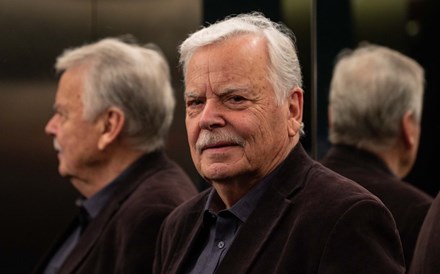
Onésimo Teotónio Alameida (Professor Emerius from Brown University, Providence, RI)
Translated by Diniz Borges
 Filamentos (artes e letras)