
LUSOPHONE WORLD IN NORTH AMERICA
In North America, Portugal is spelled AÇORES (AZORES).
The Portuguese communities in the United States, Bermuda, and Canada are primarily Azorean or of Azorean descent.
In the United States of America, the latest 2020 census reveals almost one and a half million American residents who identify as Portuguese or of Portuguese descent, with more than half concentrated in the states with the largest Azorean presence: 350,000 in California, 265,000 in Massachusetts, 91,000 in Hawaii, 84,000 in Florida, 83,000 in Rhode Island.
For example, the largest Portuguese community in North America, corresponding to the huge state of California, will comprise 95% Azoreans and Azorean descendants.
If the Portuguese presence, primarily Azorean, already has such an expression in the United States, it takes on an exceptional preponderance in the specific case of Bermuda.
It is estimated that a quarter of Bermuda’s population, with 65,000 inhabitants in 55 square kilometers, are emigrants or their descendants from Portugal, almost all from the Azores, almost all from São Miguel.
Further north, Canada is the third historical destination of the great emigration from the Azores, after Brazil and the United States. Still, it quickly became an unavoidable reference point for Azoreans without borders.
By the end of the 20th century, almost half a million Portuguese had emigrated to Canada, with an estimated 65% from the Azores.
According to the 2021 Canadian census, there are 300,000 in the province of Ontario, mainly in the cities of Toronto, Brampton, and Mississauga; 65,000 in Quebec, especially in Montreal and Laval; 40,000 in British Columbia, mainly in Vancouver and Kitimat; 20,000 in Alberta, namely in Calgary and Edmonton; and 13,000 in Manitoba, concentrated in the provincial capital, Winnipeg.
This demonstrates the numerical importance of the Azorean communities in the Portuguese diaspora in North America and the cultural relevance of Azorean accents in preserving Lusophone cultures throughout the United States, Canada, and Bermuda territories.
From the Atlantic to the Pacific, Azorean emigrants carry with them the heritage of the Portuguese language that distinguishes and makes us proud.
And they have a cultural obligation to preserve it.
They need to master the host country’s language, but they don’t need to forget their mother tongue. They must maintain their command of the Portuguese language and, above all, that they pass it on to their children and grandchildren.
This is the great challenge, but also the greatest difficulty.
That’s why we value the organized teaching of the Portuguese language in the different communities of the Azorean diaspora.
This is the case, for example, with the Portuguese Official School in Bermuda, which is mainly supported by an annual financial cooperation protocol provided by the Government of the Azores.
This is also the case with other financial support protocols maintained by the Regional Directorate for Communities with almost two dozen socio-cultural organizations in New England, California, Ontario, and Quebec, many of which teach Portuguese to the new generations of the Azorean diaspora.
But the decisive contribution to preserving the Portuguese language as much as possible in North America, in addition to the patriotic mission of the Camões Institute itself, is made by various North American universities, which have created and maintain courses and centers for Portuguese and Brazilian studies, also here, thanks to prestigious professors of Azorean origin.
For example, Caetano Valadão Serpa, in Massachusetts, Diniz Borges, in California, Dulce Maria Scott, in Indiana, Francisco Cota Fagundes, in Massachusetts, Frank Souza, in Massachusetts, Irene Blayer, in Ontario, José Carlos Teixeira, in British Columbia, José Francisco Costa, in Rhode Island, Maria João Dodman, in Ontario, or Onésimo Teotónio de Almeida, in Rhode Island, to name but a few.
It is with due recognition of Azorean excellence for North American Lusophone Cultures that this unpretentious text ends.
The only thing we want to do here is to be proud of who we are: Portuguese-speaking Azoreans in the Lusophone community of the global village.
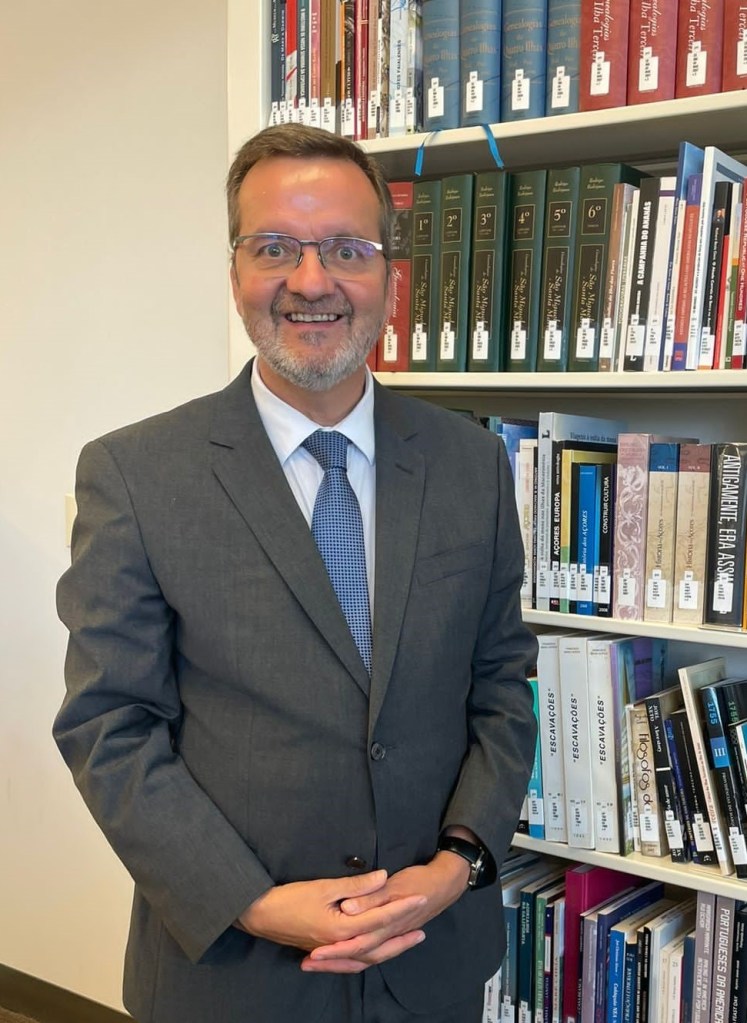
José Andrade is the Regional Director for Communities in the Government of the Autonomous Region of the Azores
This writing was taken from the book Transatlântico – Açorianidade & Interculturalidade (2024)
 Filamentos (artes e letras)