April 25, 1974 and the Portuguese Democratic Constitution

- Causes and characterization
- Originality and singularities
- How was the MFA (Armed Forces Movement) “Constituent”?
- The current Portuguese Constitution – its importance
- The root cause of the April 25 military movement was the colonial war.
- The deeper cause, however, was the existence since 1926 of a dictatorial, corporatist, and fascist regime that kept Portugal in power:
- In international isolation – only a few dozen countries had diplomatic relations with Portugal. In UN votes on decolonization, we were isolated – the fingers, on one hand, were enough to count the votes in our favor. The isolation was such that when Guinea-Bissau unilaterally declared independence in 1973 at the will of the PAIGC, the independence was recognized by more countries than had diplomatic relations with Portugal.
- Economic, social, and cultural backwardness
- Large-scale emigration – In the 1960s, for economic reasons and also to avoid going to the colonial war, the Portuguese emigrated en masse, more than 100,000 a year, mainly to France. The Portuguese youth were either in the war or had emigrated to Europe; hardly any young people were left in the country.
Faced with the dictatorship’s inability and unwillingness to find a political solution to the colonial war, which began in 1961, young military professionals became aware that war was no solution for the Portuguese people or for the colonized African peoples. The solution must be political.
In 1973, taking advantage of a corporate problem with the evolution of military careers, the young captains organized themselves into a Movement of Contestation, which quickly became politically aware, expanded to include Air Force soldiers, linked up with the Navy Movement, drew up a Political Programme, the MFA Programme, and overthrew the oldest dictatorship in 20th century Europe on April 25, 1974.

The creation of the MFA and the military action of April 25 provoked a profound rupture in the Armed Forces and their hierarchy, giving rise to multiple ruptures in Portuguese society: political, economic, ideological, social, cultural, and aesthetic.
- A political break with a one-party dictatorial regime, supported by the fascist political police – PIDE/DGE, special courts, a totalitarian youth organization, open censorship, repression of intellectuals and workers, explicit control of the press, radio, and television.
- On an economic level, rupture breaks industrial conditioning, ends the regime’s unions and guilds, and ends the corporations.
- A break, on an ideological level, with a conservative Catholic Salazar ideology and fascist corporatism.
- A break, on a social level, with a conservative, ankylosed rural society, closely monitored by the police and submissive to the Church.
- A cultural and aesthetic break with a repressed, single-minded society.
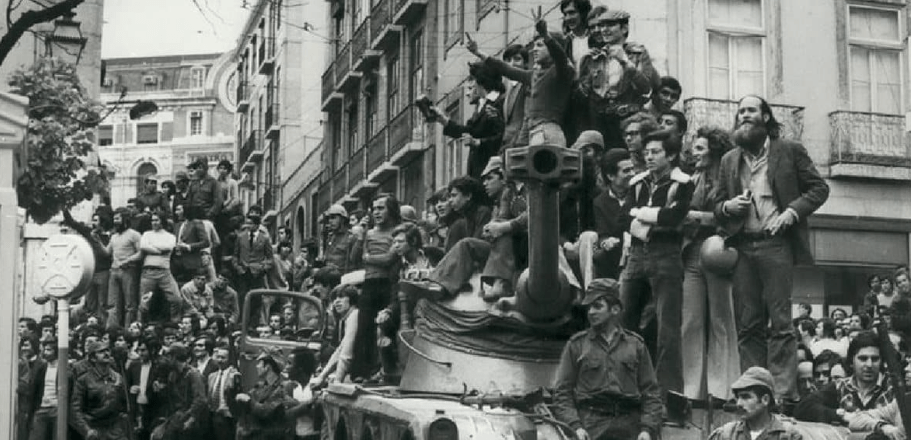
The widespread support for the young soldiers’ movement on the morning of April 25 was confirmation that we were right and had correctly interpreted their desire for peace and freedom. This widespread support strongly influenced the course of military action and quickly turned the overthrow of the dictatorial regime into a revolutionary process.
Although the objective reality at the root of April 25 was necessary, it is essential to consider the significance and strength of the ethical motivations and ideas that moved us, our subjective reality.
The values of the MFA Program are: – Freedom, Democracy, Equality, Fraternity, Peace, Solidarity and Cooperation.
They are also the values of the French Revolution, expressed in the Declaration of the Rights of Man and of the Citizen and later in the Universal Declaration of Human Rights of 1948, which constitute the essential core of human dignity, of what the expression and exercise of citizenship should be in a Democratic Republican State, in a State governed by the rule of law.
We, young soldiers, in a situation of war and enormous limitations on freedom and material resources, driven by a strong sense of dignity and solidarity between everyone and with the colonized peoples, opened doors to the liberating vocation of men and peoples.
April 25 was born out of a deep conviction about the fraternity and equality of those who share the human condition.
This is what led us to break the hierarchy and overthrow the dictatorial regime without bloodshed.
It was also ethical reasons, principles and values that motivated us in this drive for the liberation of all those who were subjected: the Portuguese people and the colonial peoples.
We started from a situation of economic, political, social and civic backwardness. After April 25, we reached a higher platform, an honorable position in Europe and in the world.
On April 25, the military and the generality of the Portuguese expressed the best of nature and the human condition. Until May 1, 1974, we lived an extraordinary week of joy, harmony and freedom. We realized that if we want to be free, we can’t build our freedom at the expense of the submission or enslavement of others.
On 25 April, we all showed solidarity in Portugal and with the colonized peoples. This manifestation of solidarity and freedom produced one of the most extraordinary moments in our history and created its own aesthetic. The generosity and strength of political ideas, the freedom achieved and democratic practice were joined by popular creativity: from plastic to musical, cinematographic to theatrical expression.
This liberating ethic and contagious aesthetic came from a group of young soldiers and a people in complete harmony with such an unlikely group of liberators: the Captains of April, Freedom and Dignity.
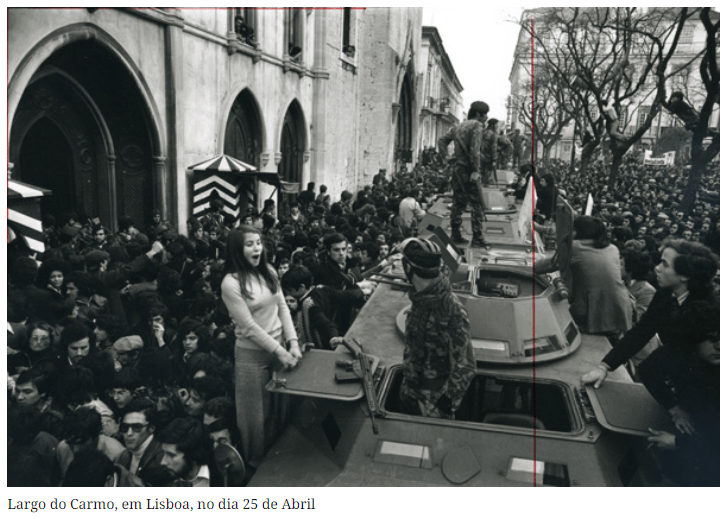
Now let’s talk a little about the originality and uniqueness of April 25
- Young soldiers overthrow a dictatorial regime; they have a Democratic Political Program; they hand over power to a military Junta – Junta de Salvação Nacional – and to a Provisional Civilian Government so that within a period of no more than a year it can promote free elections for a Constituent Assembly that will return sovereignty to the people.
- The overthrow of the dictatorship by the MFA gave it a revolutionary legitimacy recognized by the people, which it did not recognize in the organs of sovereignty: the National Salvation Junta, the Provisional Government, which were formed in accordance with the MFA’s program, or the President of the Republic, appointed by the Military Junta. The popular movement and the people in general to whom they recognize legitimacy is the MFA, the young soldiers who overthrew the regime but did not assume any position or function in the exercise of power.
- These young soldiers, the MFA, are not driven by ambition for power, nor do they seek any advantages or benefits for themselves; they take all risks for ethical and moral reasons; in conducting their military action, they are concerned with non-bloodshed, dignity, human rights and respect for others.
- April 25 was not just a military coup or a coup d’état. It was an event of multiple ruptures that led to a revolution in Portugal with consequences in Europe and throughout the world: Africa and Latin America.
- It was a unique act in Portuguese history and probably in world history, as we know of no other like it, carried out by young soldiers.
- The unlikely liberators emerged from one of the pillars of the oppressive regime, the Armed Forces.
- April 25 belongs to everyone, it is part of the Portuguese imagination, it quickly changed the image the Portuguese had of themselves. It has been so internalized by the people that, when we are not satisfied with the functioning of the institutions, we often hear people say: “25 de Abril didn’t pass through here” or “it hasn’t arrived here yet”.
- April 25 is the most recent feature of Portuguese identity.
- It carries with it its own liberating aesthetic, with a high level of symbolism, linked to and driven by popular creativity: The soldiers’ machine guns are carnations, the flowers that were born from the adherence of D. Celeste and the florists of Rossio, giving rise to a powerful image spreading the revolution and its ideals throughout the world that other revolutions or overthrows of regimes sought to copy: rose revolution, velvet revolution, Arab spring…
- The military action, despite the government’s counter-response, took place without bloodshed, except for the action of the PIDE, who fired on the people and caused 5 deaths.
- The people’s spontaneous support from the outset transformed the military action into the start of a political, economic, social and cultural revolution, boosted by the coordination and mutual support between the popular movement and the MFA military movement. It was this adherence, this popular movement that called on the young MFA soldiers to take on direct political responsibilities from the II Provisional Government onwards
- The acceleration of the revolutionary process was caused above all by the attempts of conservative and fascist forces to halt the march of the liberating forces. This is what happened at the beginning of June with the fall of the First Provisional Government, on September 28, 1974 – Spínola’s resignation and on March 11, 1975 (counter-revolutionary military coup).
- The main political parties sought and found external support. They tried to seduce or win over the MFA military to their political options for gaining power. Their own capacity was limited, even for the best organized and most established party on the ground – the PCP.
- External influences, particularly from Western countries, were decisive in the development of the Portuguese revolution and conditioned the revolutionary process.
- One of the singularities of the Portuguese revolution was the cultural dynamism and civic action promoted by the MFA military. More than 2,000 debate and clarification sessions were held throughout the country to promote the first free elections in Portugal. The main beneficiary of this civic and political action turned out to be the Socialist Party, which won a relative majority in the Constituent Assembly elections.
-In 1976, the organs of sovereignty: the Assembly of the Republic and the President of the Republic were elected through democratic elections on April 25 and June 27; on December 12, the building of democratic power was completed with the election of local authorities.

The revolutionary process and the drafting of the Constitution
The First Provisional Government, made up only of civilians, was quickly overwhelmed by social demands and was unable to define a policy for the country and the problem of the colonial war. The President of the Republic tried to take over the issue and negotiate an end to the war.
Prime Minister Palma Carlos seeks to gain power and transfer all political and democratic authority to the President of the Republic. Republic, trying to bring forward the election of the President of the Republic, ignore the elections planned in the MFA’s program for the Constituent Assembly and plebiscite his proposal for a Constitution at the time of the election of the President of the Republic.
This would be a profound blow to the military’s promise, it would be to tear up the MFA Program. We did not allow such a maneuver.
The Prime Minister resigned and the First Provisional Government fell. A Second Provisional Government was formed, now presided over by an MFA man and with some MFA military ministers.
However, the conflict between President Spínola’s project for power and the resolution of the overseas problem clashed with what was foreseen or implicit in the PMFA and with the dynamics of the popular movement.
Spínola resigned on September 28 and later attempted a military coup on March 11, 1975.
The revolution accelerated and the Council of the Revolution was formed, composed only of military personnel, which took over the powers of the National Salvation junta, the Council of State, the informal power of the MFA and also exercised the functions of the Constitutional Court.
However, the validity of the MFA’s Program is maintained, and the elections for the Constituent Assembly are held, as planned within a year, on April 25, 1975, the most participated elections to date.
MFA-PARTY PACT
In March 1975, at the initiative of the parties, a Pact began to be negotiated between the parties and the MFA to define the future structure of the Organs of Sovereignty. This pact was signed on April 13, 1975, before the election for the Constituent Assembly.
The Constituent Assembly, with an absolute left-wing majority (PS+PCP+MDP), spent almost a year working on the drafting of a Progressive Democratic Constitution.
The revolutionary process came up against international and national forces that feared a socialist revolution. The contradictions between the sensibilities of the MFA became more acute.
November 25, 1975 took place. The so-called moderates won. At the suggestion of the parties, with which the Council of the Revolution agreed, a new MFA-Party Pact was renegotiated and signed on February 26, 1976. All the parties that had signed the first pact agreed to the second, which was more favorable to them. The agreement reached in this second pact was transferred by the constituent deputies to the Constitution, which provided for the existence of the Council of the Revolution until the First Constitutional Revision (October 1982), which is why we say that we were also “Constituents”.
The Constitutional text was approved by the Constituent Assembly with the abstention of the CDS (14 deputies), out of a total of 250, and promulgated by the President of the Republic on April 2, 1976.
The 1976 Portuguese Constitution is one of the most progressive and democratic in Europe. It proclaims the transition to socialism by creating the conditions for the democratic exercise of power by the working classes.
It has undergone 7 revisions over 40 years, having lost some of its principles of a mixed economy, structures and public ownership of the means of production, planning, agrarian reform, the financial system and a reduction in the powers of the President of the Republic.
However, it retains very important articles on the exercise of participatory democracy, the fundamental tasks of the state, fundamental rights and duties, economic, social and cultural rights and duties, and democratic local power.
Article 1 – Portugal is a sovereign republic, based on the equality of the human person and the will of the people, committed to building a free, just and caring society.
Article 2 – The Portuguese Republic is a democratic State governed by the rule of law, based on pluralism of expression and democratic political organization, respect for and guarantees of the realization of fundamental rights and freedoms and the separation and interdependence of powers, with a view to achieving economic, social and cultural democracy and deepening participatory democracy.
Article 7.3 – Portugal recognizes the right of peoples to self-determination and independence and to development, as well as the right to insurrection against all forms of oppression
The Portuguese Constitution is still a barrier to the rampant neoliberalism that the American sub-prime crisis exported to Europe so that it would be paid for by the countries of the South with weaker economies, to the benefit of the exporting countries, namely Germany and above all the big transnationals and speculative financial companies.
Two documents were fundamental to the development of the Portuguese revolution and democratic consolidation:
- The MFA Program in the period following April 25 until the approval of the Constitution on April 2, 1976
- The Constitution of the Portuguese Republic from 1976 to the present day
The Constitution of the Portuguese Republic has always had and continues to have a huge base of popular support. It contains the principles, norms and democratic bodies that allow for the development and success of democracy and the country’s progress.
However, on its own, it is not enough to stop the neoliberal offensive against public services and the welfare state.

Almirante M B Martins Guerreiro ( militar de abril)
presenatation made in Toulousein 2017.
This segemnt has been sponsored by Luso Financial. We thank Luso Financial for their support of Filamentos and Novidades.

 Filamentos (artes e letras)