
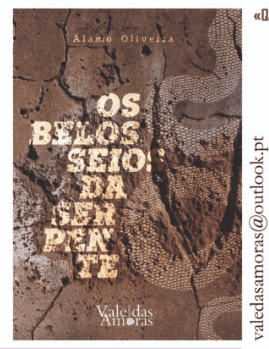
You return to the novel with “Os Belos Seios da Serpente” (which will be presented on the 19th of this month at the Angra do Heroísmo Cultural and Congress Center). Can you decode the title? Breasts? Serpent? It doesn’t seem to play well…
The decoding is simple. It was the desire to know everything through the voice of the Serpent that caused human misfortune. And yet, this desire seems to be legitimate. Ignorance does not lead to happiness. We have a special admiration for schools, even though the “curricula” and their teachers don’t continuously develop the programs in the best way. A bite of the apple of wisdom led to Adam and Eve being expelled from Eden. The result of a school lesson on defense and attack is the massacre that has taken place in one educational establishment and another, etc.
The female voice of the Serpent has the power of enchantment. It has become irresistible. How can you taste that forbidden apple whose primary function is to open the eyes of ignorance? The Serpent’s breasts—well-designed and volumetrically perfect—fulfilled their mission: They warned humanity that it was naked. Today, nudity is just a cold prejudice.
In the novel, several quotes from the “Song of Songs” (Old Testament)—almost all lovely, by the way—seem to serve as mottos for the chapters. Why? How do they work in the novel?
For me, the Song of Songs remains the world’s most beautiful book of love poetry. It is attributed to Solomon, who was intelligent enough to create such a seductive poetic work.
Given the thematic development I wanted to give to the book’s writing, using some verses in the mottling of the chapters was a specific literary imposition. The word “breasts” appears several times in these verses, which, by the way, are missing from the poem. But its seductive power remains. The Serpent was not saved, but the breasts. They show that they detest the combat car, the nuclear bomb, and the suicide drone, with its rapid evolution towards death. Symbolically, it is to them that children lost in war, xenophobia and migrant flight turn to disturb our conscience to call ourselves “good men”. Breasts are an instrument of nourishment.
This work navigates through many eras. Biblical times, of course, but the great Don Quixote is not forgotten, as are the Assyrians, the present day, the days of our islands… Where do all these times lead? At what time? In what real or imaginary place?
I don’t know who said history is made up of repeating facts. The entire Old Testament is shaped by tribal wars, sometimes motivated by simply possessing a square of land. Even a cursory analysis shows that people have never understood each other. You get the feeling that nobody likes to taste peace. Those who like it are few and have no courage to fight for it. People continue to kill each other over a simple plate of lentils. And what about dictators who have the same seductive power as the Serpent?
You don’t need binoculars to see that all this flows into the ocean of our time and place. We may occupy different terrestrial and mental geographies, but humanity’s restlessness is the same. Stability has become slippery. For example, to say publicly that “Nobody at home cares about April 25” is to insult all the people who live in freedom thanks to “April 25”.
There are situations like this everywhere in the world. These are real spaces.
“It’s easy to see that the world has gone mad after all” (p. 133). Only in fiction or in reality are we living? Is today’s madness greater or just regular madness?
Sitting and listening to the news that reaches our homes daily makes us realize that madness is the shroud of the world. Its power is to normalize lives. Madness can’t be measured in spades but with the best weapon. Madness can’t be felt. Madness does.
You’ve experienced the most varied universes of creation—poetry, novels, short stories, theater, lyrics for Carnival marches and dances, painting, etc. Where do you feel best, and do you think your primary legacy lies?
I’m like a lousy pianist who wants to play several keys simultaneously. But I like writing theater because of the challenge that the story I want to tell gives me; I like novels, short stories, and novellas because they allow me to recreate times and places to bring people together, even if they disagree; and I like poetry because it offers soliloquent intimacy, causes silences that stimulate feelings, and soothes critical and dirty moments.
The lyrics for Carnival marches and dances reflect a personal taste for conviviality and sharing joy. What about painting? Good God, where is it going? I’m a terrible piano player.
What’s next? Another novel? Poetry? What and why? And when (if it can be predicted)?
Time is starting to limit my ideas. I’m surrendering to the unexpected. I don’t know what’s coming next. I understand the curiosity, but I’m not old enough to lie in a way that sounds true and elegant. What I can add is that I have a few things left that I’d like to accomplish.

Translated by Diniz Borges-PBBI-Fresno State
We thank Luso Financial, for sponsoring FILAMENTOS

 Filamentos (artes e letras)