
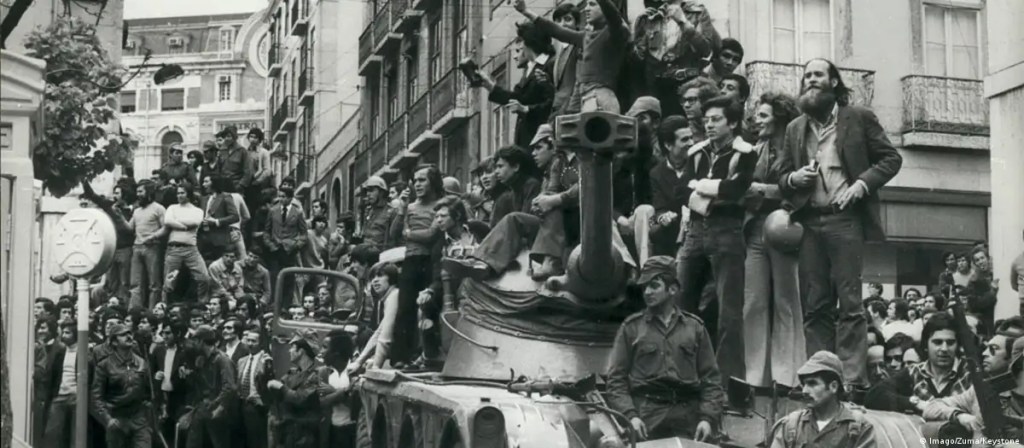
Singularities of April 25, 1974
It was from the Armed Forces, one of the pillars of the beato-fascist-corporate regime, that the unlikely liberators of the Portuguese people, the young captains of April.
That the liberating force should come from the military and that they should draw up a democratic and progressive political program had not been foreseen by the regime nor by the revolutionary theorists. Not even by the oppositionists who on the ground had been fighting against the dictatorship for many years.
The long colonial war, the constant emigration, the exhaustion of the country’s capacities and resources of the country, the fierce repression of the regime and its political police, the PIDE/DGS against the popular democratic movement and the student movement, and international isolation were awakening the military’s social and political conscience.
With the military situation in Guinea, the stubbornness of the regime, especially the ultras, the incapacity of Marcelo Caetano’s incapacity made the case of India very present and accelerated the process of radicalization of the military’s position, moving rapidly from a corporate demand to a consistent and vigilant political position so as not to be not let themselves be instrumentalized by any putschist attempt from the regime’s ultras or the or Spinolist protest. The political program, drawn up by the military with the most experience and knowledge of the Portuguese fascist-corporate dictatorship, was inspired by the Theses of the 3rd Congress of the Democratic, held in Aveiro in April 1973, corresponds to the Portuguese people’s desire for freedom, peace, and democracy.
The military movement and its political program are the exclusive responsibility of the
and take into account the failures and mistakes of the conspiracies and the failures and errors of military and civilian conspiracies and intentions, both in the Reviralist period and the period after World War II. The order of operations for the historic turning point, as well as the command and execution of all the military action, was the sole responsibility of the Armed Forces Movement.
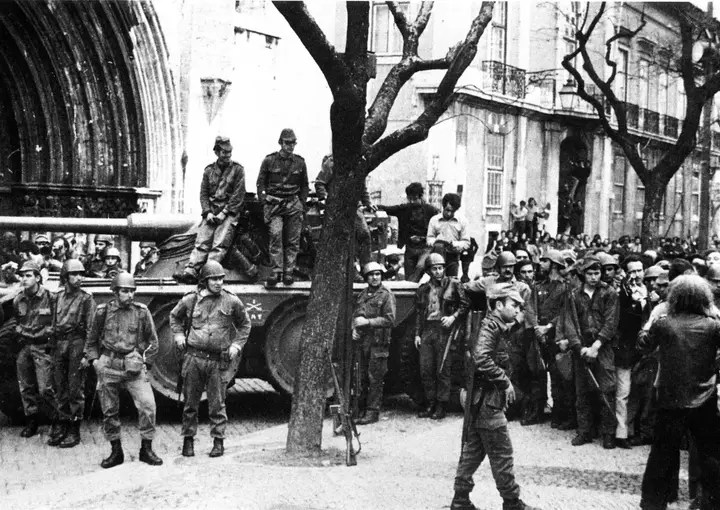
counter-offensive that was unsuccessful due to three essential factors: firstly, the government’s determination, the command and combat experience of the young captains; secondly, the movement to overthrow the regime was led exclusively by military forces. This inhibited a confrontation between cavalry forces in Terreiro do Paço; thirdly, the people of Lisbon and the south bank immediately joined the military movement in downtown Lisbon. The military movement demoralized and prevented any attack by the military and police forces who, on the orders of the government, still tried to involve the MFA (Armed Forces Movement) and took up positions that made it possible for the ministers to flee from Terreiro do Paço
MFA communiqués demoralized the command of the regime’s forces and took away their ability to maneuver, facilitating their internal neutralization and disobedience to the command’s fire orders.
Given these circumstances and singularities, despite the government’s orders for the
April 25 was a military operation that took place all over the country without bloodshed except for the bloodshed, except for deaths caused by the PIDE firing directly on the people who had gathered in Rua António Maria Cardoso Street in the vicinity of the PIDE headquarters.
In the military action and in the most profound moments, when confrontation is imminent, those who calm down and show maturity are the young captains, while the command and those in charge of the regime lose their heads and order their forces to open fire, to no avail. The colonial war had given the young soldiers more
maturity, decision-making capacity and combat experience than to the hierarchy of the
hierarchy and its government.
The regime didn’t fall apart. Rather, it fell due to a happy combination of forces and
will of the MFA military and the popular movement. It fell due to the strong desire
for peace, freedom and democracy among the Portuguese people. The MFA military, at all risks, were able to give full expression to the people’s desires, in the military action
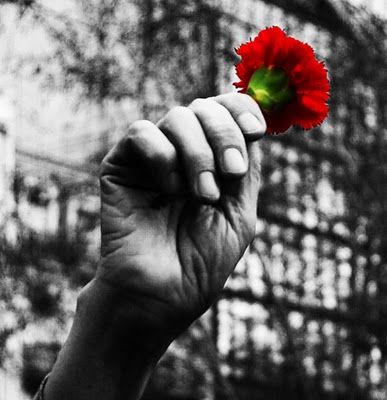
political program, in the song “Grândola Vila Morena” and in the carnations that the florists of the carnations that the florists of downtown Lisbon handed to the soldiers, transforming April 25 itself, a military action at the beginning of a unique revolutionary process, full of joy and a unique liberating process, full of joy and generosity, with a strong ethical and aesthetic charge, causing multiple ruptures in Portuguese society.
On April 25 itself, after their success, the young soldiers handed over power to a National Salvation Junta made up of seven general officers from the three branches of the FAs (Armend Forces).
Generals from the three branches of the FAs, so that they could appoint a Provisional Civilian Government and carry out the MFA’s Program, promote peace and an end to the colonial war and hold elections for a Constituent Assembly within a year.
This uniqueness of the young soldiers who overthrew fascism not assuming power, despite having all the legitimacy to do so and to intervene alongside the people in defense of their emancipation. people in defense of their emancipation, is one of the most original features of April 25 and the Portuguese revolution that makes it a unique and unrepeatable case in national and international terms.
In addition to the singularities of April 25 as a collective event, there were
many unique acts by individual soldiers: in its preparation and execution,
in drawing up and defending the MFA’s program on the night of April 25 itself, or even
in the seizure of PIDE and the release of political prisoners, which were always attributed to the MFA as a whole.
None of the most responsible members of the MFA sought to reap personal benefits or
personal advantages from the risks taken and the success achieved.
Naturally, the military members of the MFA were not immune to the revolutionary
and counter-revolutionary processes that developed in Portuguese society.
supported by the binomial MFA-Movimento Popular and the second supported by forces from the defeated forces of the defeated regime, the children and nostalgists of the empire, some traditional and conservative forces in Portuguese society and also by external forces.
The values of April 25 expressed in the MFA’s political program and in its example of
generosity, sacrifice and detachment from power, become the immediate
property of all the Portuguese people, both in the country and in the emigrant communities. In addition to being a unique historical event, April 25 has become part of
national idissincracy. There is a before and after, it has been incorporated into our greatest national references. It has become an element of Portuguese identity, the most recent of our identity, of which practically all Portuguese are proud of.
April 25 restored the country’s lost dignity and respect, and projected Portugal onto the international stage. The MFA and the Popular Movement made history in Portugal and
Portugal made world history, driving and inspiring new countries and new
democracies in Europe and around the world
April 2018 – Martins Guerreiro (now a retired Admiral from the Portuguese Navy)
Translated by Diniz Borges
 Filamentos (artes e letras)