
Letras Lavadas in São Miguel, Azores, has just announced the creation of a new prestigious publication series curated by the literary critic Vamberto Freitas. This highly selective series of books will certainly be necessary for Azorean Literature and the Azorean Diaspora.

Vamberto Freitas: The Voice of Literary Criticism in the Azores
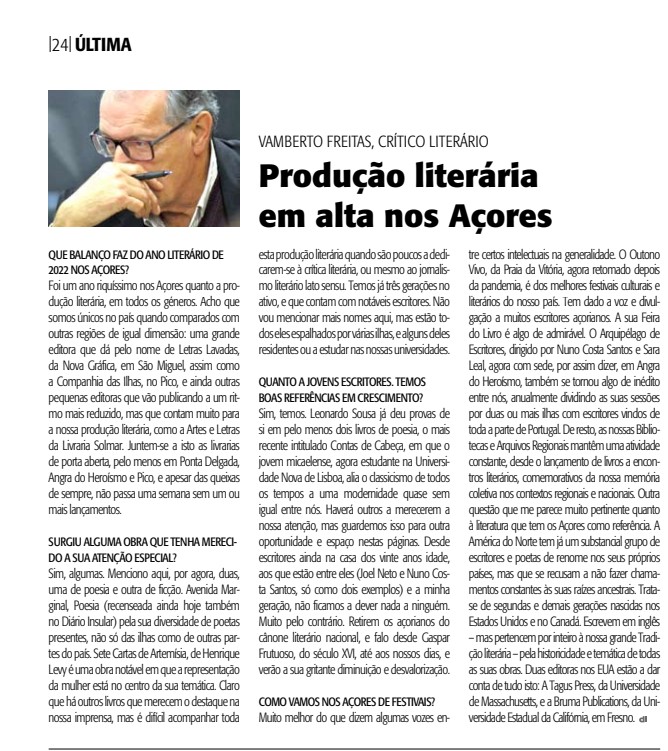
Azorean literary criticism has become more prosperous. The seventh volume of BorderCrossings: Transatlantic Readings, a series of books Vamberto Freitas has been publishing over the last few years, has just come out and was recently presented at Outono Vivo in his homeland. Those who live in the Azores follow his reviews and know very well that they are texts of a unique richness because there is an analysis of the book and a piece by the literary critic. They are always rich texts that combine analysis with creativity. They are pieces of the literary critic’s soul and contain key elements of our history, identity, and way of seeing and being in the world. One of the distinctive characteristics of Vamberto Freitas’ work is his commitment to preserving Azorean cultural identity. He has been a passionate defender of Azorean literature, highlighting the value of the unique voices and stories that emerge from these islands. The interdisciplinary approaches of his literary criticism integrate elements of history, anthropology, and sociology. His passion for literature and dedication to promoting Azorean culture have made him an essential reference for academics and readers throughout the Portuguese-speaking world and our Diaspora.
Allow me to reiterate what I wrote a few years ago when the lottery brought me the penultimate book in this series. I wrote repeatedly that I had known Vamberto since I was 19. I met him when I was on the radio. Although he was in education as a Portuguese teacher in Southern California, he also collaborated with the radio, more specifically with the L(USA)lândia program and with Portuguese-language newspapers in the diaspora, in the Azores and the prestigious Diário de Notícias in Lisbon. Like me, he suffered some hardships in a community that, particularly in the late 1970s and early 1980s, still wanted to live through the eyes of a dictatorship. Because of our fight for freedom and for a community more connected to literature, we were plagued by some who thought they were in control – unfortunately, we still have some of those in the community. I’ve maintained a 45-year friendship with Vamberto. We didn’t always agree; sometimes, we had (and still have) antipodal opinions, but with Vamberto, I learned to love literature. And with him, during my time as a radio host, we had some of the most exciting conversations and interviews I did in my 16 years dedicated to Portuguese-language radio in California. A discussion with Vamberto was always a bath in culture and a breath of fresh air. We talked about everything. From American politics to literary criticism. From political events and cultural life in Portugal to the social and political movements that marked our world. From the great southern writer William Faulkner to the literary critic Edmund Wilson, whom Vamberto knows better than anyone in the Portuguese world.

I have followed Vamberto through various stages of his life, a life dedicated to books and reflection. I still remember, with great emotion, and I confess with some nostalgia when in the now distant year of 1991, we started the symposium Filaments of the Atlantic Heritage, and in the first edition we launched, here in California, his first book, Jornal da Emigração: A L(USA)lândia Reinventada, which the year before, in 1990, had been launched in the Azores. His first book contains an amalgam of chronicles and reflections, published in various diaspora newspapers, in the Azores, and, as I’ve already written, in Lisbon’s Diário de Notícias. I recently revisited this book. I consult it often because it contains some of the most pertinent reflections on our Diaspora in the 1980s. For anyone who wants to try to understand today’s communities, I would advise reading Vamberto Freitas’ first book with due attention. What’s more, I think it should be compulsory reading for our diplomats before they are posted to North America and all politicians from all sides of the political spectrum before they visit our Diaspora. Even the President of the Republic, because after reading Jornal da Emigração, he certainly wouldn’t say, as he did recently on the east coast of the USA: “We are bacalhau. We are fado. We are caldo verde. We are Portuguese Cozido.”
Vamberto has been publishing in the Azores and mainland Portugal since 1990. His books, particularly the “Jornal da Emigração” series with several titles, are essential for understanding our Portuguese experiences in American lands. The books dedicated to Azorean literature are precious documents for the culture of the Azores, both inside and outside the archipelago. Over the last 33 years, Vamberto has published a dozen and a half books and has collaborated with many newspapers in the Azores and the diaspora. Between 1995 and 2000, he coordinated the Azorean Culture Supplement (SAC) of Correio dos Açores. Those were five remarkable years in the cultural life of the archipelago. From 2003 to 2006, he directed the Arts and Letters Supplement (SAAL) of Saber Açores magazine. For many years, he has been a member of the Advisory Board of the prestigious literary magazine Gávea-Brown of Brown University in Providence, Rhode Island, of the Bellis Azórica Collection of Tagus Press. We are very honored to have him as a member of the Advisory Board of Bruma Publications and an honorary member with distinction of Colóquio Cagarro – a community of American and Canadian writers with roots in the Azores.

As I’ve already written, but I can’t repeat it enough, Vamberto Freitas’ literary, cultural, and intellectual career is impressive. His dedication to literary criticism and the Azores, both inside and outside the archipelago, is unparalleled. He is a man of solid convictions because, as the late critic and writer Christopher Hitchens wrote, for Vamberto, the essence of independent thought is not based on what you think but how you think it. You have cultivated a genuinely autonomous spirit with the sacrifices that come with such a stance. He has no ties to particular interests or groups except for the friendships he has built with men and women from the most varied cultural movements on both sides of the Atlantic. His independence has allowed him to write in-depth literary criticism devoid of lobbies. As Professor Assis Brasil wrote: “There are people who, through their art and ingenuity, are capable of changing their times. This is the case of Vamberto Freitas… He is an intellectual “from here” and “from there,” always moving with refinement, efficiency, and originality.”
Vamberto Freitas is undoubtedly a prominent figure in the world of literary criticism in the Acores, in Portugal, in the Diaspora, and in Lusophony. He is well known for his remarkable contribution to understanding and appreciating Azorean, Portuguese, American, and diaspora literature. His erudition and acute analysis of literary works significantly contribute to cultural life in the Azores and diaspora. Vamberto wrote about writers from the diaspora before they became “fashionable.” In the archipelago and Lisbon, he introduced some names and works that today are highly well-known authors in our literature beyond the archipelago. He realized, without fear or beating about the bush, that Azorean literature was richer with the diaspora component, regardless of the language in which it was written. Anyone who reads him carefully will immediately realize his ability to contextualize works within their historical and social periods, always with a deep appreciation for literary language and style. These qualities made him the literary critic par excellence in this archipelago.
As I’ve written before, Vamberto’s writing is frontal and elegant, transporting us to a universe of ideas and debates that break down prejudices and boundaries. His work and creativity have left an indelible mark on Azorean, Portuguese, and Lusophone literary criticism and the promotion of the rich literary heritage of the Azores, consolidating him as an essential figure in the study and appreciation of literature.
Vamberto Freitas is undoubtedly a prominent figure in the culture of the Azores, and his books are essential for anyone who wants to understand and appreciate the cultural richness of this region, its diaspora, and our connection to the American world.
Diniz Borges
Bruma Publications congratulates Vamberto on this most critical endeavor. We also commend Letras Lavadas, our partners in the publishing world in the Azores, for such a meaningful vision.
 Filamentos (artes e letras)