

The History Behind the Church
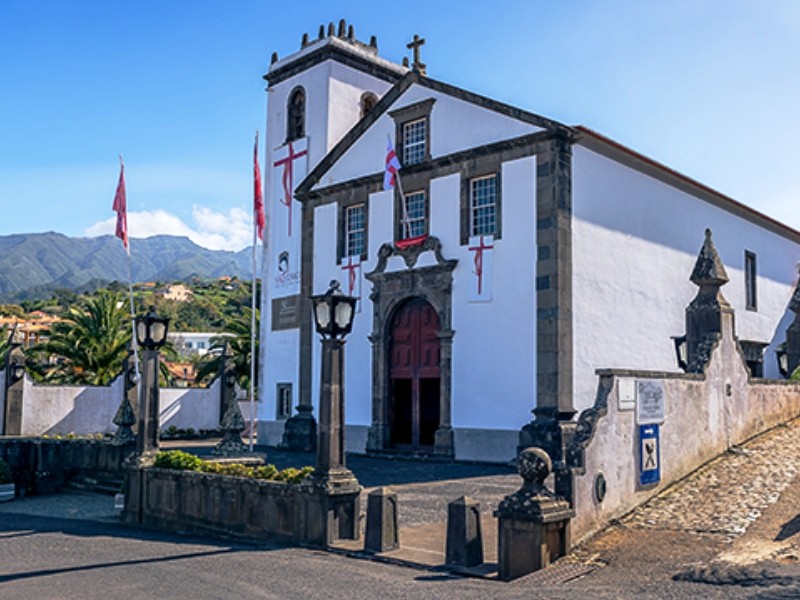
The Church of São Jorge is part of Madeira Island’s Baroque religious architecture, with some rocaille taste elements. Its construction dates back to the 18th century, and the church was completed in 1761, as attested by the inscription on the façade, and was blessed on September 17 by Bishop Gaspar Afonso da Costa Brandão.
Some Madeiran historiographers point to the year 1475 for the construction of the first Ermida de São Jorge, but it is only documented in 1509 when its antiquity is mentioned. It was built on the pebble by the sea and was destroyed by a fire in 1598, being rebuilt by the parishioners. In 1515, it received ornaments and implements, gifts from King Manuel I, “the Fortunate.”
A new church was built from the 16th to the 17th century. Still, its precarious condition led to Francisco de Carvalhal e Vasconcelos donating land on July 19, 1660, to build a new church on the Achada site, completed in 1677.
Throughout the 18th century, there were various reports about the state of the church. In 1706, the main altarpiece was damaged with cracks, and 1727 the dressing room was not finished. 1737, construction work began on what would become the fourth Church of São Jorge, “the big church,” In 1743, the chancel was already decent enough for divine worship. The petition of the vicar Francisco Marques de Mendonça, the great mentor of this construction, for the gilded altarpiece, paintings, and tiles dates back to 1746. The work involved João Martins de Abreu, master of the royal works, and the scribe of the treasury and accounts, Domingos Afonso Barroso. Between 1749 and 1756, orders were given for the high altar, with altarpiece, tribune, and painting, involving the master of the royal works, Domingos Rodrigues Martins (c.1710-1781 ), author of the “risco” (drawing/project – 1750); the carver Julião Francisco Ferreira, a native of São Miguel (Azores), who had lived in Madeira since at least 1730 and did the carving of the chancel and side altars; the gilder José António da Costa, a native of the Canaries, who set up home on the island precisely to do the painting and gilding in this church.

It should be noted that the original layout of this church was based on a project by Diogo Filipe Garcês, master of the royal works, a position he held in Funchal between 1727 and 1744.
The Church of São Jorge, with a longitudinal floor plan and a single nave, has a façade with a triangular pediment, topped by a cross, and an ashlar portal with an entire arch, a projecting cornice surmounted by volutes and Tuscan pilasters. On the outside, a stone pilaster with a scalloped shell and spirals refers to the reuse of constructive elements from an older building from the 16th and 17th centuries and the remains of tiles from a Lisbon workshop from the late 16th century (c.1580), which are in the bell tower, are, by their chronology, from the second temple of São Jorge. Inside the church, the arch of the baptistery dates from around 1660, having been placed here during the works of the 18th century. Other 17th-century objects come from the old chapel: a silver lamp with rods; several panels of patterned tiles from a Lisbon workshop; fragments of tombstones; images from national seminars, such as “Our Lady of the Incarnation,” with a silver crown, and “Saint Anthony,” made of upholstered and gilded wood, and a painting depicting the “Visitation,” possibly from a national workshop (?).

From the late 17th or early 18th century is the equestrian image of “São Jorge”, and from the 18th century are the images of “Bom Jesus”, “São Vicente Ferrer alado” and “São Sebastião”. The altarpiece carving, the tabernacle, and the Eucharistic throne stand out in the chancel. Together with the side altars and the pulpit, they form an artistic ensemble of great scenography, very much in the taste of the Joanine Baroque (2nd quarter of the 18th century to c.1740-1750), with rocaille incursions (c.1735-c.1765). The chancel also features paintings depicting “Biblical Episodes” and “Scenes from the Life of Saint George,” attributed to the Canarian painters and gilders José António da Costa and João António Villavicêncio, possibly in partnership with António Trindade da Cruz, a native of Setúbal, and the ceiling with its illusionistic effects, balconies, angels and allegorical figures, is by José António da Costa. A large canvas, “São Jorge e o dragão” (Saint George and the Dragon), is from a regional workshop, signed, it seems, by the Madeiran painter Filipe Caetano. There are two pieces of silver jewelry from the 18th century, a “seven-light” lamp and a cross.
The entire Church of São Jorge identifies the Joanine Baroque taste with the “horror vacui” (horror of emptiness), with a great sense of scenography, boasting a rich religious and artistic heritage, which completely fills the space with devotional images and paintings, and gilded woodwork, with the royal arms at the end of the triumphal arch. Madeira represents the typical “church lined with gold,” which is the expression of the American historian Robert Smith (1912-1975), a specialist in Portuguese art.
The church of São Jorge has been classified as a building of municipal interest since 1995.
Rita Rodrigues
Translated to English as a community outreach program from the Portuguese Beyond Borders Institute (PBBI) and the Modern and Classical Languages and Cultures Department (MCLL) as part of Bruma Publication and ADMA (Azores-Diaspora Media Alliance) at California State University, Fresno–PBBI thanks the sponsorship of the Luso-American Development Foundation from Lisbon, Portugal (FLAD)
 Filamentos (artes e letras)