
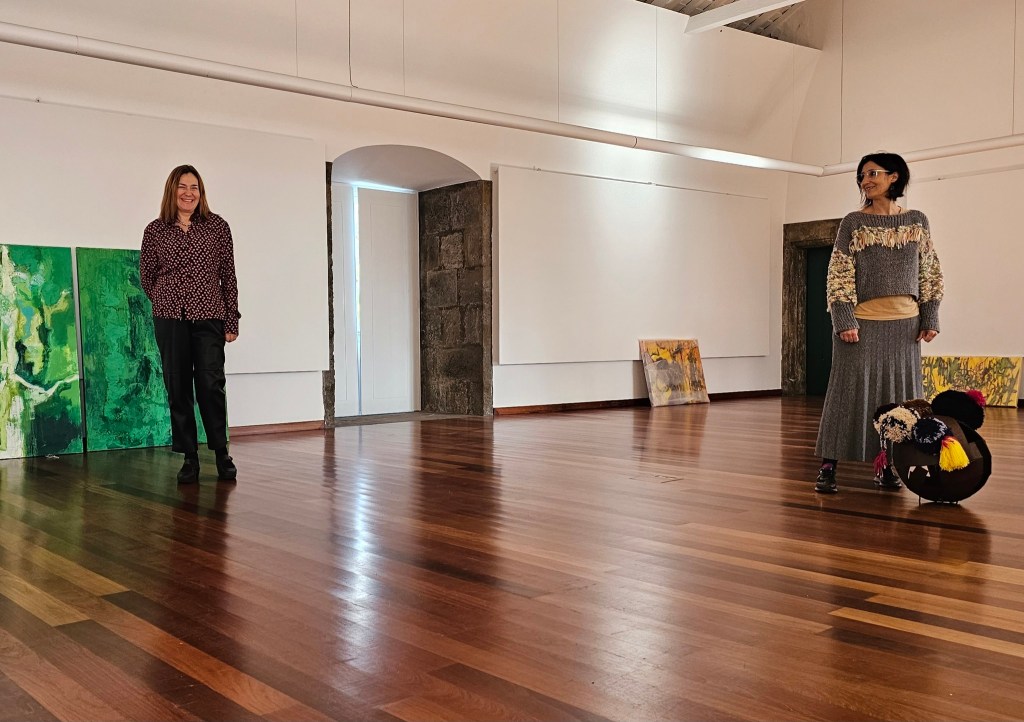
The exhibition “Mau Feitio” by artist Nina Medeiros opened yesterday and will be on display until May 17 at the Santo António Convent in Lagoa. In this exhibition, the artist from São Miguel presents 11 paintings inspired by the theme of nature. Sculptor Sofia de Medeiros, a guest artist, has four volumetric pieces made of iron and textiles. In this interview, the two artists talk about the theme and production of this exhibition and reflect on the artistic scene in the Azores, where they feel that support is one-sided and does not cover artists with established careers. In Nina Medeiros’ words, “art doesn’t start with the young from now on. There is a history of contemporary art in the Azores, and this new generation seems to want to forget it. I may be wrong with my ‘bad temper’, but that’s my perception.”
Correio dos Açores – What is the theme of the exhibition?
Nina Medeiros – The theme is nature, the essence of being, both animal and vegetable. Lately, I’ve been focusing a lot on the natural landscape, but from a more lyrical and poetic perspective, more intuitive and sensorial. The viewer immediately sees color and a movement that refers to nature, and, in a way, I challenged Sofia to find that representation.
The pieces refer to different natures in my time in the world or in this time. I love to travel, and, in this sense, “Mau Feitio” also refers to other landscapes and visions of nature. Some pieces are named after these places, such as Cairo and Viana, in Brazil.
It’s not a highly complex concept; it’s our time, mine and Sofia’s, in a space and, in my case, a specific place. Our works are different, but they complement each other plastically. There is a confrontation between sculpture and painting, but simultaneously, a plastic understanding exists.
Sofia de Medeiros – Unlike Nina’s pieces, which call for a specific time and place, mine call for timelessness. In this case, I’ve opted practically only for iron, but oxidized iron, which, in itself, has to do with the question of the ephemeral because one day it will return to nature. I like to take iron as it is, as matter. In one of the pieces, a textile note balances very well with Nina’s material.
Why did you choose the name “Mau Feitio”?
Nina – We were having coffee, and on one of the sugar packets was the phrase “Mau Feitio,” which, in a way, fits in with our restlessness: the artist always has a restlessness to produce and create, always associated with an inevitable evil deed. There’s also the relationship with the critic because there’s always a ‘we don’t like it,’ and our bad temper is to counter it!

What are the predominant techniques in this exhibition?
Nina – I returned to painting with acrylic and oil on canvas, watercolor, and oil on canvas. Sometimes, I wander into video and photography, but I decided to draw here. My work focuses on composition, in its most traditional sense, to challenge two-dimensionality. Here, I wanted to return to the essence of painting, but what is presented is entirely modern. In other words, it draws on the past, and there is a renewal through my composition and language.
Sofia – I also wanted to return to the raw and openly oxidized iron with a technique I hadn’t explored before subverting the material: the braids in the iron, in other words, turning the iron into a textile.
Collaborations between artists have been a constant in your presentations…
Nina – These collaborations arose from the need to present again. After the pandemic, we created ‘Relink’ and, as the name suggests, it means to reconnect. We had two exhibitions, one at the Teatro Micaelense and the other at the Angra do Heroísmo Museum, with two guests. In the first exhibition, we had a photographic and video repertoire by Milagres Paz and, in the second, a text by Leonor Sampaio da Silva that talked about the feminine and invited the viewer to react to our pieces.
At the moment, we’ve been collaborating on workshops with children and the elderly. We are teachers, and there is a certain complicity in our teaching style.

What is the perception of Azorean artists abroad?
Nina – In the case of the mainland, artists are always willing to come here. And from our side, there’s always a lot of acceptance of what comes from outside. But when we’re trying to mediate an Azorean exhibition abroad, there’s always the prejudice that the region’s art isn’t as developed. And that’s not true because Azoreans study at the same universities as other artists. That said, it’s easier to show in the United States or the diaspora than to break into the Lisbon scene.
I was invited to do a residency in Brazil, but it wasn’t through the recommendation of a local organization. The invitation came from outside because, with social media, artists have more visibility… I invest in my career, and I believe that Sofia also invests in hers, but we do it on an individual level. We are our own mediators and curators. In this sense, artists don’t always need a gallery owner and can be independent.
Sofia – We need more galleries, but having a commercial space is challenging because art is challenging to sell, especially in an ultra-peripheral environment.
How have your works been selling?
Nina – For a few years, it was tough, but lately, it’s been going very well. The buyers are primarily collectors from the mainland and abroad. We used to have a lot of Azorean collectors, but today, the locals invest less.
With the residencies and the focus on performance, people have gotten used to this new concept of art where everything is about that moment. On the one hand, it’s beneficial and essential, and this type of artist also needs support, but on the other hand, art has become very ephemeral.

What is your view of the artistic scene in São Miguel, particularly the policies that support culture?
Nina – I’m a little dissatisfied with the support for my generation. I don’t see art as exclusive to youth, middle age, or old age. It’s possible to create significant work at any of these stages. I’m not waiting for invitations because artists also have to manage their careers, but there is a lack of support in promoting and creating the means for things to happen.
Sofia – The start of a career is always significant, but the government can never neglect everything else. It’s not just at the beginning that artists need support.
“The history of contemporary art is being forgotten…”
Nina – At a time when practically only the work of Tomaz Borba Vieira existed, a very significant generation of artists emerged in the 1980s and 1990s because they were the ones who energized and disseminated contemporary art in the region. It would make sense to present a group show or something that evokes these artists who started the new era because they are entirely forgotten by Arquipélago – Centro de Artes Contemporâneas and other entities in the field.
Sofia – We’re talking about public services. Private entities can choose this approach, but as the only contemporary art center in the region, it must cover the entire art scene. Whoever is in charge of these institutions has to have that concern and vision because there is a history.
Nina – You’re trying to advocate that the paradigm starts here, that there’s an awakening to contemporary art, but that’s not the case! There is a history, and artists like Tomás Borba Vieira and José Nuno da Câmara Pereira are excellent references of Azorean art that are being completely forgotten. Art doesn’t start with the young from now on, but it seems this generation wants to forget contemporary art history in the Azores. I may be wrong with my “bad temper”, but that’s my perception.
The artist must also reflect and expose what happens. But I confess that this is not a concern that leads me to stop producing. I insist on presenting what I do, and I’m not limited or waiting for invitations.
What projects do you have coming up?
Sofia – We have a project ‘Sem Espartilho’, a partnership with the Museu Nacional do Traje, in Lisbon. The focus will be on sculpture, but there will also be a combination of video and a series of talks. We can’t say too much, but if we lift the veil a little, there’s a synergy in the feminine.
Daniela Canha is a journalist for Correio dos Açores-Natlaino Viveiros, director
Translated to English as a community outreach program from the Portuguese Beyond Borders Institute (PBBI) and the Modern and Classical Languages and Cultures Department (MCLL) as part of Bruma Publication and ADMA (Azores-Diaspora Media Alliance) at California State University, Fresno–PBBI thanks the sponsorship of the Luso-American Development Foundation from Lisbon, Portugal (FLAD)

 Filamentos (artes e letras)