

Exactly 46 years ago, on February 20, 1978, Vitorino Nemésio, one of the greatest names in 20th-century Portuguese literature, died. Nemésio was a poet, novelist, fiction writer, chronicler, essayist, biographer, historian of literature and culture, journalist, researcher, epistolary writer, philologist, and television communicator, as well as teaching at the Faculty of Letters of the University of Lisbon.
Nemésio was born on December 19, 1901 in Praia da Vitória, the son of Vitorino Gomes da Silva and Maria da Glória Mendes Pinheiro. At Angra High School, Professor Manuel António Ferreira Deusdado (author of the Revista de Educação e Ensino) introduced him to the world of Letters. In 1916, he published his first book of poetry, Canto Matinal. He had some difficulties with teaching and moved to Horta, Faial, where he finished the General High School Course on July 16, 1918. In this city, he came into contact with the great maritime flux and nightlife resulting from the approaching end of the First World War and the constant presence of foreigners due to this port being a place for refueling fleets and resting for sailors.
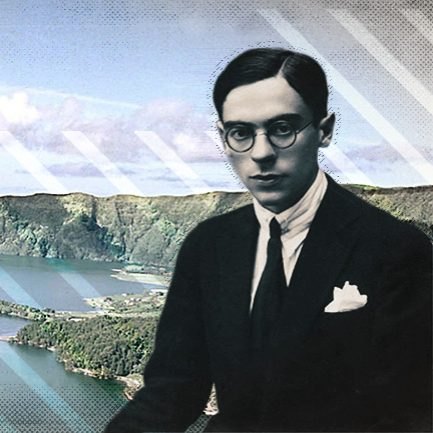
In 1919, Nemésio began his military service as an infantry volunteer, making his first trip outside the Azores. Two years later, he entered the Faculty of Law at the University of Coimbra. He switched to the Historical-Philosophical Sciences course at the Faculty of Letters in Coimbra three years later. In 1925, he enrolled in the Romance Philology course at the Faculty of Letters. During this period, he met the Spanish republican writer Miguel Unamuno, with whom he corresponded until his death in 1936. In 1926, he co-founded and directed the academic republican newspaper Gente Nova, a clear consequence of his contact with Spanish republicanism.
On February 12, 1926, Nemésio married Gabriela Monjardino de Azevedo Gomes in Coimbra, with whom he had four children in the space of five years: Georgina, Jorge, Manuel, and Ana Paula. In the meantime, he moved to the Faculty of Letters at the University of Lisbon, where he completed his degree in 1931 with excellent grades. He began teaching at the same Faculty, teaching Italian Literature and, later, Spanish Literature. In 1934, Nemésio received his doctorate in Literature from the University of Lisbon with his thesis, A Mocidade de Herculano até à Volta do Exílio. He was then invited by the Vrije Universiteit Brussel to teach in Belgium, where he stayed from 1937 to 1939, before the outbreak of World War II.

His status as a native of Terceira, the Azores, and an islander would be strongly present in his work. Regarding fiction, the author from Terceira began his career by publishing the volume of short stories Paço do Milhafre in 1924, later renamed Mistério do Paço do Milhafre in 1949. His writing was marked by the description of places and the drawing of characters, giving a very real side to the characters. His work, with titles such as Corsário das Ilhas, Festa Redonda, and Varanda de Pilatos, among many others, became well-known and recognized.
The pinnacle of Nemésio’s novel was reached in 1944 with the publication of one of the masterpieces of 20th-century Portuguese Literature, which I highly recommend, Mau Temo no Canal (Stormy Isles-An Azorean Tale), whose action takes place on the 4 main islands of the central group of the Azorean archipelago: Pico, Faial, São Jorge and Terceira, between 1917 and 1919 (these years represent the period when Nemésio was in Faial and in contact with various cultures and personalities)
Nemésio highlighted the Azoreanness that represented him and his culture in his writing. The first time Vitorino Nemésio used the word was when he spoke of his Azoreanness, homesickness, and soul as an Azorean far from home on the mainland. In Coimbra, on July 19, 1932, at the commemoration of the 500th anniversary of the discovery of the Azores (at the time, it was believed that the Azores had been discovered in 1432 and not, as is now believed, in 1427), the author from Terceira defined what Azoreanity was: “Geography is worth as much to us as history, and it is not for nothing that our written memories include some fifty percent accounts of earthquakes and floods. Like the sand, we have a dual nature: we are made of flesh and stone. Our bones sink into the sea.”

Returning to Nemésio’s life, in 1958, he taught in Brazil. Two years later, on July 19, 1961, he was made a Grand Officer of the Order of Prince Henry the Navigator and, six years later, on April 17, 1967, a Grand Officer of the Military Order of Sant’Iago da Espada (posthumously, on August 30, 1978, he was honored with the Grand Cross of the Military Order of Sant’Iago da Espada). He was awarded the National Literature Prize in 1965 and the Montaigne Prize in 1974. When he reached the legal age limit for public office on September 12, 1971, he gave his last lecture at the Faculty of Letters of the University of Lisbon.

Nemésio was the author and presenter of the television program Se bem me lembro, between 1970 and 1975, where he gave lectures, showing his unique ability as a communicator. Nemésio also wrote biographies and collaborated with various magazines and newspapers. After becoming a retired professor, he became the director of the newspaper O Dia between December 11, 1975 and October 25, 1976.
Vitorino Nemésio died on February 20, 1978, in Lisbon, at the CUF Hospital. As his last wish, he asked that the bells ring the Alleluia instead of the dobre a finados. He lies in the Santo António dos Olivais cemetery in Coimbra.

Nemésio’s work had been out of print for a long time. Hence, an edition of the writer’s complete works from Terceira began to be published this fall in 17 volumes, in an initiative by the publisher Companhia das Ilhas in partnership with the Imprensa Nacional-Casa da Moeda. The first volume was presented by Professor Luiz Fagundes Duarte at the 2018 edition of Outono Vivo in Praia da Vitória and covers the poetry Nemésio published between 1916 and 1940.
Nemésio always loved and “sang” his Praia da Vitória like no one else. An Azorean writer, Nemésio left a vast body of work worth reading by the younger generations. We must try to publicize the work of this great 20th-century Portuguese and encourage people to read his works. Like Nemésio, we must never lose our love for our land and the defense of local interests because our roots, the social environment in which we grew up and live, will forever mark our view of the world. Azoreanity is something that is very well impregnated in our souls as islanders.

Francisco Miguel Nogueira is a Historian who writes for several publications, including Jornal da Praia, where this piece was published. He will be giving two lectures per year for PBBI-Fresno State.
Francisco Cota Fagundes, Professor Emeritus from UM Amherst, translated the masterpiece Mau Tempo no Canal into English. There are several editions, the latest from Tagus Press from UM Dartmouth and the other from Letras Lavadas in the Azores.

https://www.letraslavadas.pt/stormy-isles-an-azorean-tale
 Filamentos (artes e letras)