

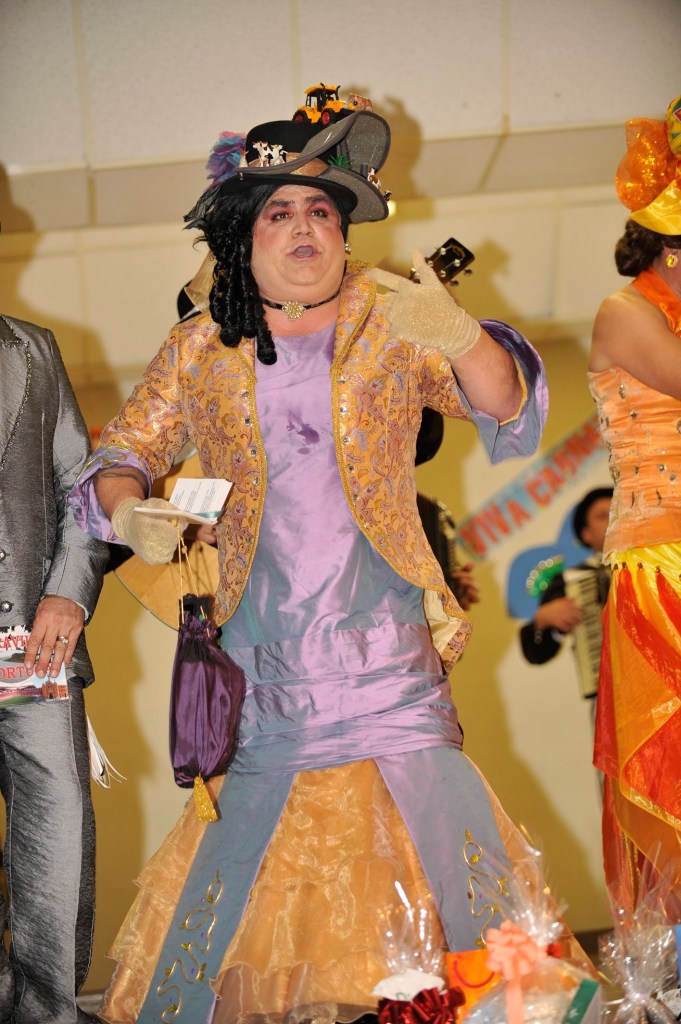
Carnaval Terceira Style in the Azores is a unique cultural phenomenon in which the entire island is involved in one way or another. Many have been true stars of these popular theatrical representations throughout the ages. One such person is João Mendonça. A key actor and writer of scripts for Carnaval, João Mendonça is an icon in Terceira and through the Azorean Diaspora in the US and Canada. We happily feature his interview with the Diário Insular Newspaper for our English language readers interested in learning about the culture of the Azores. As you will see, the interview reflects on the tradition of Carnaval, the newer Carnaval done by senior citizens, and the dilemmas with halls and social clubs, a dilemma common to all islands in the Azores and our diaspora.
This year, for the first time, you’re taking part in the Senior Carnaval, which is already touring the island’s halls at weekends. What was the experience like?
I’ve been taking part in Carnival for 53 years. There have been senior citizens’ Carnaval presentations since 2010, but I have never participated. A friend invited me, and I participated in a senior citizens’ group for the first time. It’s been a fantastic experience. I’m having a new experience, and I didn’t expect it to be so enjoyable. I’m taking part with 81-year-olds and acting opposite someone who is 76. It’s fantastic. You can see from the older people that there’s an immense love for our culture. There’s no time, there’s no tiredness, there’s enormous respect for commitment. The majority always agree there’s no discussion, everything is well organized, you arrive on time for rehearsals, and you leave early. Of course, small details, such as forgetfulness, come with age. Today, they do the passage; tomorrow, they don’t remember it; they memorize a phrase, and the next day, they don’t. There are flaws in the performances, but we managed to fill them. I have much experience; I can pick up the pieces left on stage. There’s a different audience. The experience is also a little different from normal Carnaval. For me, it’s been a reunion with the whole island. At the senior citizens’ balls, we go all over the island to places I haven’t been for many years. It’s great to see old friends again, people I haven’t seen for many years. It’s been a fantastic experience.
Is the Senior Carnival evolving more and more?
The initial idea was to tour daycare centers, older people’s homes, and holy houses of mercy. Today, it’s performed in every hall on the island. In a way, the Senior Carnival has become more professional. It goes all over the island. In three weekends, we managed to book around 36, 37, and 38 dances. You don’t wait; you arrive and dance. Our seniors don’t bend. We finish at midnight, and they will continue if there are two or three more performances to do. It’s a fantastic therapy for older people to practice physical and mental gymnastics. It’s essential for the mental health of older adults. That participation is amazing. They don’t stop; it’s very healthy. It’s great for them to leave the house and participate. They look forward to it every year. At our Cabo da Praia group, the age group is over 60. I’m participating as a guest, but it’s been a great experience.

There are many people at these balls who have never taken part in Terceira Carnival before. Is it ever too late to learn?
Most of them are people who have never been to Carnaval, but who know all the secrets of Carnival: the rhythm, the footwork, how to enter, how to beat, the music is in the ear. It’s at the heart of the Terceira person to take part for the first time as if they’d been there for 20 years. It’s never too late to survive the daily monotony. They’ve thrown themselves into it and ended up benefiting from it. It’s fantastic therapy. It’s two months of rehearsals, and it’s very healthy for them.
Is there an audience for the Senior Carnaval?
There was an audience. It’s less public but a very interesting, receptive, and applauding public. Applause is a prize that older adults receive with great affection.
Are you going to stick to the Senior Carnaval this year? Are you going to take a break from Carnival days?
As the Carnival was very short, our group, which has been alive for many years, had to stop this year because time was short to do quality work. We thought it would be better to rest, and next year, as Carnival is coming up on March 1, 2, 3, and 4, we’ll be back in full force.

Did you write any assuntos (scripts)?
I wrote five. I had seven on the grid to write, but a sword dance was postponed until Easter in Canada, and my little dance isn’t coming off. They went to this Senior Carnaval, to the United States and Canada. I’ve had to say no to several groups because I’m a different age and need a break.
What do you expect from this Carnaval in Terceira Island?
It’s coming back in force. We will have over 53 dances and a few very traditional –danças de espada. I think there are three of them this year. One is coming from Canada, and we have two from Terceira. And we have lots of dances, of course. We have a complete Carnaval, and it’s terrific; it’s a sign that the tradition isn’t going to die yet.
There are, again, community halls without directors in various townships on the eve of Carnaval. How do you view this problem? Could Carnaval be at risk?
I don’t see it. There will always be open halls, and the terreiros (outside areas) may open again one day. Of course, the problem of the community halls is repeated every year. For me, the decrease in population has been one of the biggest problems. Most people have been through as directors two, three, or four times. After a certain age, people prefer not to go because they don’t have the physical strength to stay there for a year. Our culture and government could contribute to reducing this situation by creating better conditions for our institutions and sports clubs to continue and for people to accept the commitment better. Culture is the department with the most significant obligation to help our institutions. People face big expenses and don’t want to worry. A community hall’s tax commitments and monthly expenses (electricity, water, garbage collection, IMI) could be supported, if not in total, but with 5 or 10% discounts. Board members who miss a year could also receive municipal benefits and discounts of 5 or 10%. It could help and encourage people to look for institutions. Well thought out and well considered, if you create the conditions for these institutions to have fewer monthly expenses, it may be that this problem won’t get worse any time soon because it really will be a significant loss for our philharmonics. If there is no support, I think the situation will repeat itself. The parishes are getting smaller, and the difficulties are enormous. Younger people are also more comfortable. It’s a slightly different generation; they don’t want to be stuck there for a year. That was something of a bygone or older generation.

In Portuguese, journalist Carina Barcelos conducted this interview for the Diário Insular newspaper, José Lourenço, director.
Translated to English as a community outreach program from the Portuguese Beyond Borders Institute (PBBI) and the Modern and Classical Languages and Cultures Department (MCLL) as part of Bruma Publication and ADMA (Azores-Diaspora Media Alliance) at California State University, Fresno–PBBI thanks the sponsorship of the Luso-American Development Foundation from Lisbon, Portugal (FLAD)

Picture from Diário Insular, the amazing photographer and friend Fernando Pavão and João Mendonás, Facebook page.
 Filamentos (artes e letras)