
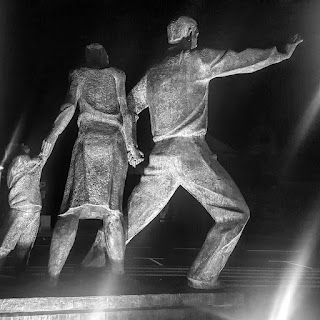
An island region of small territorial size, discontinuous, distant from the continents, with fragile terrestrial and marine ecosystems, subject to the tectonic and volcanic fury and weather events that buffet the land and its people with more or less violence every year, isolation, even though in the Atlantic basin it served as a platform for the transit of people and goods from the West and East Indies, from Africa, to the north and south of the Sahara, which allowed contact with other cultures and opened up the ways of the sea to the martyred people of these islands. Many left compulsorily, and many others of their own free will. However, the genesis of Azorean migration has common denominators: serving the kingdom and the search for conditions of economic fulfillment that their birthplace denied them (and denies them) due to an unjust distribution of wealth resulting from the accumulation of capital by the lords of the land, by servile work, which is maintained both by precariousness and by the social and wage devaluation of work.
On a stroll through our cities and towns, this evidence can be seen in every old convent, church, palace, and palatial house, contrasting with the architecture of the urban and rural outskirts where the rural wage-earners, fishermen, and, later, a lesser extent, industrial workers lived.
History is what it is. It cannot be changed, but it must be known and comprehended, so we can understand who we are and how we got here.
The purpose of this initial approach is simply to introduce a few aspects, all known and duly studied, that have contributed to the construction of a unique culture, neither better nor worse than others, but different and, for this reason, like others, worthy of preservation, not in the conservative and museological sense, but in the appreciation of its distinctive features.

Photo of the dish alcatra, from Terceira Island-by Anibal Pires
I’ve already mentioned settlement, the concentration of wealth, emigration, geography, isolation, island and archipelagic status, and, without wishing to be exhaustive, I would add religiosity. Not the utilitarian devotion of economic power to exercise dominion over the people, which, although it is decisive in the formation of the Azorean being, is not, in this case, the one that interests me, as will be seen later, but the popular religiosity that has remained free from power, that is, the cult of the Divine Holy Spirit, which is the pillar, I won’t say the only one, but the main support of Azoreanity, or if we prefer, of regional identity, if, in fact, this identity construction is consolidated. Sometimes, I doubt this is the case, and I’m not the only one with them.
The nine islands of the Azorean archipelago, although culturally they have some similarities, have some differences that make them particular and that the autonomous power has never wanted or known how to enhance.
The concept of harmonious development, now called cohesion policy, is not, and should not be, egalitarian, not least because the needs of each of the islands and municipalities are different, but also because their productive and economic potential has particularities that are not compatible with replicating the same type of public investment.

Photo of the Regional Assembly of the Azores–Anibal Pires
Dear reader, we agree that one of the goals of autonomy, and perhaps the main pillar supporting the idea of self-government in the Azores, is a long way from being achieved. I would even go so far as to say that accentuating asymmetries in development, income, and well-being between municipalities and the different islands is the greatest failure of regional autonomy. In other words, the different legislative and executive powers that have led the destiny of the region for almost 48 years, after the period of much-needed infrastructure, have limited themselves to reproducing identical models of development and investment on islands as different as, for example, Santa Maria or Terceira, and in municipalities as different as Angra do Heroísmo or Vila Franca do Campo.
After all the years of building port and airport infrastructures, setting up public health and education services that are essential to all the islands, with physical structures and human resources tailored to the needs of that specific territory, it would have been important for public policies to have been designed to boost the productive capacities of each of them and to find bridges of complementarity and cooperation between the different territorial portions of the archipelago, thus giving it a regional stamp without devaluing each of the islands.
Except for the 1996/2000 parliamentary term, the government and the legislature have repeated works year after year, some of them necessary, others not, which have not helped to create the social, cultural, and economic dynamics of development that would prevent the trend towards desertification that has begun to take hold on the smaller islands, but also in some of the municipalities of Pico, S. Miguel, and Terceira. And suppose centralism, which is more Brussels than Lisbon, can be blamed for some of this. In that case, the autonomous government, for not using all of its powers and for satisfying electoral clientelism, should be blamed for the poor results indicated by the social and economic indicators. As much as institutional propaganda tries to deny it, we are still one of the poorest regions in the country and in the European Union.
This is nothing new, and it happens all the time. As I write, my pen tends to wander and stray from its original purpose, which is now quite simple and concrete. My intention may not be as important to readers as I would like. Still, I think it would be good to share my concern, which is related to one of the symbols of the cult of the Divine Holy Spirit and with which all Azoreans and their diasporic communities identify.
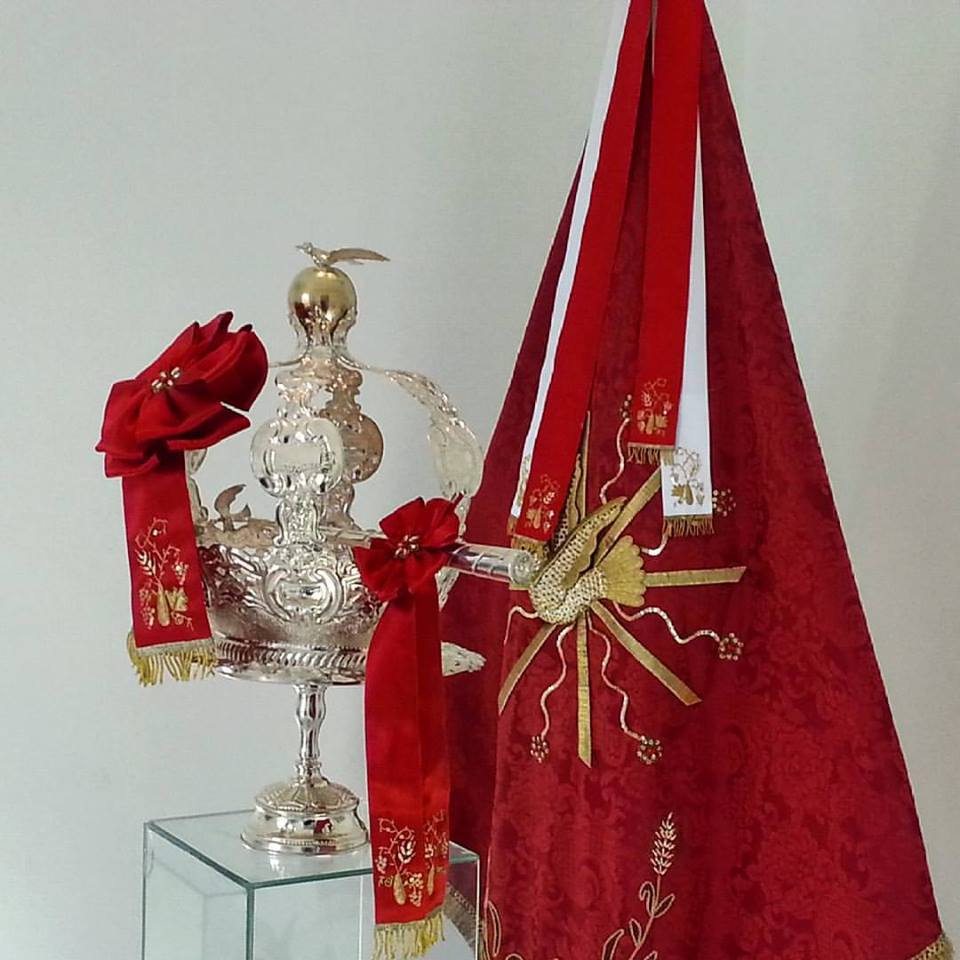
Symbols of the Holy Spirit Festas in the Azores (crown and flag) -Anibal Pires
In December, as has become customary, an exhibition of regional handicrafts is held in Ponta Delgada. I usually visit the fair to see old friends who shape and build more traditional or modern pieces and learn more about this sector of activity, which has been growing and asserting itself on all the Azorean islands. Each island has its identity mark in handicrafts, but some symbols don’t belong to one island; they belong to the Azores and the Azoreans: the Flag of the Divine Holy Spirit, the Crown, and the Sceptre. These are the most important signs in the iconography of the Holy Spirit festivities.
The miniature flags of the Holy Spirit were naturally present at the craft fair. A good friend drew my attention to the top of the flag, and, to my amazement, I didn’t see the crown topped by the dove that represents the Holy Spirit but a crown of Our Lady of Fatima. I have nothing against the crown, but I don’t think this substitution values the work of the artisans. On the other hand, it is a choice that distorts one of the icons of the cult of the Divine Holy Spirit. Perhaps it’s unimportant, or there are even plausible justifications for using a crown topped by a cross rather than the dove that has always represented the Holy Spirit. But I didn’t like it and felt that this icon was being misrepresented, just as other products sold to locals and outsiders as being produced entirely in the Azores are being misrepresented, knowing that this is not the case.
While the apparent subversion of a symbol may not be a bad thing, it is nonetheless worrying and should not happen; the same is not true of the marketing of products certified by the “Azores Brand,” which are not always genuinely and entirely produced in the Azores. Sooner or later, “consumers” in the regional and international markets will realize that they are being deceived and will certainly not like it, which means they will stop consuming. It is therefore advisable that the certification of products with the “Azores Brand” is done rigorously and does not constitute misleading advertising.
Anibal C. Pires, poet, writer, humanist, political and cultural activist

Podem ler o magnífico texto de Aníbal C. Pires em português no seu blogue
https://anibalpires.blogspot.com/
Translated to English as a community outreach program from the Portuguese Beyond Borders Institute (PBBI) and the Modern and Classical Languages and Cultures Department (MCLL) as part of Bruma Publication and ADMA (Azores-Diaspora Media Alliance) at California State University, Fresno–PBBI thanks the sponsorship of the Luso-American Development Foundation from Lisbon, Portugal (FLAD)
 Filamentos (artes e letras)