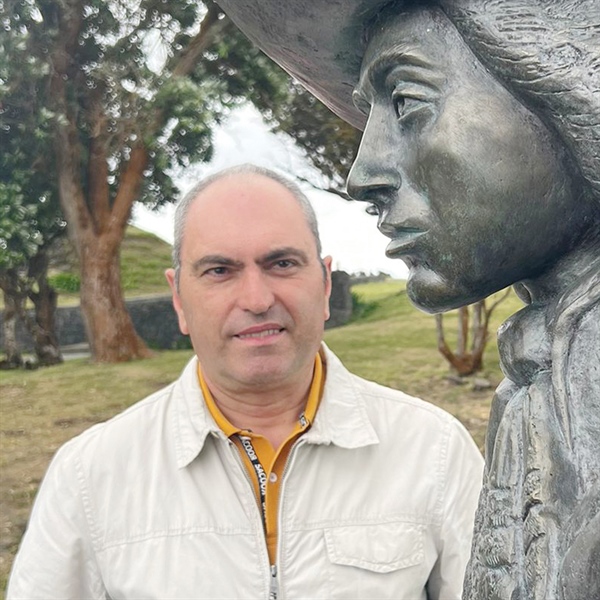
We at Filamentos (arts and letters in the Azorean Diaspora) proudly feature this wonderful interview by the journalist Mariana Rovoredo from Correio dos Açores with the amazing sculptor Rui Goulart.
Correio dos Açores- You’ve had a career of almost 32 years as a sculptor. Do you remember how your taste for this art came about?
Rui Goulart (Plastic artist and graphic designer) – I’ve had my CAE as a sculptor since 1992, and I started believing in my abilities in the arts from a very young age. The taste for plastic expressions came naturally because, for me, it was just a child’s play and leisure activity. So, without being aware of it, it was still in my childhood that I began to take an interest in art.
Do you remember the first work you did?
At a very early stage, I started with ink drawings. Then, around 14, I had my first sculpture experience in cedar wood. I made sculptural works using this material, including small figurative models and bas-reliefs. At that time, I also experimented with basalt and plaster. My first approach to clay was in 1993/94 when I attended the Sculpture Workshop at the Ponta Delgada Academy of Arts.
You have a vast portfolio of Public Art and works of homage. You have been commissioned and have created medals, monuments, statues, and busts. Which personalities have you sculpted?
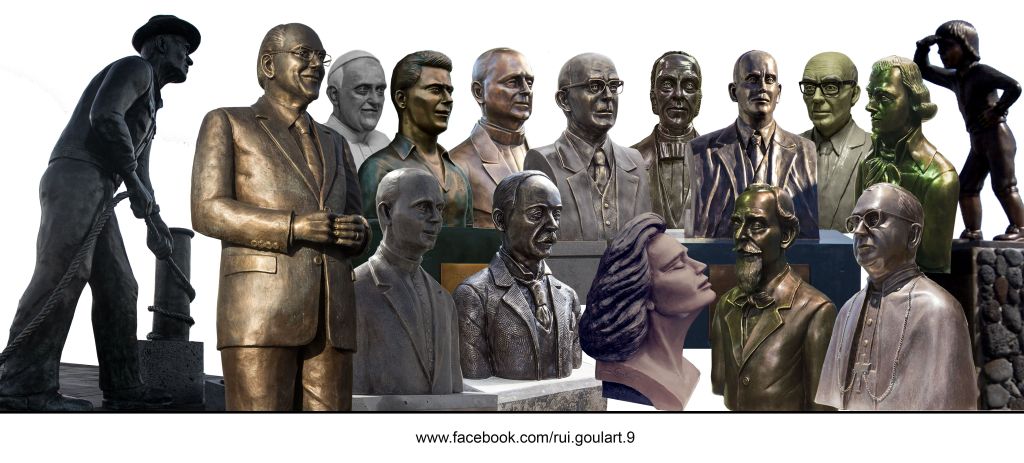
Public Art is where I have done the most work so far. I’ve been allowed to portray personalities from various sectors, from figures linked to the Church, Culture, Diplomacy, and Science, among others. In particular, entities linked to the Church, examples being Archimínio, Bishop Emeritus of Macau, Monsignor Júlio da Rosa, Monsignor José Soares Nunes, Monsignor Manuel Vieira Alvernaz, Father João Paulo Ferreira de Viveiros, Father Manuel Teófilo de Sousa, and Pope Francis.
In the field of diplomacy, I would highlight the three busts located in the garden of the official residence of the Legislative Assembly of Horta (The Cedars House) of consuls John Bass Dabney, Charles William Dabney, and Samuel Wyllys Dabney.
In the area of culture and sport, I can mention Manuel Augusto De Amaral, Vitorino Nemésio, José Saramago, Amália Rodrigues, and Joaquim Teixeira (known as Semilhas).
In the field of science, some examples are Dr. Luís Carlos Decq Motta and Engineer Frederico de Menezes Avelino Machado.
It was also possible to have the privilege of portraying some historical figures, such as King Afonso VI and Peter Francisco, Mr. Baptista Sequeira Vieira, Mr. Manuel Eduardo Vieira, Mr. Gilberto da Silva Mariano, Mr. Carlos Manuel Herz Bentes de Oliveira and Mr. Francisco de Medeiros Garoupa were also honored with busts or statues for being or having been personalities who were considered relevant and worthy of being recorded for posterity.
What were your biggest works?
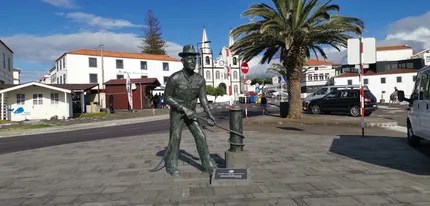
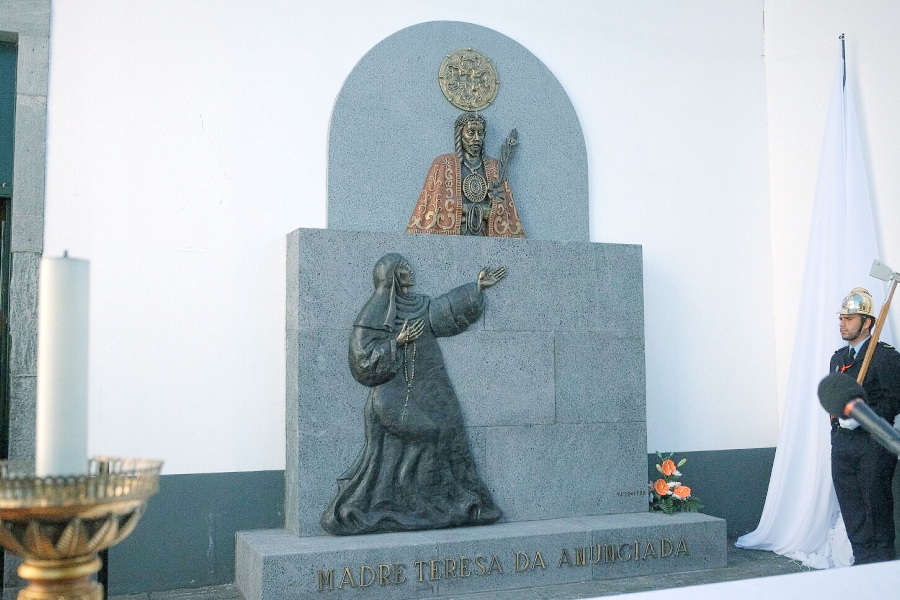
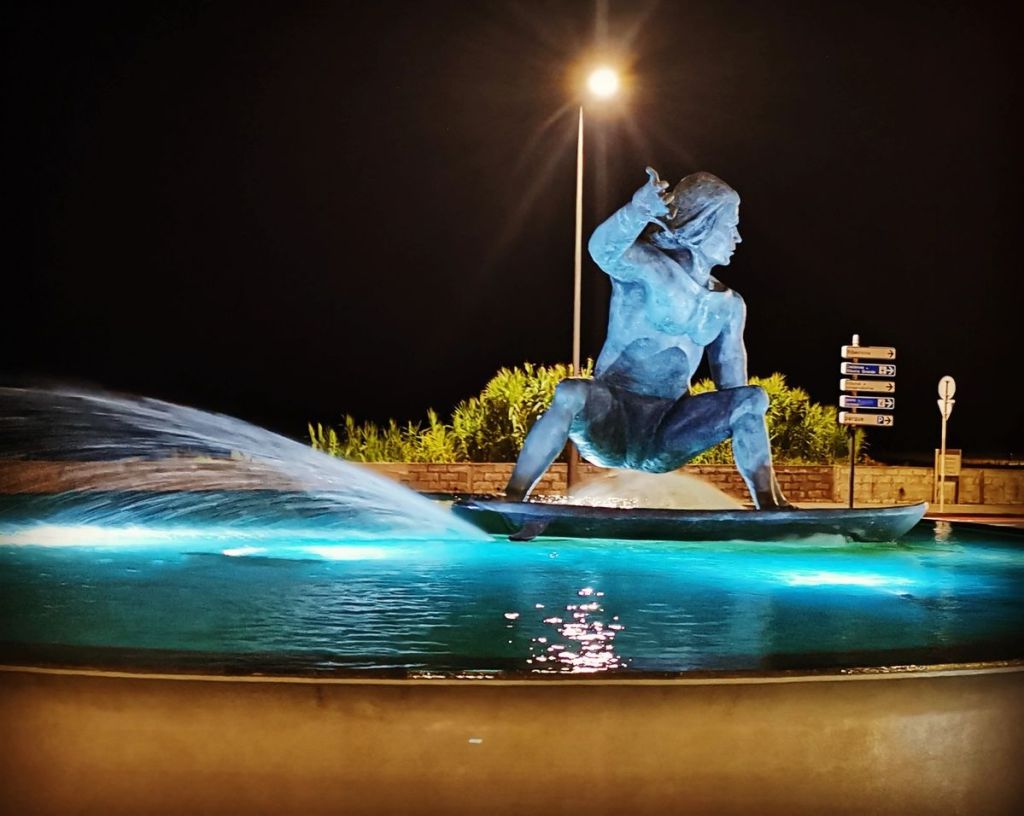
The Monument to the Surfer, located in Ribeira Grande, on the island of São Miguel, is the largest work I’ve done, as the human figure alone is over 4.5m tall, not counting the other elements. The work required the most logistics, from the full-scale clay phase to the molds and plastering in my studio in São Miguel, to the casting in Gaia, to its return transport in a particular container and its final placement, which involved a large crane. I can also highlight other works that stand out, both in terms of size and dissemination: the statues of Afonso VI (in Angra de Heroísmo) and of Commander Manuel Eduardo Vieira (in Lajes do Pico), as well as the monuments to Mr. Gilberto Mariano in the port of Madalena do Pico and to Mother Teresa D’Anunciada and Senhor Santo Cristo dos Milagres, which are in the parish of Ribeira Seca, in Ribeira Grande.
Your pieces have already reached other countries, namely the USA and Canada…?
I am emotionally connected to these countries because, here in the archipelago, we all have family members who emigrated from the Azores. What I’ve done most for the diaspora communities has been in the area of painting (oil), and there was a phase when I did a lot of portraits using the charcoal technique. In the meantime, I’ve also done some metalwork. In bronze sculpture, I’ve depicted some emigrants who stood out in the communities that welcomed them, whose names can be seen in my Portfolio list.
In this Diaspora market, and considering the contacts and requests for quotes I have received, I hope other works can be completed soon.
What works of yours can we find here in São Miguel?
In the field of sculpture, I have busts of the poet Manuel Augusto Amaral in Água de Pau, Francisco de Medeiros Garoupa in Água d’Alto, and Father João Medeiros in Santa Bárbara in Ribeira Grande. More recently, I made the memorial to Mother Teresa with the Santo Cristo dos Milagres in Ribeira Seca, Ribeira Grande, where I already had a bas-relief with this theme / Santo Cristo Registration in Bronze, since 2015, in the church of the same parish. Finally, my best-known work in São Miguel is the Monument to the Surfer in Ribeira Grande.
Are you currently working on any pieces?
At the moment, I’m finishing a portrait (bust), which is already at the plaster stage before being cast in bronze. I’m not going to reveal the person’s identity, but I can tell you that he’s an illustrious Azorean who is well-known to everyone.
In 2023, the opportunity arose to carry out some projects with different themes currently in the model phase (three monuments and a statue). Unfortunately, we’re going through some “turbulence” and political instability; we’ve had a pandemic and the financial crises also associated with the conflicts/wars, all of which have brought an increase in production costs, which have been reflected in the difficulty of securing funding for these larger projects, which for the time being are the intentions of some entities.
However, I still believe that I will be able to complete some of these projects by 2024.
What projects have challenged you the most?
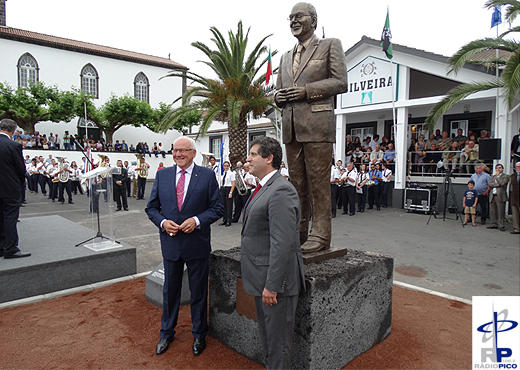
Technically and logistically, it was the Surfer’s Monument, but I’ve had other challenges that I consider equally risky, namely the portraits and tributes in life. One of them was the statue of Commander Manuel Eduardo Vieira, a work 2.4 meters high. I created this work by studying some photographic material and watching two short videos in which he had been interviewed. I met him in person moments before the unveiling of his own statue, which was indescribable in terms of his reaction and that of all the people present, of whom there were a considerable number.
The memorial to Mother Teresa of the Annunciation was also a work of great responsibility, mainly due to the need to represent the Lord Holy Christ in bas-relief, in which I tried to make an interpretation imbued with appropriate expression and feeling.
What is your assessment of these three decades of artistic production?
Manifestly positive, especially in the last decade, from the moment I had to choose to dedicate myself solely to projects for bronze castings. Not least because it’s challenging to find opportunities in this area.
I’m very proud of my three dozen works in public spaces in the Azores. Without wishing to belittle any work or highlight others, there are always those who stand out for some particularity. One of them is the statue of King Afonso VI, a work 1.90 m high, placed on Monte Brasil overlooking the beautiful UNESCO World Heritage city. It’s one of my most published works on social media and the most viewed on Google MAPS, with thousands of views.
But human beings are unsatisfied by nature. I intend to leave my sculptural ‘footprint’ on all the islands of the archipelago that saw me born. I still have to reach the islands of Santa Maria, Graciosa, Flores, and Corvo. Also, in the public domain, I haven’t been able to be represented in the largest city in the Azores. But “the path is made by walking.”
Alongside sculpture, you also work as a graphic designer. Is it easy to reconcile these two activities?
Graphic design is an activity that I love, and I work exclusively on a freelance basis. Therefore, I can reconcile creativity with various technical processes, from offset, image, and video editing to content production with web-based editors for asynchronous training, stability, and pleasure. This allows me to see sculpture as a passion and only take on projects that I identify with or fit in with my availability without compromising my personal and family quality of life or professional commitments.
How do you remember the Christmases of your childhood and youth in Pico? Were there any traditions of your own?
The Christmases of my childhood and youth ‘smell’ of family, pine trees, socializing with close friends, and, on the first day of the year, the philharmonic march, of which I was a member, through the streets of Madalena.
Today, the family has expanded, but the traditions of socializing are still divided between São Miguel and Pico.
Mariana Rovoredo, a journalist for Correio dos Açores; Natalino Viveiros, director
Translated to English as a community outreach program from the Portuguese Beyond Borders Institute (PBBI) and the Modern and Classical Languages and Cultures Department (MCLL) as part of Bruma Publication and ADMA (Azores-Diaspora Media Alliance) at California State University, Fresno–PBBI thanks the sponsorship of the Luso-American Development Foundation from Lisbon, Portugal (FLAD)
 Filamentos (artes e letras)