
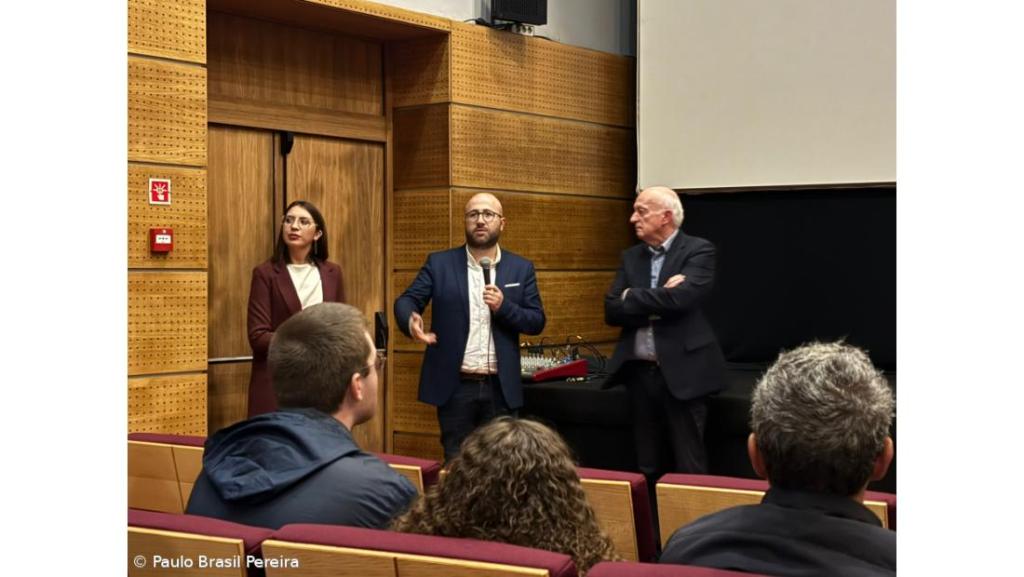
“The pyramids of Egypt, the Vatican… we’re on the same shelf,” says Francisco Maduro-Dias in “Angra do Mundo, the classification process.” Since December 7, 1983. Forty years ago.
Álamo Meneses, Álvaro Monjardino, Assunção Melo, Cláudia Cardoso, Joel Neto, Jorge Forjaz, Jorge Paulus Bruno, José Guilherme Reis Leite, Francisco Maduro-Dias and Mikhaël De Thyse are the participants in this documentary produced by Media 9 and sponsored by the Angra do Heroísmo City Council.
“I’m from the post-quake generation. For me and Eduarda Mendes, who collaborated with me on this project, Angra do Heroísmo winning the UNESCO award was always a given, but it was always associated with the idea that it was because of the earthquake and reconstruction that the city had earned this distinction. This was a somewhat erroneous idea, which we discovered when we made this documentary. Angra do Heroísmo is not a World Heritage Site because of the earthquake, but because of its crucial importance in the Portuguese discoveries and the way it grew as a result of this epic period in global history. Probably without Angra, with its port and bay, the Portuguese discoveries would not have had the structural form they did. If I could go back in time, I would probably choose that time in history to live and witness the achievements and dynamics of Angra with all its Atlantic globality,” said the Azorean director.

Regarding the choice of actors in the documentary, Paulo Pereira, a 36-year-old director from the island of Terceira, said: “The presence of the ‘fathers’ of the classification, the elite group that made up the whole process and who, practically alone, put Angra on the UNESCO map, was unquestionable. They were in political positions at the time and favored preserving heritage. They combined this preservation with the city’s historical grandeur to bring the idea of classifying the central area of Angra do Heroísmo to a successful conclusion. For all this and much more, collecting the testimonies of those who classified the city was imperative. It was an opportunity that could not be put aside: these are men with immeasurable weight whose speeches must be recorded today so they are not lost. There are current personalities that we can’t wait for to become memories, and only then think about what should have been collected; there are testimonies that can and should be recorded for future thinking,” he adds.
But this work isn’t just about stories from the past: “We wanted to bring together elements of Angrense’s current critical mass because that’s the only way to see what still needs to be done.

As several people in this project say, a heritage city is not a museum city. We need to create a document reflecting what we have and where we want to go,” says the journalist reporter.
The language of the documentary presents the dichotomy of archive images with recent images and a touch of art by urban sketcher Emanuel Félix. “The design of the city of Angra has remained practically intact since its foundation until today. The design of the streets and its buildings tell the story of the city itself, so it was a case of taking the camera, waiting for the right light and going out into the street. Angra is a very photogenic city and it was interesting to overlay old maps of the city with current images and see that the streets and buildings remain in the same places almost 500 years later. But I wanted to show a different view of the city. As well as resorting to RTP’s historical archives and retrieving maps and engravings from the collections of the Angra Museum and the Angra Public Library, I asked Emanuel Félix to draw the city as it is today, using his distinctive line, and to imagine the city of yesteryear, full of ships and caravels in its bay, and the commercial exchanges in which Angra was the scene. It was from the interconnection of these elements that a documentary was produced with a very current narrative that tells the story of the classification of the central area of the city of Angra do Heroísmo. I think it’s something that’s always needed, to tell and retell our history,” he says.

Of all the records that, for Paulo Pereira, have added value to the narrative, there is one that he particularly emphasizes: “It should come as no surprise that Álvaro Monjardino’s testimony was remarkable. A man who marked the life and history of Terceira and the entire region, who, at the age of 93, didn’t just recall memories but left questions for the future. It’s like having the opportunity to live through those times, his story, the memories he passed on, and the difficulties he went through to move this whole process forward.”
The research work allowed the journalists to learn about the reconstruction options that were on the table in the aftermath of the earthquake. “The exchange of ideas between what the city was and what it could have been was also fundamental. We had access to diagrams and drawings of projects that were made for a completely different city, ideas that ranged from taking advantage of the ruins to the option of razing it to the ground and building anew. We exchanged opinions on post-reconstruction, from those who believe that 20th century architecture could have been integrated in the 1990s to those who believe that the city’s layout should not be changed. There were 10 different voices that, among themselves, told each piece of the story from their own perspective, in the light of the position they held/hold, or even the way they want to see this city from now on.”
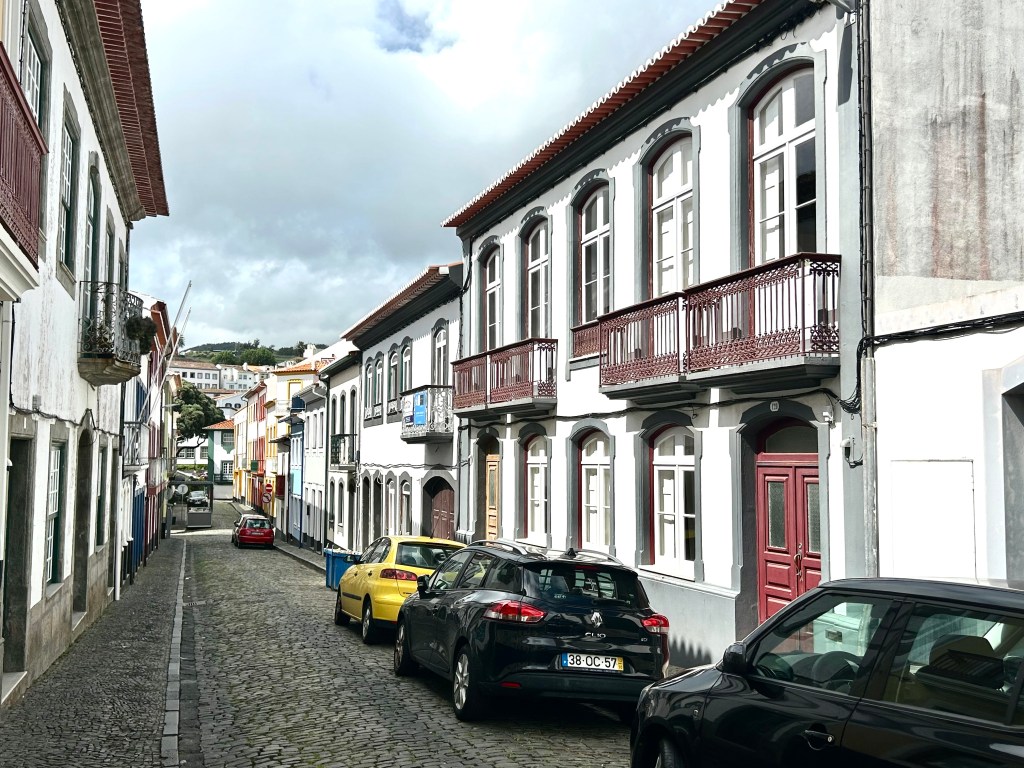
While making the documentary, the director confirmed the idea that, for the population, the only concern was to rebuild a destroyed city. That’s why the “elite” who thought up and guided the city’s destiny played a crucial role. “The priority was to rebuild houses, entire parishes. We mustn’t forget that 70% of the buildings were damaged by the 1980 earthquake. Most of the population wouldn’t consider preserving their heritage, how the reconstruction would proceed, and whether they would have a roof over their heads. This awareness has developed over time as the city has settled down. Today, this distinction, but it wasn’t always like this. It was seen as something that had been carried out by a group of intellectuals and didn’t say much to most of the population.”
The work of a group of thinkers who, amid chaos, had the lucidity to rebuild an entire city while respecting its identity and the role it played as a stopover for Atlantic shipping.
The documentary was presented on December 6 at the Angra do Heroísmo Cultural and Congress Center and will be shown on RTP-Azores on December 22 after the nightly newscast, Telejornal.
By journalist Tatiana Ourique in Açoriano Oriental.
Note from FILAMENTOS--this would be an excellent documentary with English subtitles for our Azores’ cultural classes in American universities and for presentations at many of Angra’s sister cities throughout the US.
 Filamentos (artes e letras)