
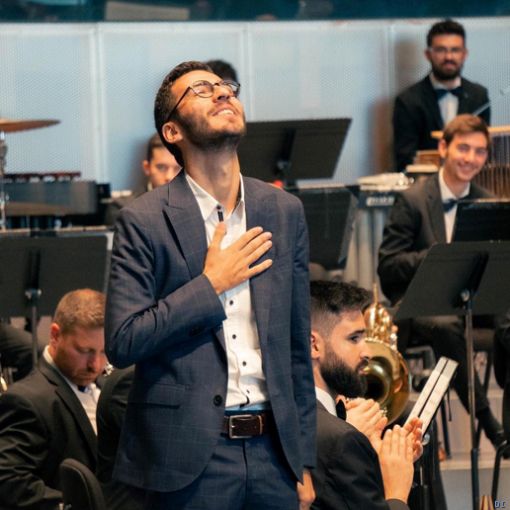
This month you premiered your work “Ciclo de Canções Tradicionais Portuguesas” at the European Piano Teachers’ Conference in Rome. How did the opportunity come about, and how do you rate the reaction to the work in front of an audience that is known to be demanding?
The opportunity came about because of some recognition of the work I’ve been doing using traditional melodies in new guises. We have a vibrant folklore in Portugal, both rhythmically and melodically, which gives the composer a good tool for work and inspiration. Fernando Lopes-Graça used to say that he took something that belonged to the people and gave it back to them with interest; in other words, he diversified. This is very much the motto that has guided my current artistic direction.
Obviously, the audience I met in Rome was highly demanding. We’re talking about some of the biggest names in piano, both performers and pedagogues, the best we have in Europe. But the critics couldn’t have been happier for me and my colleagues who performed the work. So much so that contacts have already been made for the work to have other European stops.
You’re currently completing your master’s degree in soundscapes. The final work is intended to be performed inside Algar do Carvão. What is this idea?
This idea comes from a commission that, fortunately, was sent to me to write a piece for that place. When I spoke to my supervisor about choosing the theme, I told him about this commission, which he found interesting. It’s a unique project in Portugal that has already been done by foreign composers but has been little explored in our country. Soundscape has been discussed and studied as an idea of sound imitation of environments. But I’m more interested in exploring the reproduction of sounds that fit into a space, almost combining music and art with geology.

You’re on a training course, and at the same time, you’ve already written and performed several works. How has it been possible to reach such a competitive market? What are your most significant works, and who are your main clients?
I think my ambition to create has led me to write several works in so many different styles for so many different events. In other words, I’m not afraid to take on a challenge, even if it’s outside my comfort zone. I can give examples, such as when I wrote the soundtrack for a documentary series. Music for images was an area I’d never worked in before. I accepted, and fortunately, it went well. I continued working with the company. The same happened when I wrote for a ballet, where I worked with the National Dance Conservatory, an organization I had never worked with before. Fortunately, we have projects in the pipeline to work on again. As well as these works, I’d also like to highlight the piece that won second prize in the Portuguese Symphonic Band Composition Competition, which took my music to the Casa da Música in Porto. I often perform at Composition Week in Lisbon. These are my main clients, combined with the many commissions I receive from local and national musical groups, for which I am thrilled to perform.
Artists always have a problem… The desire to make a living from art stubbornly clashes with reality, forcing you to reconcile two lives, one of which is a so-called regular job. How do you foresee your future?
We reconcile two parallel lives, which are just one, having the line of creation and the line of pedagogy. In other words, we create our art, and the best thing of all was to survive on creation alone since it’s impossible to make a living in Portugal alone. But on the other hand, we incorporate teaching into our lives to transmit an idea and create and preserve art for the future. So teaching was something I always looked forward to. It’s a natural path and one that I plan for my future.

Emigration to the large US-Canada market and, more recently, to the European Union could be a solution for those who want to make a living from the arts. Are any of these destinations on your horizon? Or would you instead try living here?
Those will always be the big markets, with more projects and companies looking for people to work with. But it’s not on my horizon to leave Portugal and Terceira Island in particular. This is because today, we live in a world globalized by the internet. I can be in the Azores in real time but work virtually anywhere. The creative process takes place in my studio in Praia da Vitória, but that studio could be anywhere worldwide. Meetings are held via videoconference, and then, for local work, I travel to places.
So I’ll try to work here, but I’ll always make myself known in Europe with my work and participation in national and international events.

How do you assess the state of music in the Azores? Do you follow it? Do you find quality, perhaps waiting for opportunities?
I follow it very closely and try to value everything done in the Azores, especially with the groups I direct. We’re in a highly artistic place, with all the tools to take a step forward in our artistic development. But sometimes, we sin by using amateurism to defend ourselves so that we don’t develop artistically. We are in a place in Portugal where, per square meter, more people either play music or have frequent contact with music. We have over a hundred philharmonic bands and choirs.
But sometimes quantity isn’t quality. And I notice that few work hard to present a high-quality artistic result. But we have the potential. Our event promoters, such as city councils or boards, will have to take care not to create subsidy-dependent groups but to create the means for these groups to perform. We have to give money for effort and work, not for existence. These are the opportunities we need.
in Diário Insular, José Lourenço-director
Translated to English as a community outreach program from the Portuguese Beyond Borders Institute (PBBI) and the Modern and Classical Languages and Cultures Department (MCLL) as part of Bruma Publication and ADMA (Azores-Diaspora Media Alliance) at California State University, Fresno.
 Filamentos (artes e letras)