
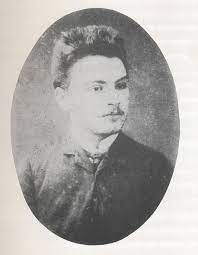
Despite having almost always lived in Flores Island – with short stays in Terceira, Faial, Pico and Corvo Islands, and a single trip of a few months to mainland Portugal – and having published only one book, Almas Cativas (Captive Souls) (an expression taken from the last verse of the first sonnet in Antero de Quental’s poem, “Redenção” [Redemption]), published at a later date (1931), the poet ROBERTO DE MESQUITA (1871-1923) is one of the most remarkable names in Portuguese Symbolist poetry: according to Vitorino Nemésio, who first drew attention to his poetry, «Roberto de Mesquita requests an essential spot in Portuguese Symbolism, next to its princes, who shouldn’t be embarrassed for his not being a resounding company (António Nobre, Camilo Pessanha, Eugénio de Castro), and that he is the first poet to express something essential on the human condition the way it presents itself in the Azores Islands» (Nemésio, 1939).
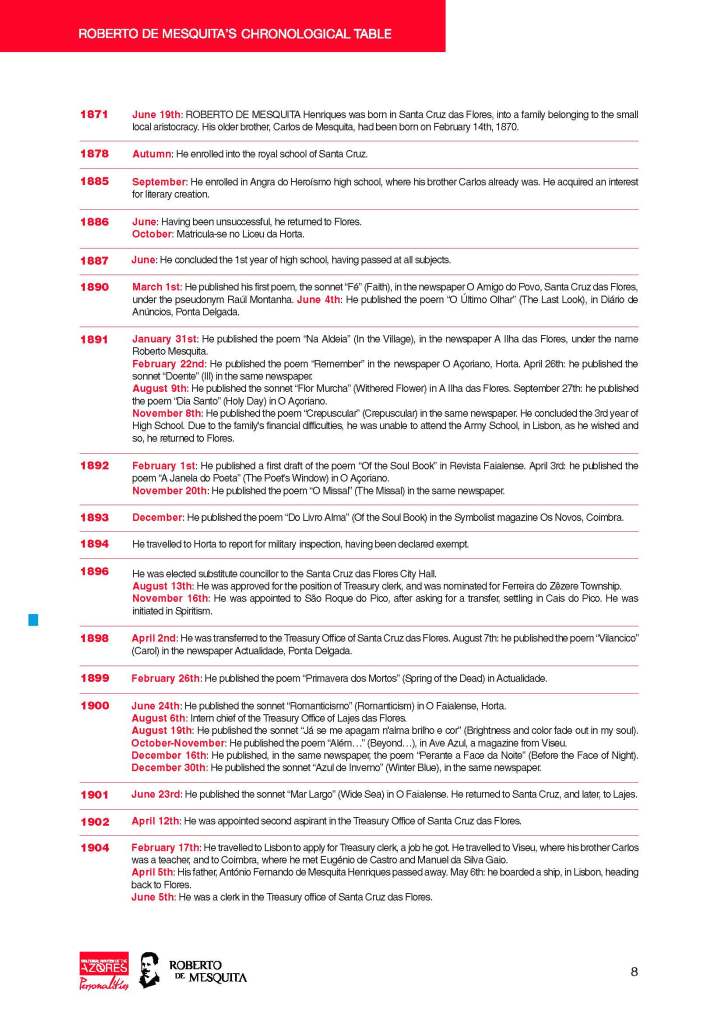
Born in Santa Cruz das Flores into a family of the minor local aristocracy, Roberto de Mesquita could not pursue an education beyond high school, from which he graduated in Horta High School, since his parents didn’t have the means to support two sons studying in the mainland: The older brother, Carlos de Mesquita, a poet of merit, was already in Coimbra attending University. Resigned, the young Roberto de Mesquita returned to his home island, where he became, although with a specific geographical intermittence, a Treasury clerk in Santa Cruz and Lajes, and also in S. Roque do Pico and Corvo. Meanwhile, through his brother Carlos, a teacher in Viseu, he kept in touch with the happenings of the Portuguese and European literary environment, and he composed his poetic work, which, although small – a poetry book and about two dozen poems published in dispersed local newspapers and magazines (Santa Cruz, Horta and Ponta Delgada) and some nationals (A Ilustração Portuguesa, Lisbon, Ave Azul, Viseu, and Os Novos, a Coimbra Symbolist Magazine) – it occupied, once divulged by Vitorino Nemésio, and later by Pedro da Silveira and Jacinto do Prado Coelho, a first tier rank in the Portuguese symbolist trend. Roberto de Mesquita did his job as a civil servant in an unmotivated manner, to the point of having been punished (compulsory transfer to the Island of Corvo, 1912-1913) and a disciplinary process for lack of professional zeal (1915), which isn’t surprising if we take into account the dryness of an administrative and bureaucratic profession, which served him exclusively to make a living, in the face of a poet’s great sensitivity whom, almost without leaving the little and isolated Island of Flores, managed to accompany the best Parnassian and Symbolist poetry being
produced in Portugal, and in Europe, to which he gave a precious contribution. Jacinto do Prado Coelho even stated that «in the isolation of Flores, the poet integrated himself perfectly, in many ways, in the “climate” of French Symbolism – as if not leaving his home» – adding that, in his poetry, «tied to the remote island, landscapes and soul states, so often Verlainian, are also typically Symbolist: the dusk, the Autumn, the mist, the rain, boredom, melancholy, sparse sobbing, nostalgia, longing,» and that in another «Verlainian corner of Roberto de Mesquita, where the Fêtes Galantes influence shows through, is the nostalgia of abolished times, with their aristocratic effulgence, their “departed elegances,” “deceased fashions,” park or lounge parties, minutes, masked balls, harlequins, and pierrots; the melancholic charm of the old albums, of houses, either abandoned or in ruins, of the mossy stones. The poet escapes into the past, “breathes” romance and ballads, dreams» (Coelho, 1973).

With an unknown social life, unhappy in love – in 1907 he called off a wedding to the one of who is said to have been his great love (and who would die single, after having dressed in mourning black for his death…), marrying, the following year, D. Maria Alice Lopes, in what was held as a marriage of circumstance, without understanding or procreation – a frustrated military man, a republican, a substitute municipal councilman, a Spiritism practitioner, Roberto de Mesquita has
left us a life which, in its essence, is his poetry. Which is not much, and yet is so much.
One of the purest Portuguese Symbolist poets passed away reciting verse in Portuguese and French – it is unknown which or whose – on the final day of 1923; he was buried on the first of 1924 at the sound of a funeral march played by the Filarmónica União Musical Florentina, where he had played first-clarinet.
Credits:
COELHO, Jacinto do Prado (1973). “Roberto de Mesquita e o Simbolismo” (Roberto de Mesquita and Symbolism), preface to SILVEIRA (1973).
NEMÉSIO, Vitorino (1939). “O Poeta e o Isolamento: Roberto de Mesquita” (The Poet and Isolation: Roberto de Mesquita). Coimbra: Revista de Portugal, vol. II, 6, January, 1939, pp. 246-261. Reedited in Conhecimento de Poesia (Knowledge of Poetry). Salvador: Bahia University, 1958; Lisbon: Editorial Verbo, 1970, pp. 131-149.
SILVEIRA, Pedro da (1973). Roberto de Mesquita, Almas Cativas e Poemas Dispersos (Captive Souls and Scattered Poems). Text establishment, a compilation of scattered texts and notes (…), with a preface by Jacinto do Prado Coelho. Lisbon: Edições Ática.
To define the routes in this Itinerary, we had the indispensable cooperation of
Luís Filipe Noia Gomes Vieira, Flores Museum Director
in Enciclopédia Açoriana



 Filamentos (artes e letras)