

The Azores, an archipelago in the North Atlantic Ocean, where about a million Americans and Canadians can trace their roots, have a rich and fascinating history spanning centuries. This cluster of nine volcanic islands, today an autonomous region of Portugal, has played a significant role in the exploration and navigation of the Atlantic, and its history is marked by discovery, settlement, and natural wonders. A new boob, recently translated and published by Bruma Publications and Letras Lavadas, brings the history of the Azores to Americans and Canadians of Azorean ancestry who aren’t fluent in Portuguese. It is part of the vision and mission of Bruma Publications to bring forth an amalgam of books in history, literature, poetry, and memoirs, allowing all who have roots in the Azores and those who are interested in world history an opportunity to learn about these magical nine islands in the North Atlantic.
The history of the Azores begins with their discovery in the early 15th century. While there is some debate about who first sighted the islands, it is generally attributed to the Portuguese navigators Gonçalo Velho Cabral and Diogo de Silves around 1427. This discovery came when Portugal was at the forefront of global exploration, and the Azores became a strategic stopover for ships traveling between Europe, Africa, and the New World.
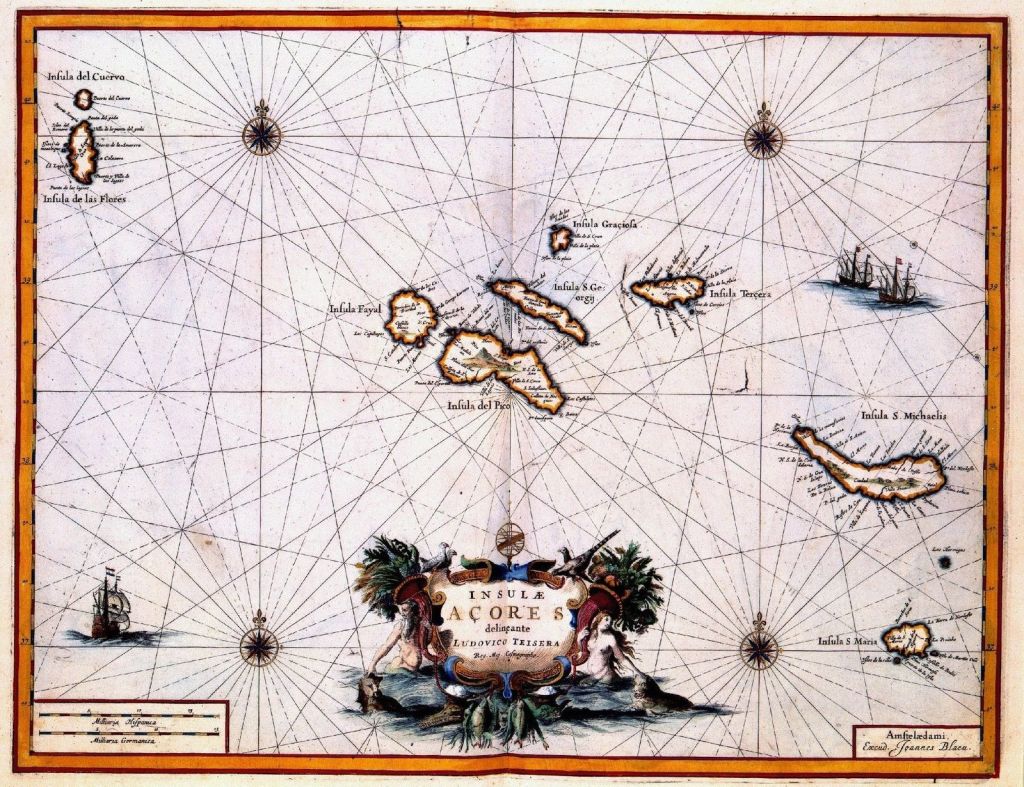
The Azores began to be populated in the mid-15th century. The settlers came mainly from continental Portugal and other parts of Europe, contributing to the islands’ cultural diversity. The Azores’ volcanic terrain and fertile soil made agriculture a crucial component of the local economy, with crops such as wheat, sugarcane, and woad (a blue dye) becoming essential exports.
The islands’ strategic location played a pivotal role in exploring the Atlantic. Christopher Columbus stopped at the Azores. The islands have witnessed several naval battles as various European powers coveted control.
In the 18th century, they had a period of relative stability for the Azores. During this time, the islands facilitated trade between Europe and the New World. Thanks to their geographic location, the Azores also served as a waypoint for scientific exploration and meteorological studies.
In the 19th and 20th centuries, the Azores continued to evolve. They became essential for naval and military purposes during World War II. The United States established a military base on the island of Terceira, known as Lajes Field, which played a critical role during the Cold War.

In 1976, the Azores became an autonomous region of Portugal, granting them self-governance while maintaining strong ties to the mainland. This autonomy allowed the Azoreans to develop their unique culture further and preserve their natural resources.
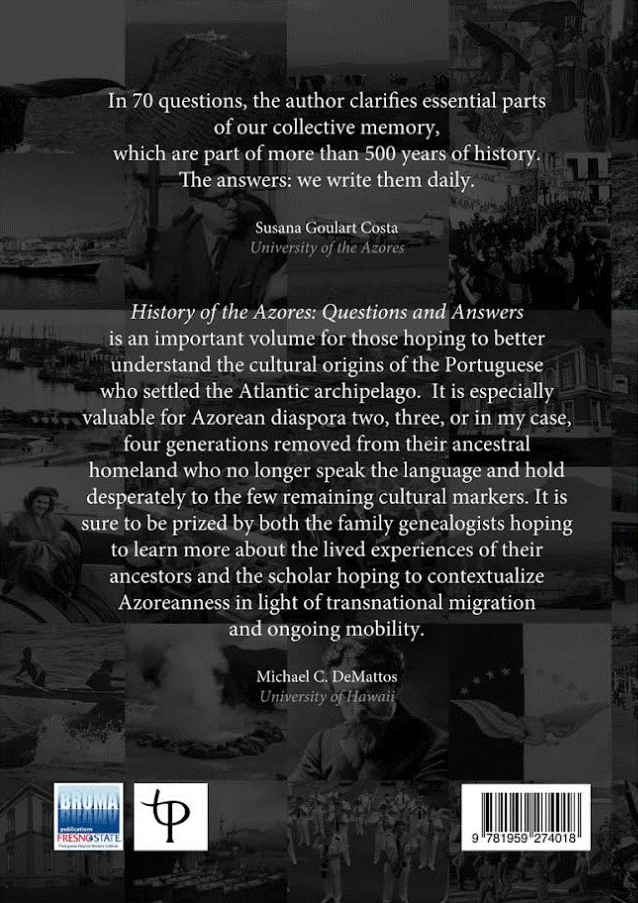
Throughout the 207 pages, the reader can glimpse the Azores, as researched and written by historian Luís Mendonça and translated by Diniz Borges. As Professor Michael C. DeMattos from the University of Hawaii eloquently wrote, “ History of the Azores: Questions and Answers is an essential volume for those hoping to understand better the cultural origins of the Portuguese who settled the Atlantic archipelago. It is precious for Azorean diaspora two, three, or, in my case, four generations removed from their ancestral homeland who no longer speak the language and hold desperately to the few remaining cultural markers. It is sure to be prized by both the family genealogists hoping to learn more about the lived experiences of their ancestors and the scholar hoping to contextualize Azoreanness considering transnational migration and ongoing mobility.”
The history of the Azores is a testament to the resilience of settlers and the strategic importance of geographic locations. These islands have played a vital role in the history of Atlantic exploration and have evolved into a unique and culturally rich part of Portugal. Their breathtaking natural beauty and historical significance continue to captivate visitors worldwide, making the Azores a remarkable and enduring chapter in the annals of human history. This book takes the various significant events in the Azores and explains them in a brief and very readable format. Please see below if you would like to order a copy.


24 dollars, including shipping and handling–checks made to Fresno State Foundation -request by mail made to
Bruma Publications-Diniz Borges (MCLL) Peters Building, Office 393 – 5245 N. Backer Avenue, M/S PB96 – Fresno, California 93740-8030
Please allow 3 weeks from the date the order is received for shipping and handling.

 Filamentos (artes e letras)