
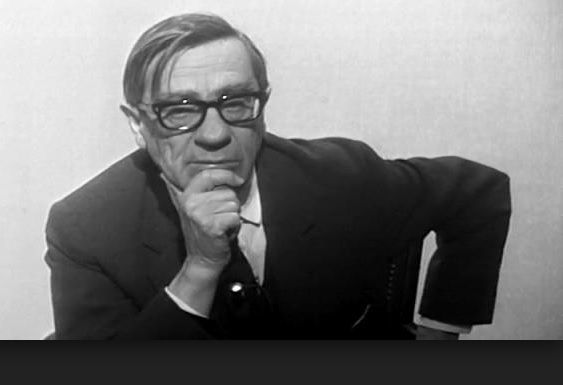
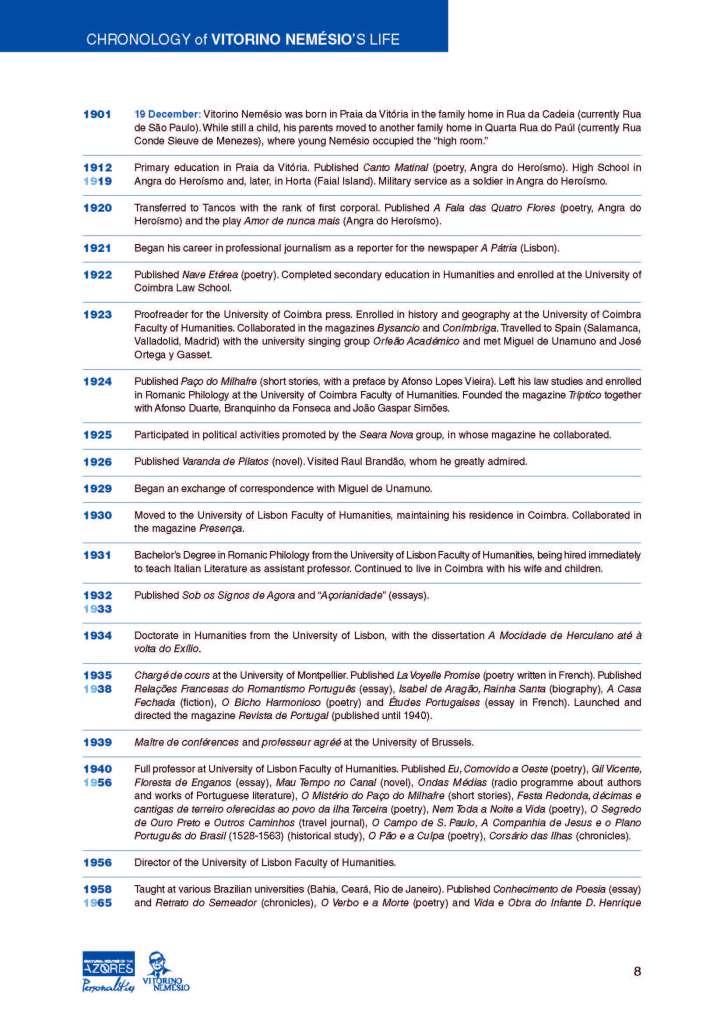
Vitorino Nemésio Mendes Pinheiro da Silva, who would be known in the world of Portuguese culture by his two given names, VITORINO NEMÉSIO, was born on December 19, 1901, in Praia da Vitória, Terceira Island, into a family whose origins date back to the first settlers of the island, as he repeatedly stated. Nemésio enjoyed distinction in 20th-century Portuguese culture, developing a career as a journalist, professor, writer, essayist, and particularly as a mass communicator; he was the first Portuguese intellectual who utilized the mass media, radio, and television to reach
an audience beyond newspaper and book readership.
Nemésio finished his primary education in Praia da Vitória in a school that was located near the beach, at the end of Rua da Alfândega, where nowadays a roundabout leads to Avenida Álvaro Martins Homem. He completed secondary school in Angra do Heroísmo and Horta, Faial Island. Nemésio was drafted into the Infantry Regiment of Angra do Heroísmo at eighteen and later transferred to Tancos and Lisbon. After military service, in 1921, he began his career as a professional journalist in the newspaper A Pátria, enrolling soon after at the University of Coimbra Law School, later pursuing a degree in history and geography at the Faculty of Humanities of the same University, while simultaneously fulfilling the duties of proofreader for the University’s Press. In 1924, he abandoned his course of study and enrolled in Romanic Philology; however, in 1930, in conflict with the University of Coimbra, Nemésio transferred to the University of Lisbon Faculty of Humanities, where he obtained his bachelor’s degree the following year and was hired to teach Italian literature as an assistant professor. He received a Doctorate in Humanities from the University of Lisbon for his dissertation entitled A Mocidade de Herculano até à volta do Exílio [The Youth of Herculano until Returning from Exile], was chargé de cours [lecturer] at the University of Montpellier, moving to the University of Brussels some years later, where he was maître de conférences [senior lecturer] and professeur agréé [associate professor].
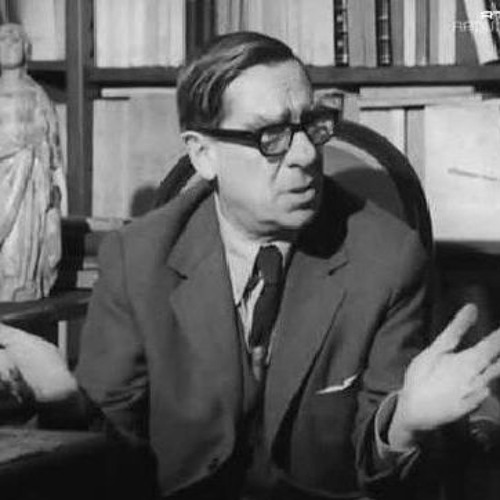
In 1939, Nemésio competed for and achieved the rank of full professor at the University of Lisbon Faculty of Humanities. He taught in several Brazilian universities (Bahia, Ceará, Rio de Janeiro) and participated in the Faculties of Humanities curriculum reform. He was elected a permanent member of the Lisbon Academy of Sciences (1963), was granted an honorary degree by the University of Montpellier (1965), and received the National Literature Award the same year for his work. In 1969, Nemésio began his regular collaboration with Portuguese television RTP, with a program entitled “Se Bem me Lembro” [“If I Correctly Remember”], which resulted in him becoming extremely popular; many Portuguese continue to remember Nemésio nowadays as a result of these programs, rather than of his literary works and essays. On December 12, 1971, Professor Vitorino Nemésio gave his final lecture at the University of Lisbon Faculty of Humanities. He received the Montaigne International Award from the Freiherr von Stein / Friedrich von Schiller Foundation in Hamburg. Meanwhile, between March 28, 1973, and May 14, 1977, he wrote a series of erotic poems which he dedicated to his late life and final love, Margarida Victória, Marchioness of Jácome Correia, which would be published posthumously under the title Caderno de Caligraphia e Outros Poemas para Marga [Notebook of Calligraphy and Other Poems for Marga].
Nemésio died in Lisbon on February 20, 1978.
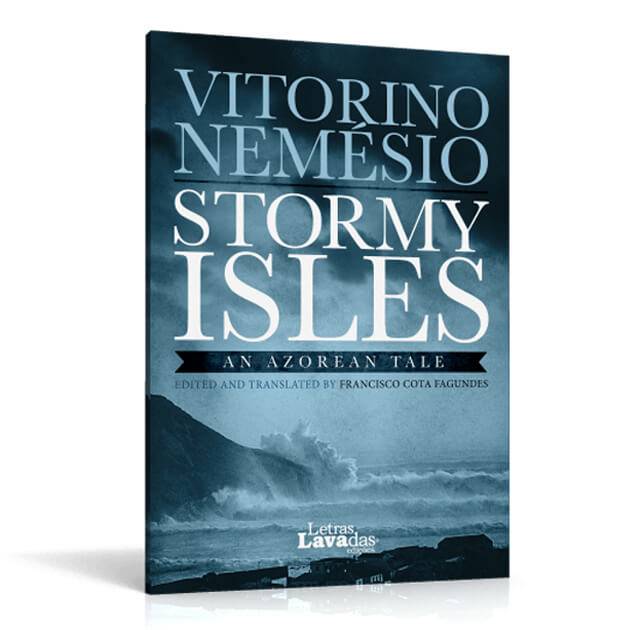
His literary works made him renowned and included poetry, fiction, essays, and diaries. The novel Mau Tempo no Canal [Stormy Isles: An Azorean Tale] is considered to be one of the greatest works of Portuguese literature, alongside Eça de Queiroz’s The Maias and, at a time when biochemistry was just beginning as a science, Limite de Idade [Limit of Age], one of his last books of poetry, pioneered the idea that “science is a source and simile of poetic creation simply because all acts of science, all new discoveries in the field of exact knowledge, will fatally be acts of beauty” (Maria Lúcia Lepecki). In this book, Nemésio, as he had already been doing through his television programs, transformed biochemistry into the material of poetry.

Having had his debut as an author at fifteen with the book of poetry Canto Matinal [Morning Chant], Nemésio authored some of the most remarkable books of 20th-century Portuguese literature, namely O Bicho Harmonioso [The Harmonious Animal], Eu, Comovido a Oeste [I, Moved in the West], Mau Tempo no Canal [Stormy Isles: An Azorean Tale], Festa Redonda [Round Feast] (a book inspired and modeled on the folk literature of Terceira), O Verbo e a Morte [The Verb and the Death], Limite de Idade [Limit of Age], Era do Átomo Crise do Homem [Age of the Atom Crisis of Man], and Caderno de Caligraphia [Notebook of Calligraphy], among others. A man of his time, unlimited by either literary genre or geography, Vitorino Nemésio actively participated
in the nation’s public life, enjoying enormous intellectual and civic prestige. Salazar invited him to join the Corporative Chamber, an invitation that he courageously declined. At the end of his life, influenced by Natália Correia, he nurtured the fantasy of being the first president of an independent Azores Archipelago while maintaining a close relationship with some important figures of European culture, such as Miguel de Unamuno, José Ortega y Gasset, and Valery Larbaud.
Enjoying national and international acclaim with the publication of some of his works in other languages, Vitorino Nemésio, as both man and artist, always stated that his roots were in the Azores, especially on Terceira Island, and coined the concept of açorianidade – azoreaness or azorianity.

“Some day, if I can enclose myself within my four walls in Terceira, free of
responsibilities to the world, and having fulfilled the duties of citizenship, I will
attempt to write about my underlying Azorianity, which has only become keener
and exacerbated by exile. Before that day of inner liberation, I would barely understand myself. A loving wave, a faint declaration of insular
solidarity, distance is the most that these lines can mean.”
Years later, he would reaffirm this concept and complete its definition in the travel journal that served as the guiding principle for this itinerary, Corsário das Ilhas [Corsair of the Islands]:
“I am an islander and, more so than the island itself, the islander is defined by the
surrounding sea. We live off fish and the time of the tide and watch the ships…”
The texts that make up this guide are based on two main works:
VITORINO NEMÉSIO, Corsair of the Islands, Lisbon: Bertrand, 1956
VITORINO NEMÉSIO, Journal, unpublished

in enciplopédia açoriana, revision of text by PBBI-Fresno State
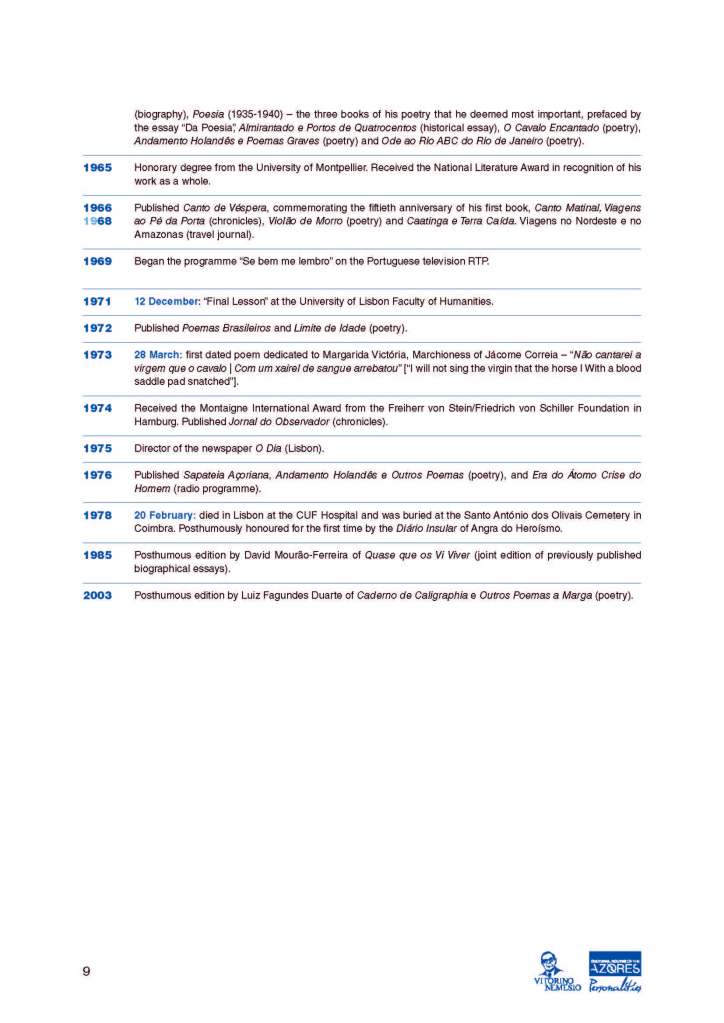
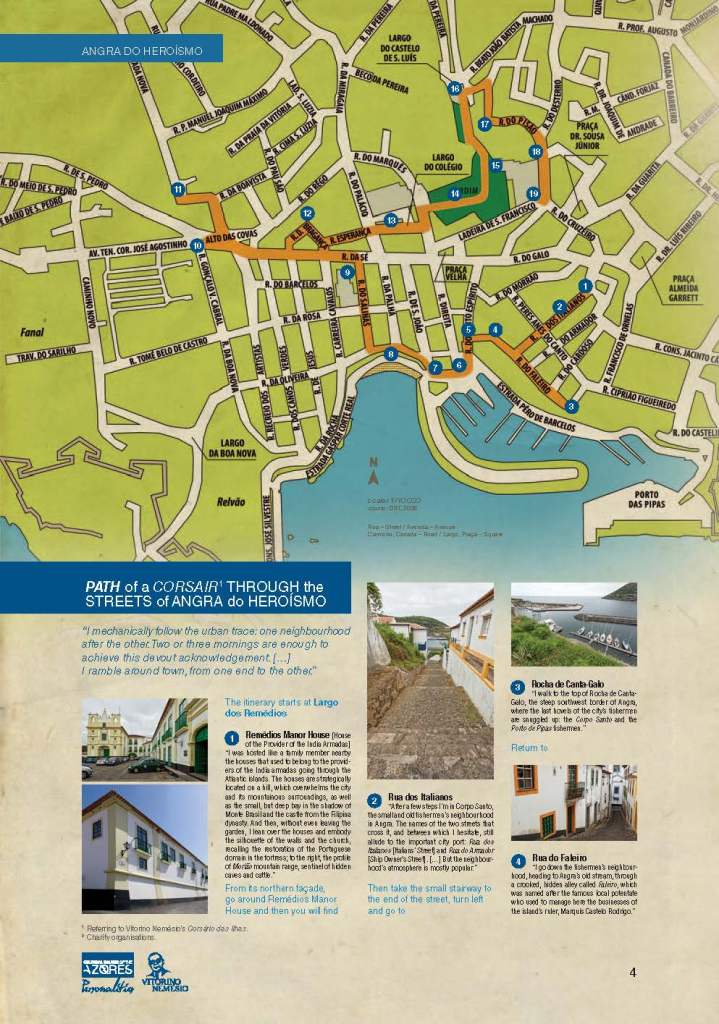
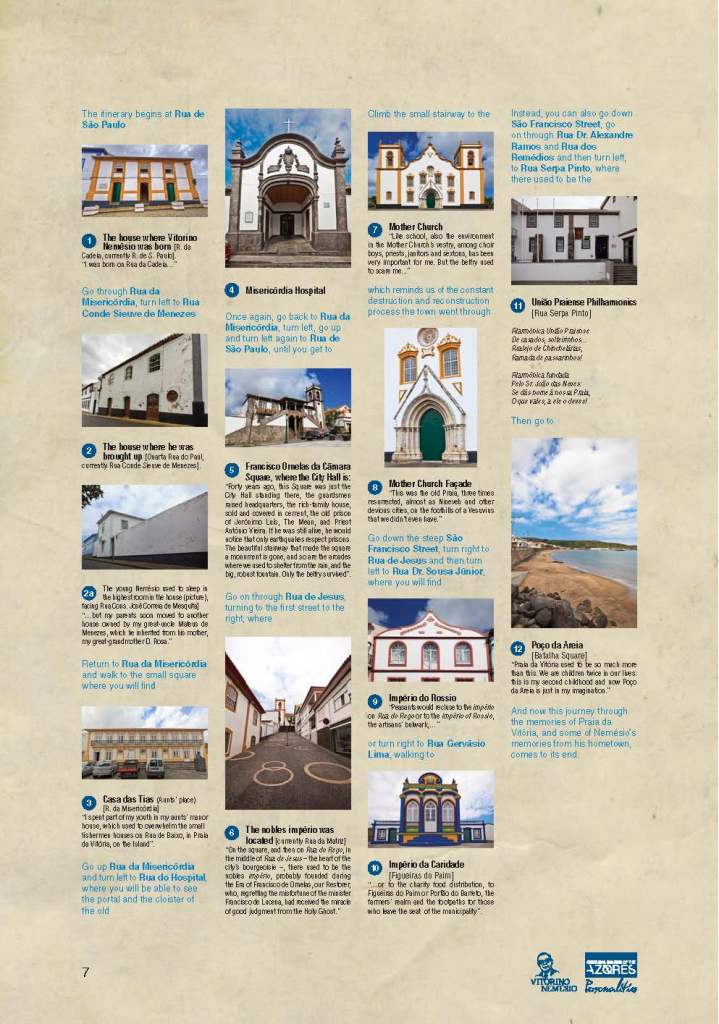
The following is a chronology from Enciclopédia Açoriana and an itinerary if you ever visit Terceira island and want to do a Vitorino Nemáesio literary tour…


excerpt of one of his television programs
 Filamentos (artes e letras)