

Tony Golart and the Portuguese Heritage Publications of California just recently published a book on the history of the Portuguese Marching Bands in California (Filarmónicas), commemorating a 125-year tradition, according to the research done by Tony Goulart and put forth in the book.
The Portuguese marching Bands are staples at the traditional Festas put forth in many communities. A highlight event for the Filarmónicas is the upcoming Band Festival on November 4th. We have the program at the bottom of this segment.
To bring this history to the Azorean community of second, third, and fourth generations, PBBI, through FILAMENTOS has translated an excellent recap, available in Portuguese from the Azorean Enclipedia hosted by the Cultural Office of the Government of the Azores.
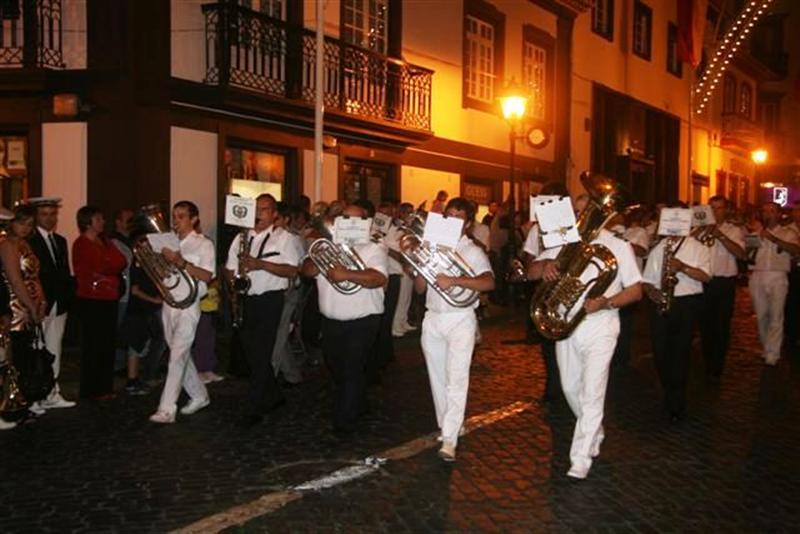
Marching Bands – Filarmónicas
The testimony of historian Gaspar Frutuoso shows that the Azoreans were involved in musical activities from the earliest days of settlement. However, music bands are a more recent sociocultural phenomenon that spread from the second half of the 19th century. The earliest known report dates back to 1818 when a man from Graciosa, Timóteo Espínola de Sousa Bettencourt, returned from Brazil accompanied by a philharmonic band entirely of Africans. A few years later, in 1831-1832, two music bands arrived in Angra do Heroísmo and Ponta Delgada as part of the liberal forces from France and England, the 5th Hunter Battalion and the 18th Infantry Regiment. They only stayed there briefly as they accompanied the military expedition to the north of the country, but their presence was enough to stir up the towns they marched through. It was around this time that legislation was published in supplement no. 23 of the *Chronica da Terceira, a publication corresponding to the Diário do Governo, determining that “the regiments will have a Muzica Band, made up of: a Master, eight musitians, a drum major, a drum major and two pifanos” (Decree of September 28, 1831). From then on, the military charangas began their activity, significantly contributing to civilian music bands’ emergence. In fact, the uniform itself, simplified today, is an evolution of the military uniform. The associative, recreational, and cultural movement that developed in the archipelago’s cities as a visible face of Freemasonry was not unrelated to the emergence of various musical groups. Whether elitist or more popular, they all gradually became part of the urban festivities. This led to the creation of festivals around the feasts of the Holy Spirit, the Lord Santo Cristo, and the promotion of performances on holy days in the most popular public places.
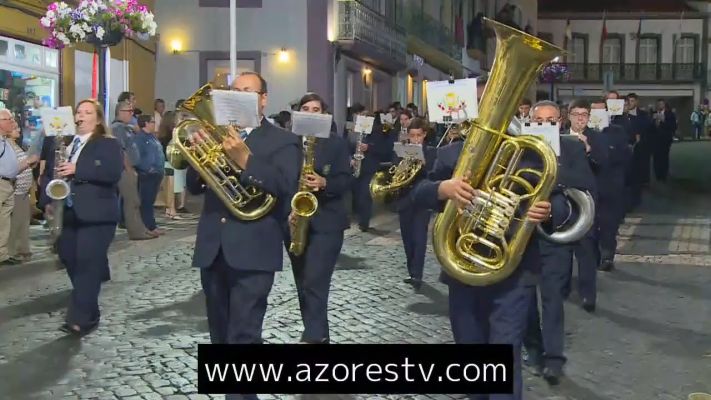
The local caciques didn’t neglect this aspect, promoting and contributing to the creation of their groups. See, for example, the *hymns that the philharmonics dedicated to their protectors in the section Hinos, in Biblioteca Açoreana, by Ernesto do *Canto. During the festivities commemorating the liberal revolution, the chieftains paraded through the streets, accompanied by their respective bands, to attract and excite the population. Politics became music, but in most cases, music was not political. Gradually, the philharmonic became a constant presence at the most varied events of a profane or religious nature, coexisting for some time with the revelers of Ancien Régime society. But the band gave solemnity to what until then had been banal events. A simple funeral was transformed into an event full of collective gratitude, with a tragic note that had hitherto been uncommon.
Rivalries, a lot of caring, and a love of art are factors that have contributed to the permanence of the philharmonics. A movement that permeates all social groups, although in some cases, differentiation has been present. Setting up a philharmonic required and still requires some investment in the purchase of instruments and uniforms. While the chieftains drove and contributed to the creation of some groups, in most cases, the people’s contribution and the participants’ sacrifice sustained them. And so the band became a symbol of identity and pride for the respective parish. In this way, hundreds of philharmonic bands were created throughout the archipelago, many short-lived but which soon gave rise to other groups with different names. These true schools of art and civility reached thousands of citizens over time. This whole movement ended up influencing and enriching other cultural activities. It was the musicians themselves who made up the orchestras of the theater groups, known as comédias; who accompanied and accompanied the Danças do Entrudo, the famous São João festa marches, etc. It was also through the philharmonic bands that island fraternization deepened. From the beginning of the 20th century, in the exchanges promoted between the islands, the philharmonics played a fundamental role in strengthening ties between the islanders (see Azoreanism). This dynamic continues today, particularly during the summer festivals. Parades are a highlight of the program of many festivals in which bands from various islands participate. The connection to the emigration centers appears as a natural extension of this whole movement, as a factor of unity. On the other hand, the contribution of emigrants to the support of many bands is another not insignificant factor. Thanks to this cultural heritage, the attachment to the art of music is kept alive despite all the sacrifices since public support has always been scarce. During the First Republic, some town councils even gave bands subsidies to perform at certain events, but it was short-lived. The only rewards for the musicians were soups or doughnuts when they participated in the Espírito Santo festivities. During the Estado Novo period, many philharmonic bands benefited from the construction of recreational societies, supported by the people themselves, providing adequate space for rehearsals. More recently, support from the Regional Government has been fundamental in improving quality: training for conductors, decent accommodation, and funds to buy instruments and uniforms. Until “April 25”, only men were in the bands. Since then, girls of various ages have constantly been in almost all the philharmonic bands.

From the list of 103 philharmonics in existence in 2003 [see list of philharmonics], it can be seen that, in rounded percentages, 46% were founded during the Constitutional Monarchy, 11% during the First Republic, 28% during the Military Dictatorship and the Estado Novo and 14% during the democratic regime after the “25 de Abril”. The Azores thus have the highest average number of philharmonic bands per inhabitant in the country: one philharmonic per 2,500 inhabitants. The situation is entirely different on the mainland and in Madeira, with a ratio of one per 20,000 and 40,000 inhabitants, respectively.
Article by Carlos Enes
Bibliography-. Cabral, J. M. (1985), Filarmónicas da ilha de São Miguel. Angra do Heroísmo, Instituto Açoriano de Cultura. Gomes, F. (1997), A Ilha das Flores: da redescoberta à actualidade (subsídios para a sua história). Flores, Câmara Municipal de Lajes das Flores. Merelim, P. (1967), Filarmónica Recreio dos Artistas. Angra do Heroísmo, União Gráfica Angrense. Id. (1974), As 18 paróquias de Angra ? sumário histórico. Angra do Heroísmo, Tip. Minerva Comercial. Id. (1983), Freguesias da Praia. 2 vols., Angra do Heroísmo, Direcção Regional de Orientação Pedagógica da Secretaria de Educação e Cultura. Monterey, G. (1979/1981), 5 guias turísticos dos Açores. Porto, Ed. do Autor. Pacheco, N. (1997), Tradições musicais da ilha Graciosa. Graciosa, Academia Musical da Ilha Graciosa. Trigueiro, J. A. A. (2000), Filarmónicas da Ilha do Corvo ? subsídios históricos 1916-1999. Corvo, Corvo Town Hall.
Portuguese Band Festival in California for 2023

List of philharmonic bands
(# marks those active in 2003)
ANTA MARIA
Banda Marcial Mariense (1860?); Banda 15 de Agosto (1899); Banda Recreio Espirituense# (1923)
SÃO MIGUEL
Filarmónica Micaelense, Ponta Delgada (1842); Banda Harmónica Recreativa dos Artistas Michaelenses (1846); Harmónica Micaelense, Ponta Delgada (1848); Sociedade Escholastica Philarmonica, Ribeira Grande (1849); Banda Lyra Lagoense (1850); Banda Marcial Estimulo, Ponta Delgada (1851); Banda Timbre, Vila Franca do Campo (1853); Banda Triunfo, Ponta Delgada (1853); Harmónica Artista ou Marcial dos Artistas, Ponta Delgada (1856); Banda União, Água de Pau (1859); Banda Marcial Trofeo#, Povoação (1860); Banda Eco Edificante#, Nordeste (1861); Música do Tamborinho, Ponta Delgada (1863), Banda Marcial Progresso, Ponta Delgada (1864); Banda Marcial da Luz, Fenaes da Luz (1864); Banda Estímulo Artístico, depois Fraternidade Rural#, Água de Pau (1865); Philarmonica de Nossa Senhora das Neves# (também usou a designação de Popular Progressista Relvense), Relva (1866); Banda Lealdade Artística#, Vila Franca do Campo (1867); Banda Lira do Norte#, Rabo de Peixe (1867); Banda Fraternidade, Ribeira Grande (1868); Banda Emoção Popular, Lagoa (1868); Banda Melodia Furnense# (1868); Banda Recreio Musical dos Mosteiros# (1868), actual Banda Fundação Brasileira; Banda Aliança, Água de Pau (1870); Banda Estrela do Norte#, Fenaes da Ajuda (1870); Banda Rival das Musas, Ponta Delgada (1871); Recreio dos Amigos, Fenaes da Luz (1871); Banda Voz do Progresso, Ribeira Grande (1874); Banda São Salvador do Mundo#, Ribeirinha (1877); Banda Euterpe, Ponta Delgada (1877); Banda União dos Amigos#, Capelas (1879); Banda Triumpho da Inveja, Capelas (1880); Banda Triunfo#, Ribeira Grande (1880); Banda União Fraternal, Ponta Delgada (1880); Banda Camões, Vila Franca do Campo (1880); Banda Camponeza Fraternidade, Ribeira Grande (1882); Banda Marcial Bom Jesus, Rabo de Peixe (1882); Banda Amor da Pátria, Água de Pau (1883); Banda Recreio dos Amigos (Aflitos), Fenaes da Luz (1885), reaparecida em 1935; Banda Harmonia Mosteirense# (1885); Orquestra 1.o de Dezembro, Ponta Delgada (1886); Banda Progresso do Norte, Rabo de Peixe (1888); Banda Estrela d?Alva#, Lagoa (1889); Banda União e Arte, Povoação (1891); Banda União e Amizade#, Lomba do Loução (1892); Filarmónica da Imaculada Conceição#, Lomba da Fazenda (1893); Banda Triunfo, Fajã de Baixo (1893); Sociedade Musical Coração de Jesus#, Faial da Terra (1894); Filarmónica de Ponta Garça ou Lira do Sul# (1896), reaparecida em 1923; Banda Triunfante ou Lira de São Roque# (1899), reaparecida em 1948; Banda Estrela do Oriente#, Algarvia (1900); Banda Voz de Monforte, Ribeira Seca da Ribeira Grande (1903); Banda Minerva#, Ginetes (1906); Banda União Progressista#, Vila Franca do Campo (1907); Banda Lira Euterpe, Povoação (1908); Banda Eco Musical#, Arrifes (1910), depois Lira Nossa Senhora da Saúde; Banda de Nossa Senhora da Oliveira#, Fajã de Cima (1911); Banda União dos Amigos, Bretanha (1912); Banda Rival Outeirense, Arrifes (1912); Fanfarra Marcial Troféu, Povoação (1912); Banda Lira do Oriente, Fajã de Cima (1912); Banda Lira Açoriana, Ponta Delgada (1913); Banda Lira dos Prazeres, Pico da Pedra (1914); Banda Lira Camponesa, Ribeira Seca de Vila Franca do Campo (1914); Banda Lira Luz e Glória, Fenaes da Ajuda (1915); Banda Artista Micaelense, Ponta Delgada (1916); Banda Lira do Rosário#, Lagoa (1920); Banda União dos Prazeres Micaelense, Pico da Pedra (1921); Lira de Santa Luzia, Feteiras (1924); Banda Lira de Santa Luzia, Feteiras (1927); Recreio dos Aflitos, Fenaes da Luz (1935); Banda Lira do Espírito Santo#, Maia (1937); Banda Lira das Sete Cidades# (1946); Banda de Nossa Senhora de Penha de França#, Água Retorta (1947); Banda Nossa Senhora da Luz#, Ponta Delgada (1976); Banda Lira de Nossa Senhora da Estrela#, Ponta Delgada (1983); Sociedade Recreativa Filarmónica Nossa Senhora das Vitórias, Santa Bárbara (1984); Filarmónica de Nossa Senhora dos Remédios#, Bretanha (1986)
TERCEIRA
Sociedade Filarmónica Recreativa, Angra (1850); Filarmónica Terceirense (1856); União Praiense (1866); Filarmónica Agualvense (1868); Harmónica Popular Angrense (1870); Sociedade Filarmónica Recreio Serretense# (1873); Harmónica Lajense (1874); Sociedade Filarmónica Instrução e Recreio dos Artistas#, Angra (1877), sucessora da Harmónica Progressista; Sociedade Filarmónica Recreio de Santa Bárbara# (1877); Filarmónica Altarense do Sagrado Coração de Jesus#, Altares (1879); Sociedade Musical União das Fontinhas# (1884); Sociedade Recreativa e Musical São Sebastião# (1886); Sociedade Filarmónica Popular Praiense (conhecida como a do Artistas), (1886); Sociedade Filarmónica Recreio dos Lavradores#, Ribeirinha, ex-Harmónica Recreio dos Lavradores (1889); Filarmónica União Praiense# (1904); Filarmónica Santo António, Porto Judeu, (1904); Sociedade Filarmónica União Católica da Ribeirinha# (1904); Filarmónica Espírito Santo da Casa do Povo de São Bartolomeu# (1905); Fanfarra D. Carlos I, depois Pátria e Liberdade e Fanfarra Operária Gago Coutinho e Sacadura Cabral#, Angra (1906); Sociedade Filarmónica Popular Angrense (1908); Sociedade Filarmónica Espírito Santo da Agualva# (1922); Sociedade Musical Recreio da Juventude da Terra Chã# (1928); Sociedade Filarmónica Recreio Lajense# (1931); Sociedade Progresso Biscoitense# (1935); Sociedade Progresso Lajense# (1947); Sociedade Brianda Pereira (1955); Filarmónica Lira do Espírito Santo de Vila Nova# (1955); Sociedade Recreativa Biscoitense# (1959); Associação Filarmónica Cultural e Recreativa «Santa Bárbara»#, Fonte do Bastardo (1983); Sociedade Recreativa Filarmónica União de São Brás# (1984); Sociedade Recreativa Rainha Santa Isabel das Doze Ribeiras# (1985); Grupo Filarmónico Nossa Senhora das Mercês#, Feteira (1986); Filarmónica Nossa Senhora do Pilar das Cinco Ribeiras# (1987); Banda de Música de Santa Beatriz das Quatro Ribeiras# (1992); Filarmónica da Casa do Povo de São Mateus# (1994); Filarmónica da Associação Cultural do Porto Judeu# (2000).
SÃO JORGE
Sociedade União Popular de Instrução e Recreio#, Ribeira Seca (1854); Sociedade Filarmónica Velense (1868); Sociedade Instrução e Recreio Club União#, Topo (1869); Sociedade Filarmónica Recreio e Progresso dos Lavradores#, Santo Antão (1886); Sociedade Estímulo#, Calheta, (1895), Sociedade Filarmónica Instrução e Recreio Nova Aliança#, Velas (1900); Recreio Calhetense (1911); Filarmónica Liberdade, Velas, (1880 e 1929); Sociedade Lusitânia Club Recreio Velense# (1923); Sociedade União Urzelinense#, sucessora da Filarmónica Triunfo (1923); Sociedade Filarmónica Recreio Amarense#, Santo Amaro (1929); Sociedade Filarmónica Recreio Nortense#, Norte Grande (1931); Sociedade Filarmónica Recreio Terreirense#, Terreiros (1935); Sociedade Filarmónica União Rosalense#, Rosais (1935); Sociedade Filarmónica Recreio dos Nortes#, Santo Antão (1945); Sociedade Filarmónica Recreio Topense# (1955, com uma antecessora em 1891); Sociedade Filarmónica Nova Aliança#, Santo Antão (1971); Filarmónica Recreio de São Lázaro#, Norte Pequeno (1981).
GRACIOSA
Banda com executantes de Santa Cruz e Praia, em 1857, extinta em 1861; Filarmónica Graciosense (1868); Sociedade Filarmónica União Praiense# (1889); Filarmónica Liberdade (1903); Filarmónica Rival, Praia (1906); Filarmónica Recreio dos Artistas#, Santa Cruz (1913); Filarmónica União Popular, Praia (extinta em 1937); Filarmónica União Popular Luzense# (1938), sucessora de uma outra com o mesmo nome que existiu entre 1903-1913; Filarmónica União Progresso do Guadalupe# (1963).
FAIAL
Sociedade Filarmónica Artista Faialense#, Horta (1858); Sociedade Filarmónica Nova Artista Flamenguense# (1881); Sociedade Filarmónica Unânime Praiense#, Praia do Almoxarife (1881); Sociedade Filarmónica União Faialense, Angústias (1897); Harpa Recreativa Fayalense, Conceição (1900); Real Sociedade União Musical da Horta (1906); Sociedade Filarmónica Euterpe de Castelo Branco# (1912); Lira e Progresso Feteirense# (1921); Recreio Musical Ribeirinhense# (1924); Nova União Recreativa Feteirense (1937-1939); Filarmónica Lira Campesina Cedrense# (1981), continuadora de outra fundada em 1927.
PICO
Filarmónica Liberdade Lajense# (1864); Sociedade Filarmónica União Artista, São Roque#, (1880); Lira Fraternal Calhetense, Calheta do Nesquim# (1888); Lira Madalense# (1897); Recreio Ribeirense#, Santa Cruz das Ribeiras (1900); Recreio dos Pastores#, São João, (1907); Sociedade Filarmónica Liberdade#, São Roque (1910); União e Progresso Madalense# (1917); Sociedade Recreio União Prainhense#, Prainha do Norte (1934); União Musical da Piedade# (1944); Recreio Santamarense#, Santo Amaro (1946); Sociedade Filarmónica União Ribeirense#, Santa Bárbara das Ribeiras (1950).
FLORES
Filarmónica Amizade, Santa Cruz (1875); Filarmónica Amor da Pátria, Santa Cruz (1892); Filarmónica União Musical Operária de Nossa Senhora da Conceição, Santa Cruz (1915); Filarmónica União Musical Florentina, Santa Cruz (1915), depois Sociedade Filarmónica «Dr. Armas da Silveira»#; Filarmónica Lombense «Manuel Martins», Lomba, (1931); Filarmónica Nossa Senhora do Rosário, Lajes, (1932); Filarmónica União Fazendense da Califórnia, Fazenda das Lajes, (1938); Filarmónica União Musical Nossa Senhora da Saúde#, Fajã Grande (1951); Filarmónica União Operária e Cultural Nossa Senhora dos Remédios#, Fajãzinha (1953); Filarmónica União Progresso Musical, Ponta Delgada (1986).
CORVO
Filarmónica União Musical Corvina (1918); Sociedade Filarmónica Lira Corvense# (1938), com algumas interrupções.

 Filamentos (artes e letras)