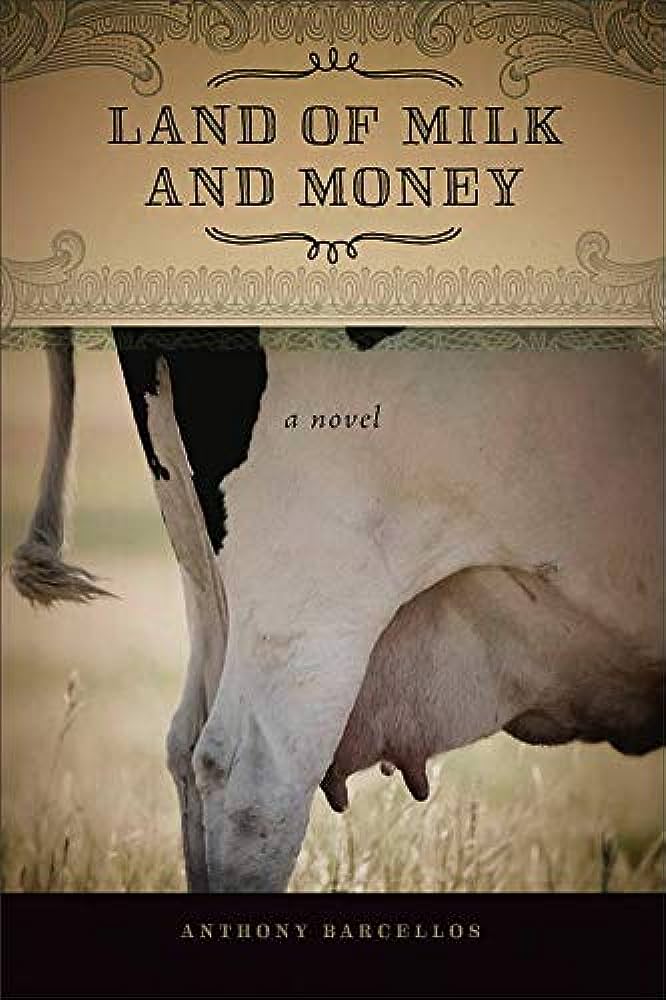
Land of Milk and Money is the story of the Francisco family, Portuguese immigrants from the Azores who settle on a dairy farm in California’s Central Valley. Their plans to eventually return to the Old Country fall by the wayside as their success grows and their American lives take root. The legacy of one generation becomes a point of contention as the members of the next generation begin to compete to inherit and control their heritage, which includes herds of cattle and tracts of farm land.
The death of Teresa Francisco, the family’s matriarch, sets off a string of battles (both personal and legal) between brothers, spouses, in-laws, and cousins. A courtroom confrontation over Teresa’s will is at center stage as the contending factions discover that the old lady had plans of her own for securing her legacy.

Cast of Characters
Chico Francisco chose to go to America to seek his fortune, in contrast to his grandfather’s choice of Brazil. However, unlike his grandfather, Chico discovered that he couldn’t go back home to the Azores. He had to make a new home in California.
Teresa Francisco pined for a return to the islands, but accepted her role as matriarch and peacemaker in the family’s new home. If only she could find a way to keep the family together after she and her husband were gone.
Candido Francisco relished the privileged position of first-born son, but he liked the role’s authority more than its responsibility. It was irksome that his mother seemed disapproving and that his younger brother was uncooperative. And he regarded his wife Odile as yet another burden.
Paulinho Francisco was eager to build on his parents’ legacy and bring modern ideas to the management of the family dairy farm, but he chafed under the unimaginative and plodding leadership of his older brother.
Louis Salazar was a successful and prosperous dairyman in his own right, but he nursed a quiet and growing resentment over slights, real and imagined, from his brothers-in-law Candido and Paulinho. When the opportunity to strike at them presented itself, he could not resist it.
Beatrice Onan understood that the world was divided into users versus used. Feeling herself one of the latter, she would employ her law degree to even the score. In Louis Salazar she found a willing vehicle.
Odile Avila Francisco had been her father’s spoiled daughter and aspired to Teresa’s position as honored matriarch of the Francisco clan. Her husband Candido, however, seemed too afraid of his mother to insist on Odile’s primacy as spouse of the dairy farm’s senior manager.
Junior Francisco felt underappreciated by his father Candido and refused to acknowledge that he bore his father’s name. Completely lacking in empathy, Junior did his best to lord it over his brothers and his cousins as the first-born son of Teresa and Chico’s first-born son.
Henry Francisco loved the family dairy farm as much as anyone else in the Francisco clan, but as the second son of the second son he had no illusions about his lack of seniority. He feared that his fate was to serve at the whim of his Uncle Candido and Candido’s sons.
Elvino Salazar was content as one of the younger sons in Louis’s large brood, as well as good friends with his contemporary cousin Henry Francisco. He never anticipated that his father would maneuver him into becoming a tool in Louis’s vendetta against the Franciscos.
Catarina Salazar never recognized that her pampered status as the only daughter in the Salazar clan was making her a case of arrested development. Unready to take on adult responsibilities in the absence of her mother, Catarina becomes a problem for the family to solve.
Mary Carmen Francisco did not quite scandalize the family when she brought home an English-only non-Catholic boyfriend to meet a Portuguese-speaking family, but she came close.
Lysistrata Margaret Hunter prided herself on her expertise in handwriting analysis and found numerous opportunities to serve as an expert witness in court proceedings. She assumed it should be a relatively simple matter when Beatrice Onan invited her to testify in the Francisco-Salazar dispute, but she was incorrect.
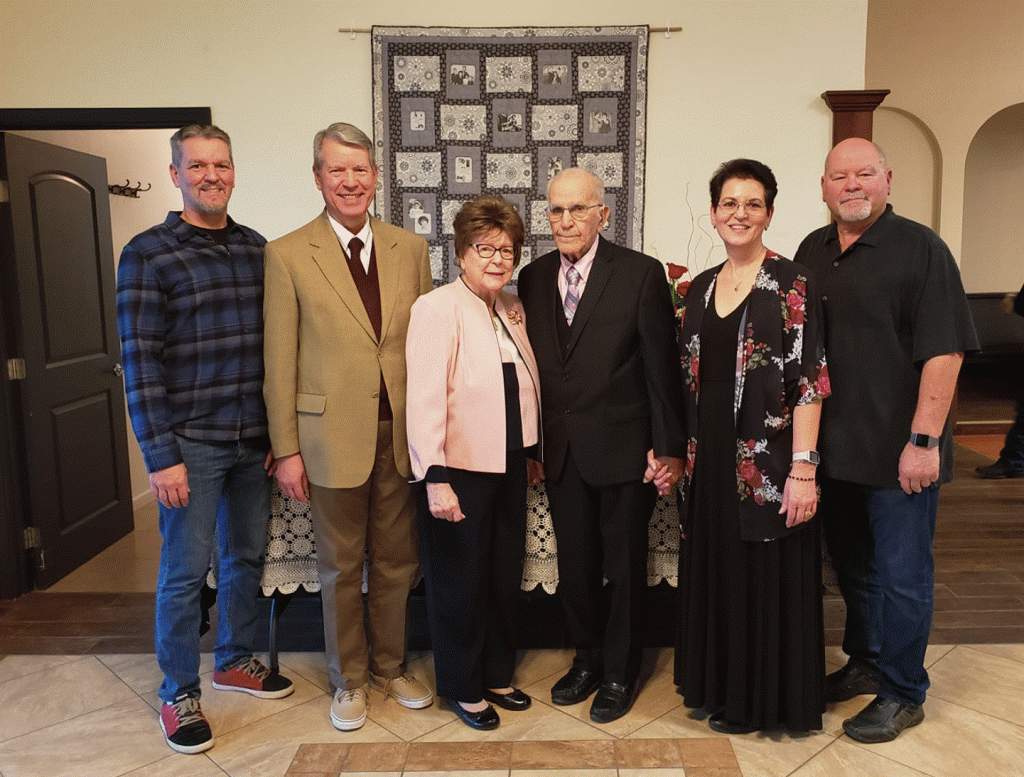
Anthony Barcellos and his family
Some excerpts from the wonderful novel…
December 1979: Teresa’s Cows
Teresa Francisco paused in the midst of writing a letter to her grandson Paul. Candido’s pickup truck was leaving the dairy yard by means of the driveway past her house. He was towing the cattle trailer again. It had become quite a habit with him. Every other week or so, Candido would haul up to four cows to the auction. He had become remarkably dedicated to the process of culling the less-productive milk cows from the herd. Or so it seemed.
Was it a good sign that her son had become so diligent in the years since he took over sole management of the Francisco dairy farm? As much as she’d like to think so, Teresa found it difficult to believe that. The pattern had become too clear. Although Candido never let his mother see any of the herd books or the business’s financial records — documents that Chico had once freely shared with her — Teresa still had eyes with which to see.
Her eyes watched the flow of familiar cattle to the auction yard and strange cattle into the Francisco corrals. Teresa pondered yet again how best to rein in her older son. She could never bring herself to the point of open confrontation. Even an uneasy tranquility was better than an open dispute within the family. Teresa intended to keep the peace for the undoubtedly meager balance of her life. After that, however, Candido would have to deal with his mother’s posthumous wishes. Soon her revised will would be ready for her signature, prepared in accordance with the exacting specifications she had given her attorney.

Anthony Barcellos with students from Tulare High School when he was honored by the Society of Portuguese-Ameicna Students.
Another excerpt from the Novel…
June 1983: Otelo on the Stand
“Petitioners’ next witness is Otelo Salazar.”
“The court calls Otelo Salazar to the stand.”
Heads swiveled and eyebrows were raised as the witness approached the clerk to be sworn in. Otelo was in his mid-thirties and movie-star handsome. His short hair was a shade lighter than that of most of his relatives and his gray-blue eyes were a legacy from his grandfathers. Both men were thought to carry a dash of Flemish blood from a group of fifteenth-century sailors who had spiked the Azorean gene pool with some recessive-trait variety.
Otelo had had a notorious career as the hell-raising bad boy of the Francisco-Salazar clan. The right hand that he held up was missing half its ring finger, a Fourth-of-July souvenir from an unexpectedly successful youthful experiment in homemade firecrackers. He seldom looked directly at people during conversations, which gave him the reputation of being stand-offish. That was true enough, but Otelo actually kept his head slightly turned to favor his functioning left ear. His right eardrum had never recovered from the silo incident, an even greater disaster than the Independence Day accident and the one that finally put an end to his experimentation with explosives.
Commments on this amazing book that should be in every Portuguese-American home
Reinaldo Silva, Professor of Language and Culture
University of Aveiro, Portugal
“It is a splendid piece of fiction, a wonderful story, and an invaluable fictional representation of the Portuguese contribution to California’s dairy industry. In my view, it is the best fictional work to date on this theme, the process of acculturation, assimilation, the erosion of Portuguese ‘ethnic signs.’ I enjoyed reading your first novel very, very much!
Vamberto Freitas, literary critic
University of the Azores
“The first great Portuguese-American novel to fully bring to life a whole way of life and history in California. Steinbeck, believe me, would be jealous.
George Monteiro
Brown University
“I like Land of Milk and Money. Good, honest, straight-forward writing, very much in the grain of American literary realism.”
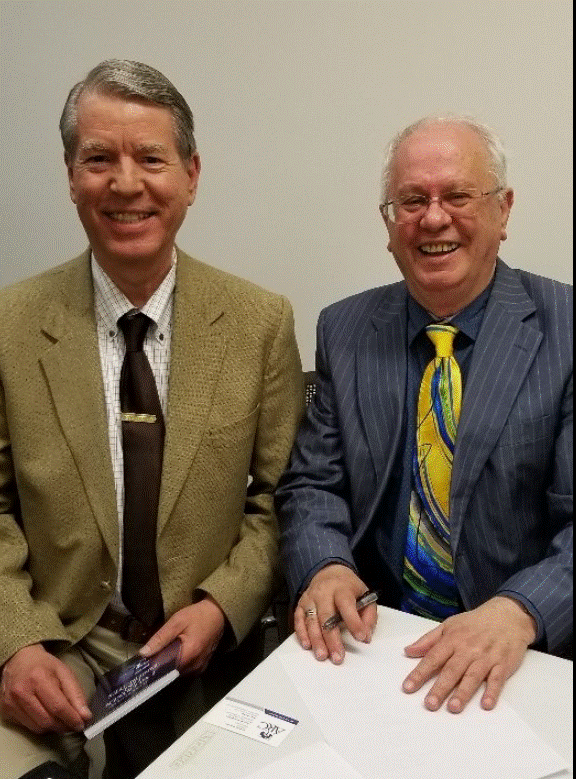
Anthony Barcellos with Azorean Author Álamo Oliveira.
A few other reviews…
Trina Drotar
Sacramento Press
“Land of Milk and Money is at once interesting, entertaining and thought-provoking. The number of characters sometimes reminds us of the quantity found in Russian novels, but we never get lost. We come to know each character and his or her positive and negative aspects through the stories of attending school, dating, marriage and work… [T]he story is sure to please anyone with an interest in history, Portuguese-Americans, dairy farms, intergenerational struggles within immigrant families or California history.”
Julian Silva, author
Move Over, Scopes and Other Writings
- “excellent book”
- “[One chapter comprises] the brilliantly orchestrated, hilariously funny, and at the same time touching, wedding of the hapless Catarina Salazar to the reluctant and very drunk Kevin Lineman.”
- “[The characters] are a lively and varied bunch and Mr. Barcellos delineates them with considerable verve, humor, and intelligence. You will enjoy getting to know them.”
Mary Chancellor
The author’s sister
“I’m afraid you’re going to get into a lot of trouble.”

for more information please consult the excellent website
http://www.landofmilkandmoney.com/
Some links, inluding where to order the book
http://www.landofmilkandmoney.com/links.html
The Portuguese Beyond Borders Institute (PBBI) at Fresno State is pleased to encourage all who love to read a good book to dive into this most rearding novel.
To get another sample of Anthony Barcellos’ writing please k=look at our very first edtion of Filamentos (arts and letters in the Azorean Diaspora) by Bruma Publicationns.
 Filamentos (artes e letras)