
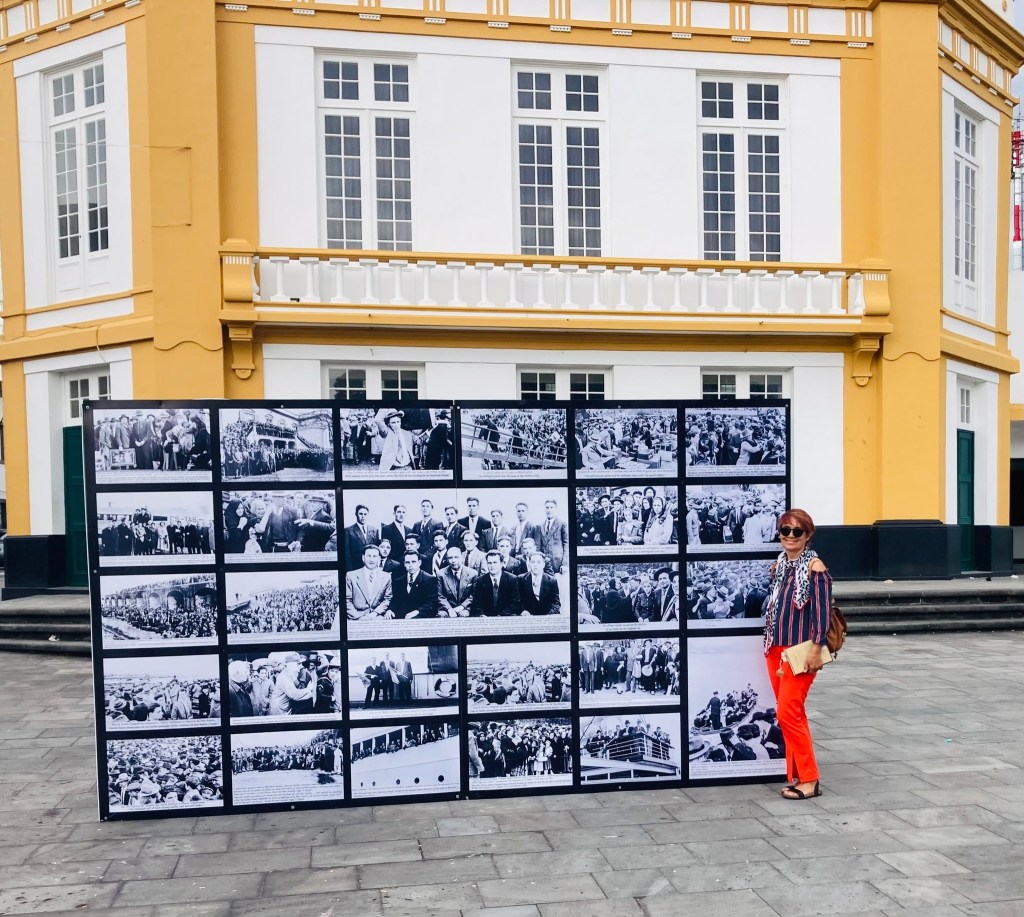
“Much of what the Azorean community is today abroad is due to the commitment of women” who still preserve the traditions of their homeland.
In the photographic exhibition, “Da Saudade às Açorianas no Canadá”, by the Portuguese-Canadian teacher and journalist Humberta Araújo, we remember the first Azorean emigrants to Canada, a land of opportunities but, even so, vast and unknown. The farewells, the tears, the hugs and kisses between those who did not know if and when they would meet again, presaging longing, in a mixture of hope and anguish, feelings shared by the young people who went and by the families who stayed. Several farewells and emotions are perpetuated in black and white photographs, present on one side of the panel and recovered by journalist and teacher Humberta Araújo.
On the other side of the panel are the faces of Azorean women who left their homeland at a young age to seek better living conditions. In the panel entitled “Diaspora in the feminine – Between Lines and Dots: the Alphabet of the Forgotten,” Humberta Araújo writes about the experience of these ladies today and how they remember their youth in the Azores: “While the snow falls and the winter matures, they meet around the table. They share tea, cookies, or Azorean sweet bread. They remember their mothers, grandmothers, and their long-lost childhoods. They recall the affairs and lives, the fending off of hunger and cold, as they lined up skirts and dresses and learned to embroider, make lace, and knit. Taking advantage of the moonlight, the whale oil lamps or the oil lamp, they became women in their small world. Then came the letters with authorization to emigrate(Cartas de Chamada), or the promised bride and groom from the Americas, and off they packed their suitcases, taking with them a wealth of traditions. In the new land, the common gestures and the repetition of island rituals gave meaning to life. Over time, they moved to the winters, the big cities, the new languages, and people.”

During a year of collecting stories of the diaspora in Canada, the journalist had contact with many emigrants in Canada for several decades, who in various nursing homes, shared their stories with their countrywomen: “They spent their time with their lace, embroidery … and one of the things they constantly said was that their children and grandchildren did not want those jobs they did and that later everything would go to waste. From then on, I took pictures of several older women in various care centers for the elderly. It’s a different side of emigration.”
Azorean emigrants took their cultural and religious traditions, gastronomy, and handicrafts.
Nowadays, they are coming to terms with the fact that the world they knew no longer exists, but the habits of “threads and wool, needles and thimbles, sewing and patchwork” persist, even though their children and grandchildren no longer want to “know about quilts, embroidery, blankets, sweaters, and cushions.”
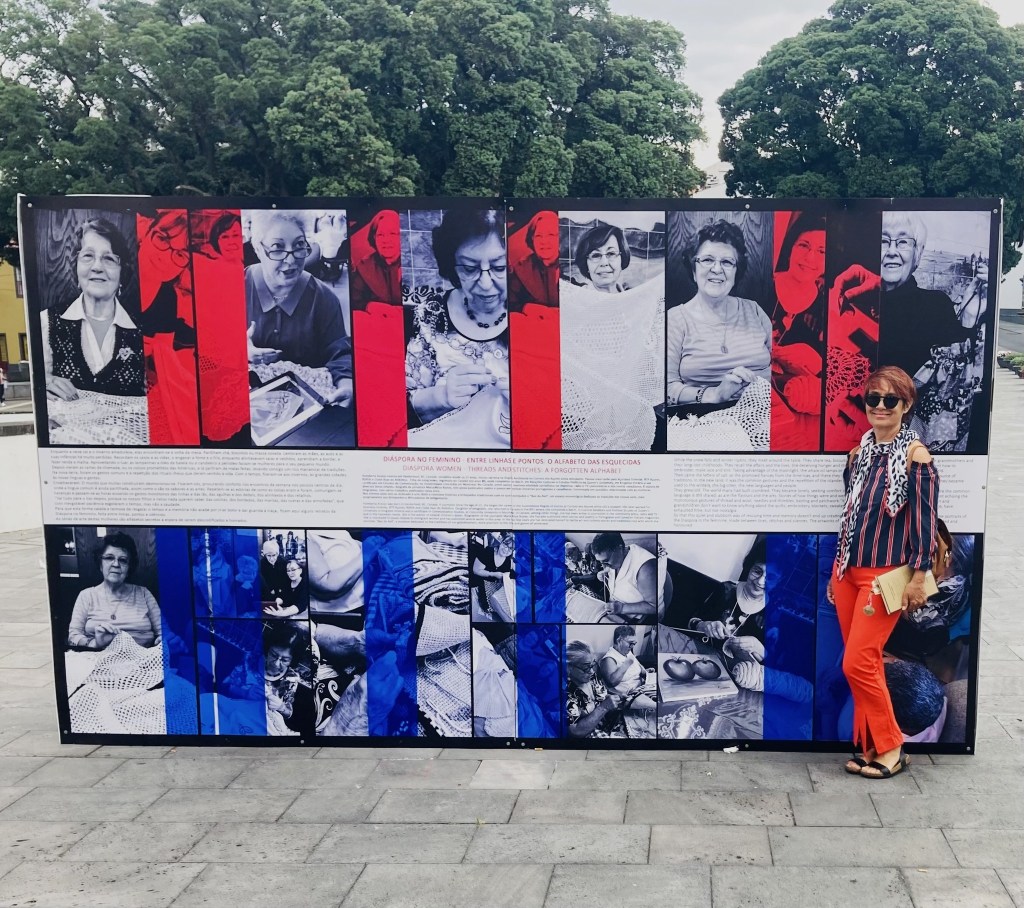
As Humberta explains, the purpose of the photographic exhibition is “to show people that it was the women who, in essence, took the cultural and religious traditions and crafts to the countries of Portuguese emigration, in this case, Azorean. In British Columbia, women from Flores started the Holy Spirit festival. They sent for a crown from the United States of America since Azorean emigration to the United States is much older. They were the ones who taught the priest, at the time, in Canada, how the Holy Spirit celebrations were.”
“Therefore, much of what the Azorean community is today abroad is due to the commitment of women, ranging from issues of culture, crafts, religion, and gastronomy. Our grandparents’ food is still very much appreciated by their grandchildren. They may not be interested in anything else or have nothing to do with the Portuguese language or the Azores. Still, they usually relate to the food their grandmother makes, which is the traditional food of the islands,” explains the journalist, who wants to remind the community of this part of Azorean identity: the history of emigration.
“I hope that people see, reflect and that an effort is made in the region so that the youngest know and do not forget what the struggle” of the Azoreans who left for Canada was, concludes Humberta Araújo in the interview with ‘Correio dos Açores.’
Araújo argues that the history of Azorean emigration be taught in schools.

Humberta Araújo, daughter of emigrants, was born in Vanderhoof, Canada. Her parents returned to the Azores when she was six. She has been a journalist since she was 15, starting her career in the Azores while still a student. She returned to Canada at age 20, where he studied Cultural Relations and Political Studies at Queen’s University in Ontario and then Communication Studies at Concordia University in Montreal. In Canada, she continued to work as a journalist. She is the author of several children’s books. She has also published short stories and poetry. She has published several works on immigrant women, a subject of great interest to her. In recent years, she has devoted herself to textile art and “collects” stories and traditional toys for her “Granny’s Treasure Chest” project. Humberta knows these two worlds well, on opposite sides of the Atlantic Ocean. She also knows the challenges Azorean emigrants have encountered in American lands.
Now, in São Miguel, before the pandemic, she works as a teacher of Portuguese as a non-native language, teaching children of emigrants who have returned to the land of their parents.
According to the journalist and Portuguese-descendant teacher, the general community must know the history of Azorean emigration, which according to Humberta, should be taught in schools: “This is one of the projects that I would like to take forward and make the government aware so that the issue of emigration is a subject in schools in the Azores.”
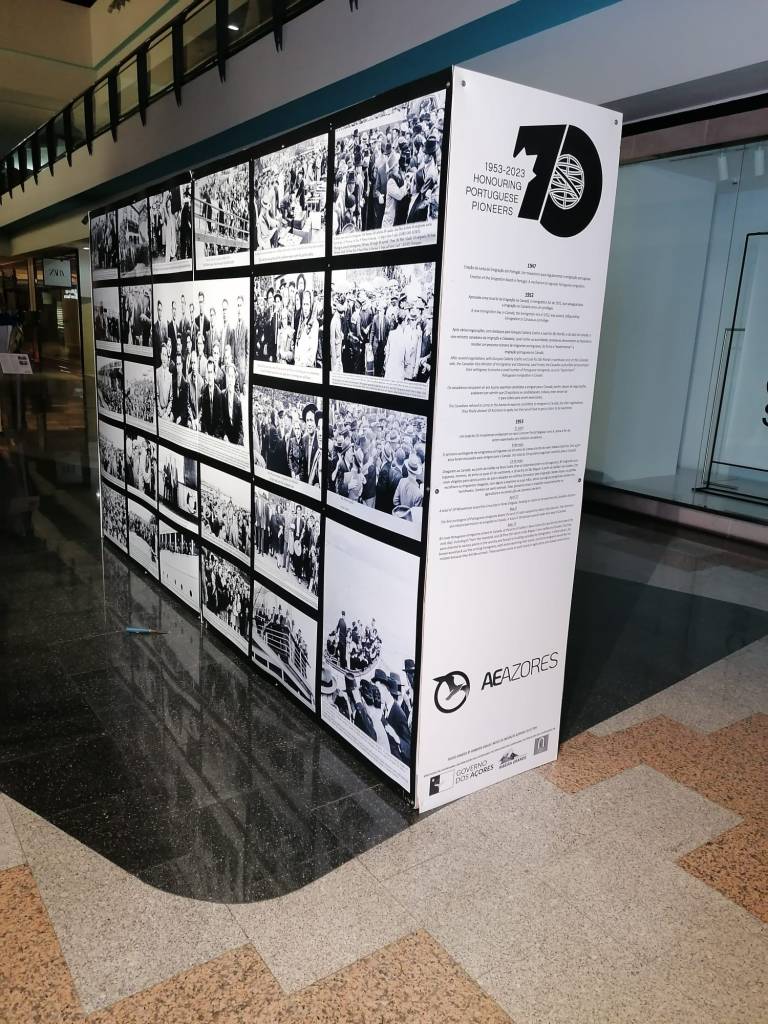
Pioneering Azorean emigrants in Canada worked in agriculture and building railways.
This year marks the 70th anniversary of the beginning of Portuguese Official Emigration to Canada. Twenty Micaelenses left for Lisbon in 1953 to be examined before going to Canada. Among these, 18 were accepted to enter that country. But it was after several negotiations that Portuguese emigration to Canada was allowed.
In 1952 a new immigration law was passed in Canada, the “Immigration Act,” which safeguarded immigration to Canada as a privilege. After several negotiations, with Gonçalo Caldeira Coelho and José Rui São Romão in particular, and on the Canadian side, the Canadian Deputy Minister of Immigration and Citizenship, Laval Fortier, Canada was willing to receive a small number of Portuguese immigrants as an experimentation of Portuguese immigration in that country. The Canadians refused to come to the Azores to examine the candidates for emigration to Canada and eventually, after negotiations, admitted 20 Azoreans to apply. However, they would have to go to Lisbon to be examined first and to make sure they could emigrate. On April 21, 1953, 20 Azoreans boarded the ship Lima, bound for Lisbon to be examined by Canadian doctors. On May, the first contingent of Portuguese emigrants left Lisbon on Saturnia, among them 18 Azoreans who had been admitted. The emigrants arrived in Nova Scotia on May 13. These pioneers ended up working mainly in agriculture and railroad construction.
Eighteen Azoreans constituted the first wave of Portuguese emigrants to Canada.
These were the 18 pioneers accepted to go to Canada: Evaristo Almeida (Atalhada, Lagoa), José da Silva (Santa Cruz, Lagoa), José Bento (Achadinha, Nordeste), António do Couto (S. Pedro de Nordestino, Nordeste). Pedro de Nordestino, Nordeste), Constantino Carvalho (Feteira, Ponta Delgada), Manuel Machado (Furnas, Povoação), Guilherme Cabral (Matriz, Ribeira Grande), Jaime Pacheco (Pedreira, Nordeste) Armando Vieira (Água de Pau, Lagoa), Afonso Tavares (Rabo de Peixe, Ribeira Grande), Énio Vasconcelos (Salga, Ribeira Grande), João Martins (S. Brás, Ribeira Grande), João Martins (S. Brás, Ribeira Grande). Brás, Ribeira Grande), Manuel Arruda (Bretanha, Ponta Delgada) and Manuel Vieira (Água de Pau, Lagoa), Vasco Moreira (Fajã de Cima, Ponta Delgada), José Martins (Feteiras, Ponta Delgada), Manuel Pavão (Candelária, Ponta Delgada) and Vitorino Castro (Feteiras, Ponta Delgada).
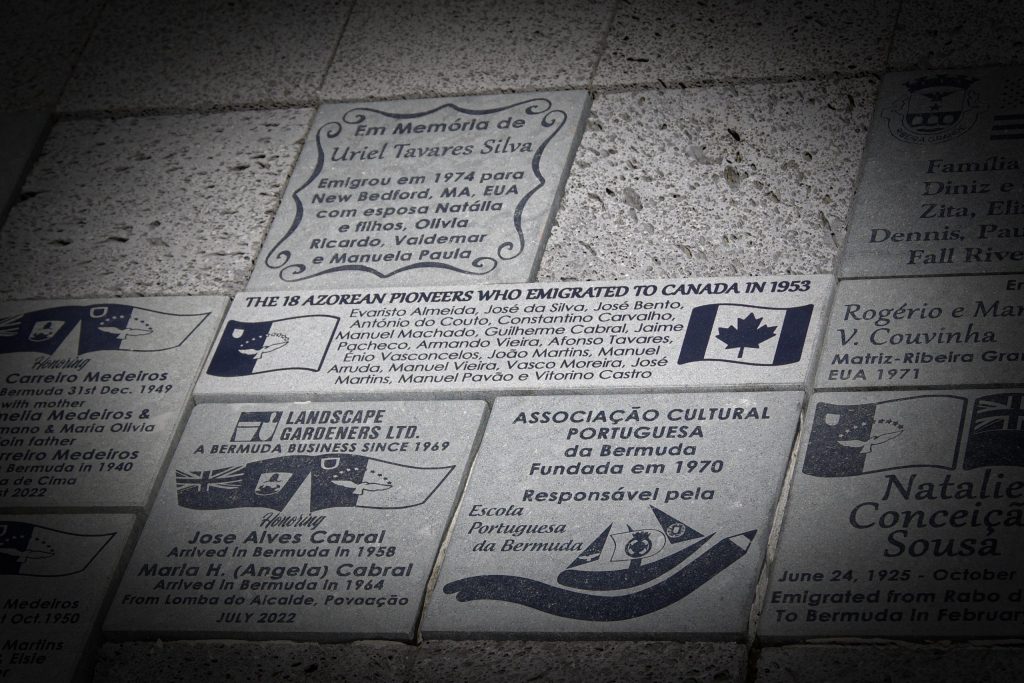
After this first experiment in 1953, the Canadian government officially opened Portuguese emigration in 1954. That year, three ships took 800 Azoreans to Canadian lands in the North American Continent. Many others followed them in the following decades and gave birth to the large community of Azoreans and their descendants who still celebrate their traditions, be it the Holy Spirit and Holy Christ processions, the favors and crafts, or the flavors of Azorean gastronomy.
Mariana Rovoredo – jounalist for Correio dos Açores
From the Correio dos Açores newspaper, Natalino Viveiros-director.
Translated to English as a community outreach program from the Portuguese Beyond Borders Institute (PBBI) and the Modern and Classical Languages and Cultures Department (MCLL) as part of Bruma Publication and ADMA (Azores-Diaspora Medial Alliance) at California State University, Fresno.

From the Azorean Emigrant Association–our PBBI friend Rui Faria, president, regarding the display featured here:
It is on display until the end of this month (July 31), the photographic exhibition promoted by the Association of Azorean Emigrants entitled “Da Saudade às Açorianas no Canadá”, by Humberta Araújo, at Parque Atlântico, Ponta Delgada, São Miguel.
The exhibition was inaugurated during the celebrations of the Day of Portugal, Day of Camões and Portuguese Communities, which refers to the anniversary of the 70th Anniversary of Portuguese Official Emigration to Canada celebrated this year.
“Da Saudade às Açorianas no Canadá” in addition to containing magnificent photos of many of those who were brave to emigrate to a “new world”, this still has the stories, first hand, of many of the emigrants who took a little of their Azoreanity with them so far from home.
 Filamentos (artes e letras)